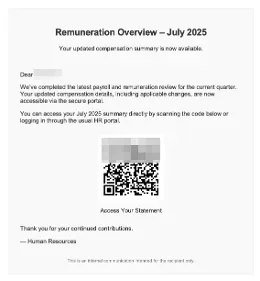
ReliaQuest observed a 241% surge in activity using the Axios user agent between June and August 2025, with campaigns pairing Axios and Microsoft Direct Send achieving up to a 70% credential-theft success rate and broadening from high-profile targets to everyday users. The report highlights abuse of Axios for automating phishing, MFA/session token interception, and API exploitation—often delivered via QR-coded phishing and short-lived domains like .es and Firebase links—calling for tightened Direct Send controls and enhanced detection. #Axios #DirectSend
Keypoints
- Axios user-agent activity surged 241% from June to August 2025, representing 24.44% of flagged user-agent activity and making it ten times more common than any other flagged user agent.
- Campaigns combining Axios with Microsoft Direct Send achieved a 70% success rate in recent incidents and a 58% overall success rate over three months versus 9.3% for non-Axios campaigns.
- Attackers used Axios to automate phishing workflows that capture session tokens, MFA codes, and exploit SAS tokens (Azure), enabling account takeovers and API access.
- Phishing delivery frequently used QR codes embedded in PDFs and short-lived .es domains or Firebase-hosted links to bypass email defenses and reputation filters.
- Direct Send is trusted by many email security tools, allowing attacker-sent messages to bypass reputation-based filtering when paired with Axios automation.
- ReliaQuest recommends disabling or securing Direct Send, enforcing anti-spoofing (SPF/DKIM/DMARC), blocking uncommon TLDs, user training, and deploying updated detection/playbooks.
- Recommended incident playbooks include blocking malicious CIDR ranges (e.g., 185.168.208.0/24), resetting passwords, and disabling compromised accounts to contain Axios/Direct Send abuse.
MITRE Techniques
- [T1078] Valid Accounts – Attackers stole credentials and used them for account takeover, described as “70% of incidents leveraging Axios and Direct Send resulted in credentials being stolen successfully.”
- [T1110] Brute Force – Automated credential harvesting and subsequent automated cracking/brute forcing is implied by “automation-driven brute forcing and credential harvesting” used after compromises.
- [T1113] Screen Capture – QR-code-driven phishing and PDF attachments were used to capture user interaction and credentials, referenced as “malicious QR codes embedded into PDF attachments” leading victims to phishing portals.
- [T1556] Modify Authentication Process – Axios was used to intercept and replay authentication tokens and MFA codes: “…Axios let attackers exploit the data they captured… used Axios to capture session tokens or MFA codes through sophisticated phishing workflows.”
- [T1476] Download from Cloud Storage Object – Attackers used Firebase-hosted apps and short-lived hosted links to host phishing content, noted as “Firebase-hosted apps that ride on Google’s trusted reputation to bypass defenses.”
- [T1190] Exploit Public-Facing Application – Axios automated API interactions and exploited SAS token workflows in Azure: “Axios requests leveraged the Shared Access Signature (SAS:BeginAuth) mechanism to manipulate or hijack tokens…”
- [T1071] Application Layer Protocol – Abuse of Direct Send to deliver phishing emails via trusted Microsoft delivery channels is described: “Direct Send is a Microsoft feature… phishing emails sent via Direct Send can bypass these defenses.”
Indicators of Compromise
- [IP Address] Direct Send/attacker infrastructure – 185.168.208[.]63, 185.168.208[.]61 (and other addresses in 185.168.208[.]0/24 observed)
- [IP Address] Additional infrastructure – 178.130.47[.]216 (context: observed in campaign infrastructure)
- [Domain] Phishing redirect/landing domains – ywnlzl.dwqewi[.]es, ooox.hrcbods[.]es (used as short deceptive .es domains redirecting to fake Outlook login portals)
- [Domain] Additional disposable phishing domains – cpewyx[.]es, ogyhr[.]es (and bsfff[.]es observed)
Read more: https://reliaquest.com/blog/threat-spotlight-attackers-exploit-axios-for-automated-phishing/