.png?language=en "Abusing Windows File Explorer and WebDAV for Malware Delivery")
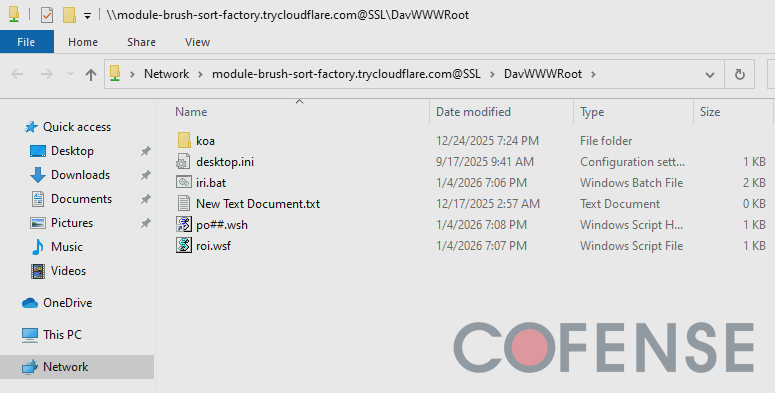
This report describes how threat actors abuse WebDAV access via Windows File Explorer to deliver remote access trojans (RATs) by hosting payloads on short-lived Cloudflare Tunnel demo domains. Campaigns use .url and .lnk shortcuts, UNC paths, and script chains to fetch payloads such as XWorm, Async RAT, and DcRAT from trycloudflare[.]com instances #WebDAV #CloudflareTunnel
Keypoints
- WebDAV is a legacy HTTP-based file management protocol natively accessible via Windows File Explorer (deprecated as of November 2023) and rarely recognized by typical users.
- Threat actors exploit File Explorer’s WebDAV support to bypass web browser download controls and sometimes evade EDRs by delivering files outside normal browser flows.
- Adversaries host short-lived WebDAV servers on Cloudflare Tunnel demo instances (trycloudflare[.]com) to expose payloads and make detection harder.
- Delivery chains commonly use .url and .lnk shortcut files, UNC paths, direct File Explorer links, and multiple script payloads to download and execute RATs (notably XWorm, Async RAT, and DcRAT); 87% of observed ATRs delivered multiple RATs.
- URL shortcut files with UNC paths can trigger automatic DNS lookups and outbound connections (example resolved to 104[.]16[.]231[.]132), potentially notifying threat actors when a victim browses a directory.
- Mitigations include user education to check File Explorer address bars, EDR behavioral detections for .url/.lnk that execute remote files, and threat hunting for demo Cloudflare Tunnel domains on trycloudflare[.]com.
MITRE Techniques
Indicators of Compromise
- [Domain ] WebDAV servers and Cloudflare Tunnel demo hosts – module-brush-sort-factory[.]trycloudflare[.]com, frontier-shops-timothy-cal[.]trycloudflare[.]com, and many other trycloudflare[.]com demo domains
- [IP Address ] Observed network artifact from a demo domain resolution – 104[.]16[.]231[.]132
- [File Name ] Malicious script and payload filenames referenced in delivery chains – rec.wsh, dat.wsh, and other WSH script files
- [Shortcut/File Type ] Shortcut types used to invoke File Explorer retrieval and execution – .url (InternetShortcut) and .lnk files used to open/run remote files
- [UNC Path ] Windows UNC/WebDAV path examples used to access remote files – harbor-microwave-called-teams[.]trycloudflare[.]comnew, exampledomain[.]comDavWWWRootMy_Files
Read more: https://cofense.com/blog/abusing-windows-file-explorer-and-webdav-for-malware-delivery