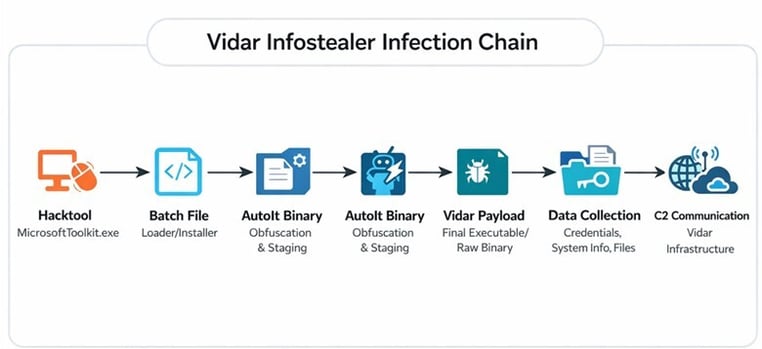
LevelBlue analyzed a multi-stage infection chain that started with MicrosoftToolkit.exe, used script masquerading and AutoIt-based staging, and ended with communication tied to Vidar infrastructure. The activity included defense evasion, payload extraction, self-cleanup, and likely credential-stealing behavior via C2 over public web services and DNS infrastructure. #MicrosoftToolkit #AutoIt #Repliesscr #Vidar #telegramme #technicalprorjxyz
Keypoints
- The infection chain began with MicrosoftToolkit.exe, a commonly abused hack tool that spawned cmd.exe to start the next stage.
- A disguised .dot file was renamed to a .bat script and executed, showing file extension masquerading to bypass security controls.
- The attack used tasklist and findstr for process discovery and possible security-tool identification before deeper payload staging.
- Payload extraction was performed with extract32.exe, followed by execution of the AutoIt loader Replies.scr with an external argument.
- Network activity from Replies.scr matched Vidar-associated infrastructure, indicating deployment of an information-stealing payload.
- The malware used anti-analysis and defense-evasion behavior, including debugger checks, indicator removal, file deletion, and self-termination.
- Observed communications included telegram.me, steamcommunity.com, and gz.technicalprorj.xyz, along with a Vidar-associated IP address.
MITRE Techniques
- [T1204.002] User Execution: Malicious File – The attack relied on the user running a hack tool to begin execution (‘User downloaded and executed MicrosoftToolkit.exe’ and ‘User executed microsofttoolkit.exe’).
- [T1059.003] Command and Scripting Interpreter: Windows Command Shell – cmd.exe was spawned to continue the staged execution (‘spawn of cmd.exe’).
- [T1036] Masquerading – The threat renamed a .dot file to a .bat file to hide the true file type (‘Renaming and execution of swingers.dot as swingers.dot.bat’).
- [T1059.003] Command and Scripting Interpreter: Windows Command Shell – Batch/script behavior was used to stage and run additional commands (‘renaming and execution of swingers.dot as swingers.dot.bat’).
- [T1082] System Information Discovery – tasklist and findstr were used to enumerate running processes and identify security-related tooling (‘Process discovery (tasklist, findstr)’).
- [T1027] Obfuscated Files or Information – Payloads were staged in disguised or embedded file formats, requiring extraction (‘Payload extraction via extract32.exe’ and ‘payload container format’).
- [T1140] Deobfuscate/Decode Files or Information – extract32.exe was used to unpack the next-stage payload (‘Payload extraction via extract32.exe’).
- [T1059] Command and Scripting Interpreter – Replies.scr executed scripted loader logic with an external parameter (‘Execution of replies.scr with parameter D’).
- [T1218] Signed Binary Proxy Execution – The .scr AutoIt-compiled binary was abused as a loader to execute malicious logic (‘Execution of replies.scr’).
- [T1027.005] Indicator Removal from Tools – The malware used staged and disguised components plus cleanup to reduce visibility (‘file-based staging’, ‘removal of execution artifacts’).
- [T1562.001] Disable or Modify Security Tools – The malware attempted to identify and potentially disrupt security-related processes (‘attempts to identify security-related processes’).
- [T1057] Process Discovery – tasklist and related checks were used to discover running processes (‘tasklist, findstr’).
- [T1070.004] Indicator Removal on Host: File Deletion – The malware deleted dropped and staged files to erase traces (‘Deletion of dropped or staged files from the disk’).
- [T1489] Service Stop – The malware terminated its own processes and other processes during cleanup (‘Termination of its own processes’).
- [T1497.001] Virtualization/Sandbox Evasion: System Checks – ZwQueryInformationProcess was used to detect debugging and instrumentation callbacks (‘detect the presence of a debugger’ and ‘instrumentation callbacks’).
- [T1105] Ingress Tool Transfer – The loader reconstructed and loaded a payload from a separate file into memory (‘reads it into memory for decryption and execution’).
- [T1071.001] Application Layer Protocol: Web Protocols – C2 communication used HTTP/HTTPS via WinINet and HTTP requests (‘InternetConnectA’, ‘HttpOpenRequestA’, ‘HttpSendRequestA’).
- [T1573] Encrypted Channel – Communication occurred over HTTPS to hide traffic content (‘https[:]//telegram[.]me/…’).
- [T1071.004] Application Layer Protocol: DNS – The malware used DNS resolution for dynamic infrastructure (‘DNS resolution for gz[.]technicalprorj[.]xyz via public DNS’).
- [T1041] Exfiltration Over C2 Channel – Observed activity aligned with Vidar data theft over the C2 path (‘likely exfiltration of credentials, browser data’).
Indicators of Compromise
- [SHA-256 ] Malware samples and staged payloads – fc27479ff929d846e7c5c5d147479c81e483a2ec911bd1501a53aa646a29620d, d4fe9f48178cdf375a3be30d17f1dc016b5861dff8683f0bb35a0ba8d44f892f, and 3 more hashes
- [File names ] Dropped/executed files seen in the chain – MicrosoftToolkit.exe, swingers.dot.bat, and 3 more files
- [IP address ] Vidar-associated C2 infrastructure – 149.154.167[.]99
- [Domain names ] C2 and related network destinations – telegram[.]me, gz[.]technicalprorj[.]xyz
- [URL paths ] Observed request targets used in C2 communication – /sre22qe, /profiles/76561198777118079