Mandiant describes AVDH, an agentic vulnerability discovery harness that combines LLMs, structured orchestration, and human expertise to find and validate software flaws at scale. In real-world use, it uncovered over 100 critical vulnerabilities in two days, contributed to 12 assigned CVEs, and identified an RCE in a client web application source code. #AVDH #Mandiant #CodeMender #GoogleAntigravity #GoogleAgentDevelopmentKit #GeminiFlashLite #CVE-2026-13242 #CVE-2026-55803
Keypoints
- AVDH is a structured, multi-agent vulnerability discovery framework designed for proactive code analysis, penetration testing, red teaming, and incident response.
- The system combines AI-driven analysis with human subject-matter expertise to reduce false positives and improve validation quality.
- In a recent incident response case involving stolen corporate repositories, AVDH found more than 100 true-positive critical vulnerabilities in two days.
- The harness has been used at scale across tens of millions of lines of code and thousands of pipelines, generating tens of thousands of findings.
- Its use has led to 12 assigned CVEs, including CVE-2026-13242 and CVE-2026-55803, with additional disclosures still in progress.
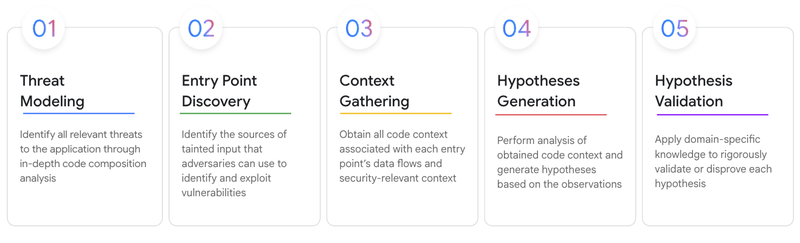
- The pipeline includes threat modeling, entry point discovery, context enrichment, hypothesis generation, validation, and expert review to systematically assess vulnerabilities.
- Google AI Threat Defense and CodeMender are presented as complementary continuous-defense tools that can be paired with AVDH for a two-layered strategy.
MITRE Techniques
- [T1190 ] Exploit Public-Facing Application – The harness found a remote code execution flaw in a client web application that enabled initial access (‘quickly found a remote code execution (RCE) vulnerability that enabled initial access’).
- [T1059 ] Command and Scripting Interpreter – The analysis specifically looks for command execution paths where malicious input could reach a dangerous sink and execute (‘command injection’).
- [T1083 ] File and Directory Discovery – The Explorer agent reviews directories and excludes areas such as unit tests while mapping the codebase (‘flags directories to exclude from scanning’).
- [T1068 ] Exploitation for Privilege Escalation – The Access Control agent identifies flaws such as missing authorization and privilege escalation (‘including missing authorization, privilege escalation’).
- [T1003 ] OS Credential Dumping – Not mentioned directly in the article; no technique mapping applicable.
- [T1056.001 ] Input Capture: Keylogging – Not mentioned directly in the article; no technique mapping applicable.
- [T1195 ] Supply Chain Compromise – The article focuses on stolen corporate repositories and open-source code analysis, but does not explicitly describe supply chain compromise execution; no direct technique mapping is claimed.
- [T1021 ] Remote Services – The framework analyzes IPC listeners and HTTP routes as attack vectors (‘HTTP routes, inter-process communication (IPC) listeners’).
- [T1595 ] Active Scanning – The harness performs broad, parallelized code scanning across in-scope files to discover entry points and vulnerabilities (‘parallelized Discovery agents to analyze every in-scope file’).
- [T1040 ] Network Sniffing – Not mentioned directly in the article; no technique mapping applicable.
- [T1211 ] Exploitation for Defense Evasion – Not mentioned directly in the article; no technique mapping applicable.
- [T1190 ] Exploit Public-Facing Application – The framework identifies CSRF, XSS, SQL injection, path traversal, and related flaws in web applications (‘cross-site request forgery (CSRF)’, ‘SQL injection, cross-site scripting (XSS), command injection, and path traversal’).
Indicators of Compromise
- [CVE IDs ] Assigned and in-disclosure vulnerabilities identified through the harness – CVE-2026-13242, CVE-2026-55803, and 12 additional CVEs in active disclosure.
- [Software/tools ] Security and AI platforms referenced in the workflow – AVDH, CodeMender, Google Antigravity, Google Agent Development Kit (ADK), and Gemini Flash Lite.
- [Organizations ] Entities and environments involved in the analysis – Mandiant, Google AI Threat Defense, and client/stolen corporate repositories.
- [Dates / events ] Public presentation and deployment timeline references – Cyber Defense Summit September 15-16, 2026, and a recent incident response investigation.