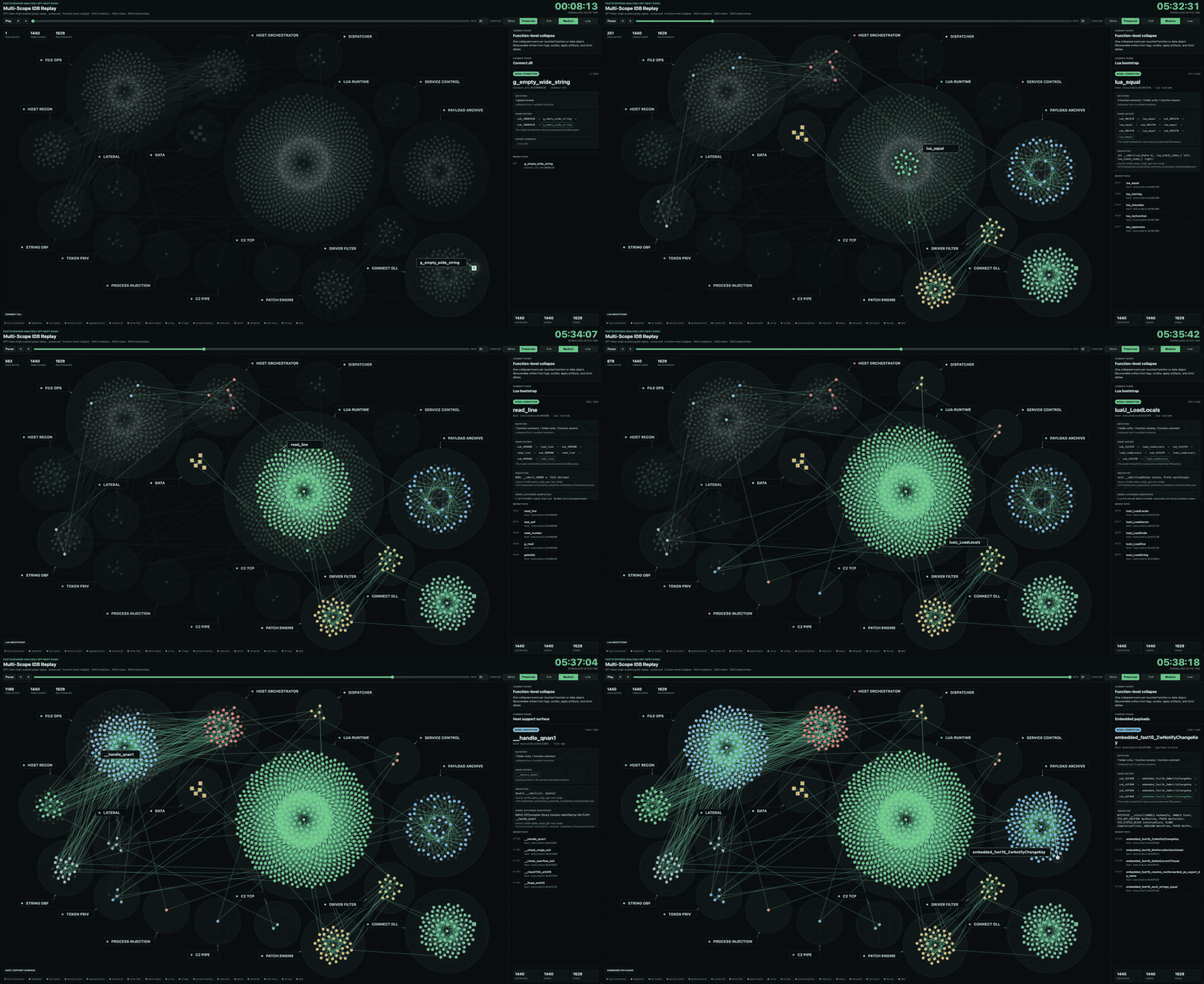
SentinelLABS built a multi-stage benchmark around the fast16 sabotage implant to test whether frontier models can sustain a trustworthy malware investigation as new evidence repeatedly overturns earlier conclusions. OpenAI’s GPT-5.6 Sol was the only public model to complete all eight stages, showing project-scale recovery by revising theories, repairing artifacts, and preserving valid evidence while analysts retained final authority. #SentinelLABS #fast16 #GPT-5.6Sol
Keypoints
- SentinelLABS created an eight-stage reverse-engineering benchmark based on its fast16 investigation.
- The benchmark tested whether models could maintain investigative trustworthiness as new evidence invalidated earlier conclusions.
- GPT-5.6 Sol was the only publicly available model to complete the full benchmark across all eight stages.
- GPT-5.5, GLM-5.2, and the Opus 4.x family showed useful local analysis but failed to sustain full project-wide closure.
- The strongest runs demonstrated “project-scale recovery,” including withdrawing contradicted claims, repairing analysis gaps, and updating dependent artifacts.
- Even top-performing models still made semantic errors, accepted weak quality controls, and required human expert supervision.
- The article argues that the best current use for these systems is supervised investigative agency, not replacement of senior reverse engineers.
MITRE Techniques
- [T1055 ] Process Injection – The article describes svcmgmt.exe as a “Windows service implant,” indicating malicious code inserted into a legitimate service context (‘appears to be a Windows service implant’).
- [T1027 ] Obfuscated Files or Information – fast16 used encrypted and layered components to hide its true behavior, including an “encrypted Lua-driven operations framework” (‘an encrypted Lua-driven operations framework’).
- [T1543.003 ] Create or Modify System Process: Windows Service – The sample presents as a Windows service implant, implying abuse of a service mechanism for persistence or execution (‘appears to be a Windows service implant’).
- [T1106 ] Native API – The kernel driver contained a patching engine that manipulated executable behavior at a low level (‘a patching engine with 101 rules’).
- [T1014 ] Rootkit – The article notes the driver was “easily mistaken for a filesystem rootkit,” showing concealment through kernel-level tampering (‘easily mistaken for a filesystem rootkit’).
Indicators of Compromise
- [File names ] Host/sample and embedded component context – svcmgmt.exe, fast16-idbs
- [Software / tool names ] Analysis and target software context – IDA Pro 9.3, LS-DYNA
- [Hashes ] The article references codifying file hashes for validation during analysis – file hashes, and routine-operation hash checks
- [Domains / network indicators ] No specific domains or IPs were provided in the article – none mentioned
- [Other binary artifacts ] The investigation involved embedded components and a kernel driver within the fast16 sample – embedded components, kernel driver, and 101 byte-pattern rules
Read more: https://www.sentinelone.com/labs/frontier-models-tackle-autonomous-long-horizon-malware-analysis/