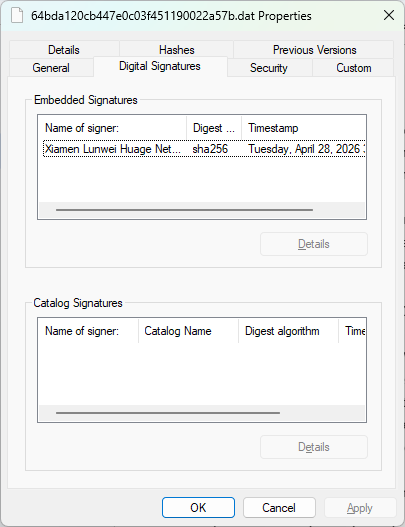
A fake RVTools MSI installer was distributed with a valid Sectigo code-signing certificate and used to deploy a modular Python RAT via VBScript, PowerShell, Dropbox, and staged payloads. The campaign targeted VMware administrators and used persistence, reconnaissance, and encrypted C2 traffic to maintain access and steal data. #RVTools #Sectigo #XiamenLunweiHuageNetworkCo #BinaryMyScriptvbs #Pmanagerpy #collectorpy
Keypoints
- Threat actors distributed a fake RVTools installer as a malicious MSI that closely mimicked the legitimate VMware administration tool.
- The MSI was signed with a valid Sectigo code-signing certificate tied to Xiamen Lunwei Huage Network Co., Ltd., helping it bypass SmartScreen and security trust checks.
- The attack used a multi-stage chain: embedded VBScript in the MSI, hidden PowerShell, a Dropbox download, and a WinPython-based payload archive.
- The payload deployed a modular Python RAT with separate components for reconnaissance, persistence, encryption, and command-and-control.
- collector.py gathered host, network, privilege, and Active Directory information and stored it in configA.json for later exfiltration.
- Pmanager.py handled persistence through Registry Run keys and scheduled tasks, while also encrypting data with RC4 and sending it to hardcoded C2 IPs.
- The campaign was especially dangerous for VMware environments because RVTools is commonly used by administrators with high-level domain access.
MITRE Techniques
- [T1218.007 ] System Binary Proxy Execution: Msiexec – The attacker abused MSI custom actions to run embedded script content during installation (‘the attacker abuses this mechanism to trigger the VBScript during the install process’).
- [T1027 ] Obfuscated Files or Information – The VBScript and Python components were obfuscated with decimal-to-character encoding and meaningless names to hinder analysis (‘Decimal Obfuscation to hide its true intent’ and ‘core logic buried under meaningless function names’).
- [T1059.001 ] Command and Scripting Interpreter: PowerShell – Hidden PowerShell was used to download and launch the payload (‘spawns a Hidden PowerShell instance’ and ‘calls Invoke-WebRequest’).
- [T1059.005 ] Command and Scripting Interpreter: Visual Basic – A VBScript loader embedded in the MSI executed the first-stage payload (‘malicious script embedded within the installer’s Binary tab’).
- [T1105 ] Ingress Tool Transfer – The malware downloaded a malicious archive from Dropbox (‘Invoke-WebRequest to download a malicious archive nearly 30MB from Dropbox’).
- [T1070.004 ] File Deletion: File Deletion by Windows Installer – The installer used reboot and artifact-cleaning messaging to conceal ongoing activity (‘appears to be meant for “cleaning installation artifacts” but actually serves the purpose of ensuring that persistence is completed’).
- [T1547.001 ] Boot or Logon Autostart Execution: Registry Run Keys / Startup Folder – Persistence was established through Registry Run entries (‘creating a Registry Run entry’).
- [T1053.005 ] Scheduled Task/Job: Scheduled Task – The malware created a scheduled task for persistence (‘schedule task’ and ‘schtasks to create a daily Scheduled Task’).
- [T1082 ] System Information Discovery – collector.py gathered host details such as hostname, privileges, services, and network connections (‘collecting sensitive host system data such as hostname, user privileges’).
- [T1016 ] System Network Configuration Discovery – The malware fingerprinted the host using MAC address and hostname and collected network context (‘retrieves the machine’s MAC address and hostname’ and ‘active network connections’).
- [T1069.001 ] Permission Groups Discovery: Local Groups – It checked whether the user belonged to BUILTINAdministrators (‘noting if the user belongs to BUILTINAdministrators’).
- [T1087.002 ] Account Discovery: Domain Account – It enumerated computer objects in Active Directory using [adsisearcher] (‘search across the directory for all objects categorized under the “computer” class’).
- [T1036 ] Masquerading – The malicious MSI impersonated RVTools and used a believable EULA and admin request to look legitimate (‘fake RVTools installer’ and ‘false sense of security’).
- [T1573.001 ] Encrypted Channel: Symmetric Cryptography – RC4 was used to encrypt reconnaissance data and commands (‘uses a hardcoded RC4 key to encrypt the staged configA.json data’).
Indicators of Compromise
- [File hashes ] malicious installer and modules – 0f5e98fb840fb5656d3f50613b6f1ec60e57392643159841bc1fa95396087a4, 64bda120cb447e0c03f451190022a57b and 2 more hashes
- [File names ] dropped or embedded payloads – Binary.MyScript.vbs, Pmanager.py, collector.py
- [File names ] downloaded archive and local staging file – winp.zip, configA.json
- [Certificate / signer ] code-signing identity used to sign the MSI – Xiamen Lunwei Huage Network Co., Ltd. (Sectigo), Sectigo
- [URLs / service ] delivery and reference locations – Dropbox URL used for payload download, VirusTotal file page and Any.run task link
- [Network indicators ] C2 infrastructure – five hardcoded IP addresses used for beaconing and failover, with one primary IP list referenced in the article