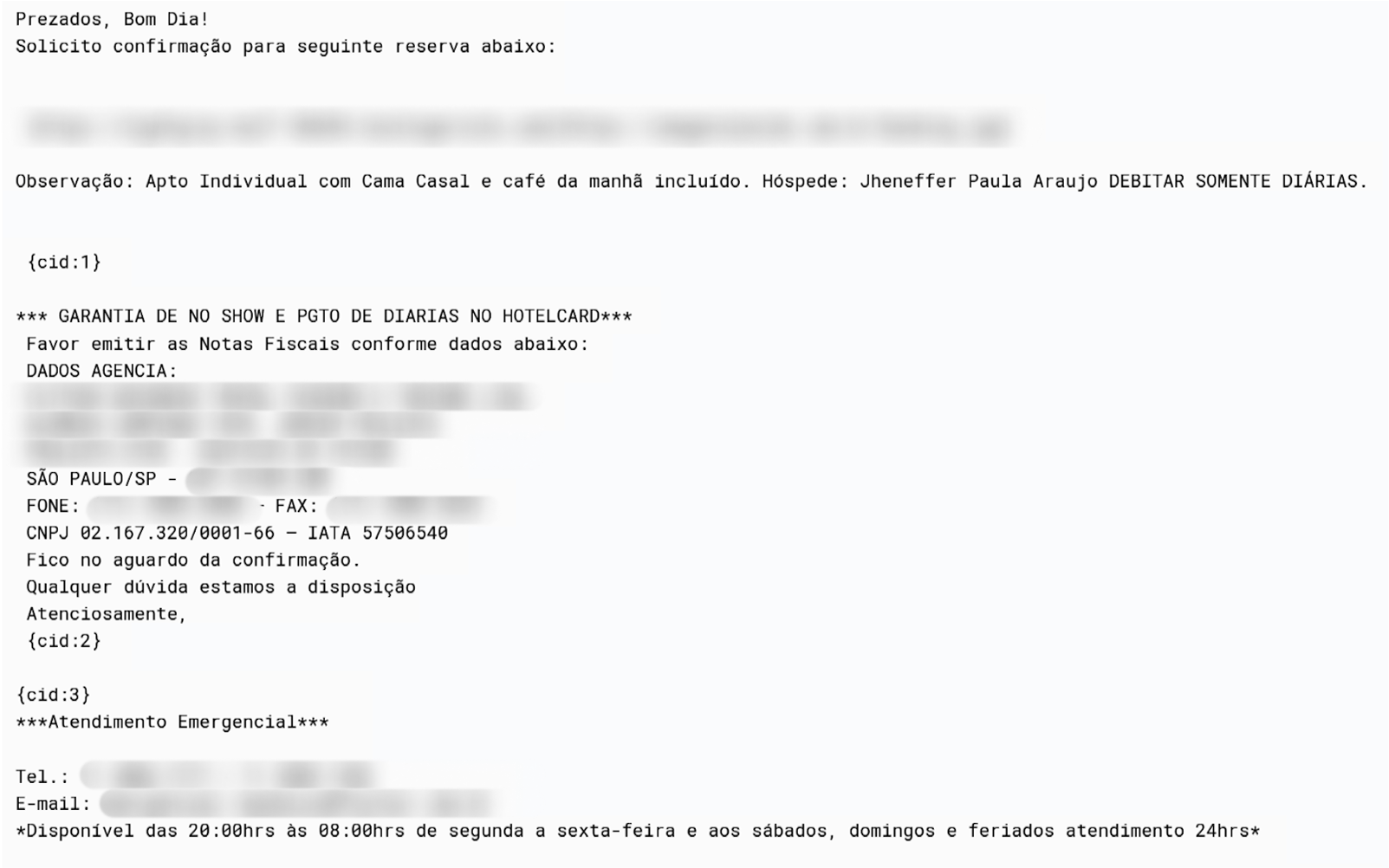
RevengeHotels (TA558) runs targeted phishing campaigns against hotels—primarily in Brazil—using invoice- and job-themed lures to deliver multi-stage loaders that ultimately deploy VenomRAT and other RAT families. The group increasingly leverages LLM-generated code for initial loaders and abuses legitimate hosting and Portuguese-themed domains for payload delivery. #RevengeHotels #VenomRAT
Keypoints
- RevengeHotels (TA558) targets hotels and front-desk personnel with phishing emails themed as invoices, booking confirmations, or fake job applications.
- Initial infection uses phishing links to websites that download WScript JS files (e.g., Fat{NUMBER}.js) which act as loaders.
- Loaders decode and save PowerShell scripts (SGDoHBZQWpLKXCAoTHXdBGlnQJLZCGBOVGLH_{TIMESTAMP}.ps1) that fetch Base64-encoded components: venumentrada.txt (loader) and runpe.txt (VenomRAT payload).
- A significant portion of the new initial infector code appears generated by LLM agents, identifiable by clean structure, extensive comments, placeholders, and lack of obfuscation.
- VenomRAT (an evolution of QuasarRAT) provides HVNC, file grabber/stealer, reverse proxy, UAC exploit, anti-kill, persistence mechanisms, ngrok tunneling, USB spreading, and defenses against Windows Defender.
- VenomRAT implements anti-kill by modifying process DACLs, terminating analyst/security processes, setting SeDebugPrivilege/RtlSetProcessIsCritical (if admin), and preventing sleep via SetThreadExecutionState.
- The campaign uses legitimate hosting services and rotating Portuguese-themed domains; primary victims remain hotels in Brazil with expansion into Spanish-speaking markets.
MITRE Techniques
- [T1566] Phishing – Threat actor sends targeted invoicing and job-application emails with links to malicious sites that download script files (“phishing emails with invoicing themes, which urge the recipient to settle overdue payments”).
- [T1204.002] User Execution: Malicious File – Victims execute WScript JS files downloaded from malicious sites (e.g., Fat{NUMBER}.js) that start the infection chain (“download a WScript JS file upon being visited, triggering the infection process”).
- [T1059.001] Command and Scripting Interpreter: PowerShell – Loader saves and executes a PowerShell script (SGDoHBZQ…_{TIMESTAMP}.ps1) that runs Base64-encoded commands to retrieve subsequent payloads (“runs a PowerShell command with Base64-encoded code. This code retrieves the cargajecerrr.txt file from a remote malicious server and invokes it as PowerShell”).
- [T1105] Ingress Tool Transfer – Downloader fetches Base64-encoded files venumentrada.txt and runpe.txt from remote servers and decodes them for execution (“fetching the remaining files from the malicious server and loading them. Both downloaded files are Base64-encoded and have descriptive names: venumentrada.txt … and runpe.txt”).
- [T1569.002] System Services: Service Execution (ngrok tunnel installation) – VenomRAT installs ngrok and receives tunnel parameters from C2 to expose remote services (RDP/VNC) to the internet (“VenomRAT implements tunneling by installing ngrok on the infected computer … token, protocol, and port for the tunnel”).
- [T1106] Native API – VenomRAT modifies process security descriptors and calls native APIs to set SeDebugPrivilege and RtlSetProcessIsCritical for persistence (“sets the SeDebugPrivilege token, enabling it to use the RtlSetProcessIsCritical function to mark itself as a critical system process”).
- [T1547.001] Boot or Logon Autostart Execution: Registry Run Keys/Startup Folder – Persistence via VBS that creates a RunOnce registry entry to relaunch the malware (“creates a new key under HKCUSoftwareMicrosoftWindowsCurrentVersionRunOnce, pointing to the executable path”).
- [T1490] Inhibit System Recovery/Defense Evasion: Clear Windows Event Logs – Malware clears Windows event logs to hinder detection and forensic analysis (“clears all Windows event logs on the compromised system, effectively creating a ‘clean slate’ for its operations”).
- [T1070.004] Indicator Removal on Host: File Deletion (Zone.Identifier) – VenomRAT deletes Zone.Identifier streams to remove Mark of the Web metadata and evade defenses (“deletes the Mark of the Web streams … avoid being quarantined”).
- [T1021.002] Remote Services: SMB/Windows Admin Shares (USB/Removable Media propagation) – Malware copies itself to removable drives under “My Pictures.exe” to spread via USB drives (“scans drive letters from C to M … copies itself to all available drives under the name My Pictures.exe”).
Indicators of Compromise
- [File Hash] initial JS and scripts – fbadfff7b61d820e3632a2f464079e8c (Fat146571.js), d5f241dee73cffe51897c15f36b713cc (SGDoHBZQ…_{TIMESTAMP}.ps1).
- [File Hash] downloader and payload files – 607f64b56bb3b94ee0009471f1fe9a3c (venumentrada.txt), dbf5afa377e3e761622e5f21af1f09e6 (runpe.txt), 3ac65326f598ee9930031c17ce158d3d (VenomRAT implant).
- [File Name] decoded resource names – cargajecerrr.txt (remote PowerShell stage), venumentrada.txt (VenomRAT entry loader), runpe.txt (in-memory execution payload).
- [File Hash] deobfuscated artifacts – 91454a68ca3a6ce7cb30c9264a88c0dc (deobfuscated runpe.txt), 11077ea936033ee9e9bf444dafb55867c (cargajecerrr.txt original mapping), b1a5dc66f40a38d807ec8350ae89d1e4 (cargajecerrr.txt referenced hash).
Read more: https://securelist.com/revengehotels-attacks-with-ai-and-venomrat-across-latin-america/117493/