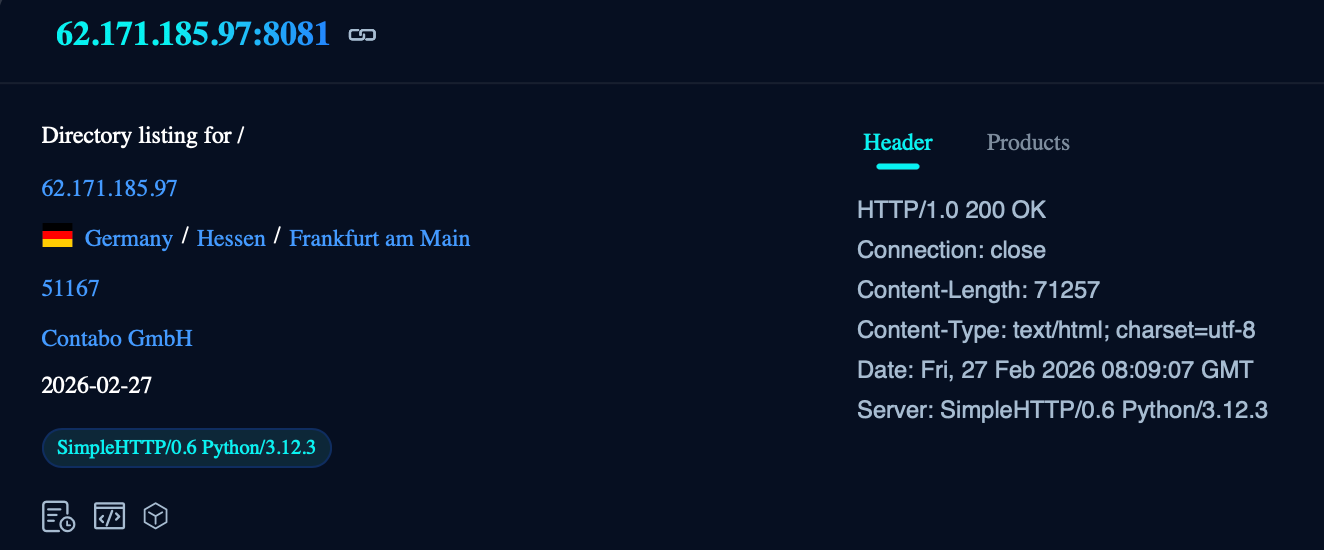
A multi-stage campaign attributed with medium confidence to MexicanMafia aka PanchoVilla targeted critical infrastructure across Latin America using Kimera reconnaissance, exploit kits for Fortinet, Ivanti, Cisco, SAP, and Oracle, plus layered persistence through Neo-reGeorg, Chisel, and compromised Cisco routers. The staging server artifacts showed large-scale credential theft, Active Directory mapping, and data exfiltration against government and enterprise systems, including confirmed activity tied to 62.171.185[.]97 and 165.22.184.26. #MexicanMafia #PanchoVilla #Kimera #NeoReGeorg #Chisel #Fortinet #Ivanti #Cisco #SAP #Oracle
Keypoints
- The threat actor is assessed with medium confidence as MexicanMafia aka PanchoVilla, based on staging server artifacts and prior linked activity.
- The campaign targeted critical infrastructure in Latin America, with Mexico as the primary focus and additional activity in Ecuador, Portugal, and other regions.
- Kimera, a custom distributed reconnaissance framework, was used for high-speed subdomain enumeration, port scanning, vulnerability scanning, and host fingerprinting.
- Initial access leveraged public-facing application exploitation, including Fortinet FortiOS, Ivanti Connect Secure, Apache Tomcat AJP, GeoServer, Oracle, SAP, and SMB-related weaknesses.
- The actor maintained persistence through Neo-reGeorg webshells, Chisel reverse tunnels, GRE tunnels on compromised Cisco routers, and abused remote-access tools like AnyDesk and N-able.
- Credential access and collection included LSASS dumping, Kerberoasting, browser credential theft, SAP and Oracle abuse, and extraction of Active Directory datasets and cryptographic material.
- Exfiltration was performed through alternative protocols, web services, and C2 channels, with evidence of large-scale data theft including over 1.3 million PII records and a 407 MB BloodHound dataset.
MITRE Techniques
- [T1595.001 ] Active Scanning: Scanning IP Blocks – Used for high-velocity subdomain enumeration and broad discovery across targets using subfinder, assetfinder, findomain, gobuster, dnsx, and naabu (‘parallelised subdomain enumeration’, ‘naabu port scanning at 5,000 pps’).
- [T1595.002 ] Active Scanning: Vulnerability Scanning – Automated CVE and misconfiguration scanning with Nuclei and dalfox (‘Nuclei fed all discovered URLs’, ‘dalfox automated XSS hunting’).
- [T1592 ] Gather Victim Host Information – Fingerprinted live hosts and technology stacks using httpx and whatweb (‘fingerprint live hosts’, ‘technology-stack fingerprinting’).
- [T1589.001 ] Gather Victim Identity Information: Credentials – Extracted credentials and secrets from repositories with regex-based scanning (‘extracting AWS keys, JWTs, bearer tokens, Base64 secrets, LDAP strings and SAP credentials’).
- [T1593.002 ] Search Open Websites/Domains: Search Engines – Used LinkFinder to uncover hidden endpoints and admin panels (‘JavaScript endpoint extraction … to uncover hidden APIs and administrative panels’).
- [T1590.001 ] Gather Victim Network Information: Domain Properties – Mapped DNS and subdomains using brute forcing and resolution (‘Subdomain brute-forcing … DNS resolution mapping across government and corporate domains’).
- [T1587.001 ] Develop Capabilities: Malware – Built custom tooling including Kimera, Xortigate variants, SMB handlers, and ZipSlip droppers (‘Custom Kimera V1/V2 … custom SMB protocol handlers’).
- [T1588.006 ] Obtain Capabilities: Vulnerabilities – Pre-staged exploit chains for Fortinet, Ivanti, Zerologon, EternalBlue, and SMBGhost (‘Pre-staged CVE-specific exploit chains’).
- [T1583.003 ] Acquire Infrastructure: Virtual Private Server – Used a DigitalOcean VPS as primary C2, relay, and staging server (‘62.171.185.97 used as the primary C2’).
- [T1608.001 ] Stage Capabilities: Upload Malware – Staged payloads and exploit tooling on the server (‘Centralized exploit armory … chunked payload delivery’).
- [T1190 ] Exploit Public-Facing Application – Exploited Fortinet, Ivanti, GhostCat, GeoServer, Oracle, and SAP services (‘FortiGate SSL-VPN exploitation’, ‘SAP RFC abuse’).
- [T1133 ] External Remote Services – Used harvested credentials and configuration dumps for VPN and RDP access (‘credential-based VPN access’, ‘RDP access via harvested credentials’).
- [T1566.002 ] Phishing: Spearphishing Link – Maintained credential-harvesting phishing pages for tax and document-management users (‘Custom phishing pages targeting tax-authority employees’).
- [T1059.004 ] Command and Scripting Interpreter: Unix Shell – Ran OS commands through DBMS_SCHEDULER, SAP RFC, and webshells (‘executing OS commands’, ‘Bash webshells’).
- [T1059.007 ] Command and Scripting Interpreter: JavaScript – Triggered Java execution via GeoServer WFS injection and JSP webshells (‘Runtime.getRuntime() execution’).
- [T1059.008 ] Command and Scripting Interpreter: Network Device CLI – Injected TCL scripts and configured GRE tunnels on Cisco routers (‘Cisco IOS TCL script injection’).
- [T1072 ] Software Deployment Tools – Used SAP function modules to execute OS commands (‘SXPG_CALL_SYSTEM and SXPG_COMMAND_INSERT’).
- [T1203 ] Exploitation for Client Execution – Delivered ysoserial Java deserialization payloads to vulnerable Java servers (‘CommonsCollections5 Java deserialization payload’).
- [T1569.002 ] System Services: Service Execution – Achieved Oracle scheduler-based command execution (‘DBMS_SCHEDULER job-based command execution’).
- [T1505.003 ] Server Software Component: Web Shell – Deployed Neo-reGeorg and multiple PHP/JSP/CFM shells for persistence (‘Neo-reGeorg JSPX/JSP webshells’).
- [T1572 ] Protocol Tunneling – Used Neo-reGeorg, Chisel, and GRE tunnels for layered tunneling (‘TCP-over-HTTP reverse-proxy tunnelling’, ‘GRE tunnel configured on a compromised Cisco router’).
- [T1546 ] Event Triggered Execution – Used malicious ZIP archives and ZipSlip extraction to deploy webshells (‘deploying webshells when extracted’).
- [T1068 ] Exploitation for Privilege Escalation – Used PwnKit and FortiOS heap grooming for root/privileged code execution (‘PwnKit CVE-2021-4034’).
- [T1210 ] Exploitation of Remote Services – Leveraged Zerologon, EternalBlue, SMBGhost, SambaCry, and MS08-067 for escalation and movement (‘confirm domain-controller compromise’).
- [T1078.002 ] Valid Accounts: Domain Accounts – Used domain admin and harvested credentials for access and movement (‘domain-admin accounts’).
- [T1562.003 ] Impair Defenses: Impair Command History Logging – Suppressed forensic artifacts and cleaned up commands (‘post-exploitation cleanup’).
- [T1036.005 ] Masquerading: Match Legitimate Name or Location – Used LNK files mimicking N-able RMM components (‘mimicking the N-able RMM agent’).
- [T1027 ] Obfuscated Files or Information – Hid payloads with Base64, AES encryption, chunking, and custom encoding (‘Base64-encoded payloads’, ‘AES-encrypted Neo-reGeorg webshell channel’).
- [T1090.002 ] Proxy: External Proxy – Routed traffic through external SOCKS5 relays and proxychains (‘Multi-port SOCKS5 relay’).
- [T1550.002 ] Use Alternate Authentication Material: Pass the Hash – Used Impacket tools for credential-free lateral movement (‘psexec.py, wmiexec.py and ntlmrelayx.py’).
- [T1205 ] Traffic Signaling – Bypassed WAFs with spoofed headers, user agents, and encoding tricks (‘X-Forwarded-For localhost spoofing’, ‘double URL encoding’).
- [T1140 ] Deobfuscate/Decode Files or Information – Decrypted FortiGate, WebLogic, and Oracle credentials/configuration (‘FortiGate AES-CBC configuration decryption’).
- [T1003.001 ] OS Credential Dumping: LSASS Memory – Used secretsdump and captured NTLM hashes (‘NTLM-hash interception’).
- [T1558.003 ] Steal or Forge Kerberos Tickets: Kerberoasting – Retrieved service-account hashes with GetUserSPNs.py (‘Kerberoastable service-account hashes’).
- [T1552.001 ] Unsecured Credentials: Credentials in Files – Found cleartext credentials in configuration and text files (‘FortiGate configuration extraction’, ‘pgpass.conf’).
- [T1552.005 ] Unsecured Credentials: Cloud Instance Metadata API – Extracted cloud secrets and tokens from source code repositories (‘AWS access keys, Azure secrets and JWT tokens’).
- [T1555.003 ] Credentials from Password Stores: Credentials from Web Browsers – Collected Chrome credential stores (‘Login Data and Login Data For Account SQLite databases’).
- [T1110.002 ] Brute Force: Password Spraying – Used automated spray and cracking tools against victim accounts (‘aggressive_spray.py, fast_brute.sh’).
- [T1212 ] Exploitation for Credential Access – Read passwd/shadow files and exfiltrated SSL private keys through database functions (‘read /etc/passwd and /etc/shadow without OS root’).
- [T1082 ] System Information Discovery – Retrieved OS and system details using SAP and Oracle commands (‘CHECK_OS and DIR_LIST command execution’).
- [T1016 ] System Network Configuration Discovery – Extracted topology, routing tables, and subnet layouts from FortiGate and Cisco configs (‘full network topology, routing tables and internal subnet layouts’).
- [T1018 ] Remote System Discovery – Scanned subnets and ports to identify reachable systems (‘scanning the 10.39.x.x subnet’).
- [T1069.002 ] Permission Groups Discovery: Domain Groups – Enumerated AD groups and privileged roles (‘identifying SQL service users, Citrix administrators and CyberArk vault operators’).
- [T1087.002 ] Account Discovery: Domain Account – Reconstructed hierarchy from account attributes and SAP roles (‘PasswordLastSet and LastLogon attribute correlation’).
- [T1135 ] Network Share Discovery – Probed SMB shares across internal subnets (‘SMB port-445 probing across the 10.8.7.0/24 subnet’).
- [T1526 ] Cloud Service Discovery – Assessed VMware AirWatch MDM for exploitation opportunities (‘authentication bypass’).
- [T1046 ] Network Service Discovery – Performed high-speed port scanning and service validation (‘naabu port scanning’).
- [T1021.002 ] Remote Services: SMB/Windows Admin Shares – Used PsExec and Impacket for remote execution over SMB (‘psexec.py and smbexec.py’).
- [T1021.001 ] Remote Services: Remote Desktop Protocol – Used harvested RDP credentials and config files for movement (‘default.rdp, users_rdp.txt and pass_rdp.txt’).
- [T1090.001 ] Proxy: Internal Proxy – Used SOCKS5 pivots and Chisel to access internal subnets (‘SOCKS5 pivot through 165.22.184.26:5571’).
- [T1080 ] Taint Shared Content – Staged router-to-router pivoting and TFTP-based configuration staging (‘router-to-router pivot using rt01_telnet_rt02.py’).
- [T1213 ] Data from Information Repositories – Accessed document repositories and Zabbix macros for credentials (‘SeedDMS phishing’, ‘Zabbix global-macro extraction’).
- [T1005 ] Data from Local System – Read local files and database outputs from victim systems (‘Oracle UTL_FILE reading output files from /tmp’).
- [T1119 ] Automated Collection – Automated bulk extraction from Oracle and SAP data sources (‘dump_batch.sh iterating through Oracle tables’).
- [T1114 ] Email Collection – Extracted email infrastructure passwords and credentials (‘Zimbra password extraction’).
- [T1185 ] Browser Session Hijacking – Abused CORS and session tokens to hijack authenticated sessions (‘req.withCredentials=true CORS abuse’).
- [T1071.001 ] Application Layer Protocol: Web Protocols – Used HTTP POST-based Neo-reGeorg C2 and web-like callbacks (‘reverse shells on ports 80, 443 and 8080’).
- [T1090.003 ] Proxy: Multi-hop Proxy – Built a layered proxy chain through VPS, relay, and internal nodes (‘Layered architecture using a public VPS’).
- [T1132.002 ] Data Encoding: Non-Standard Encoding – Used BLV and custom Base64 encoding in C2 traffic (‘Binary Length Value encoding’).
- [T1001.001 ] Data Obfuscation: Junk Data – Hid payloads with AES-encrypted channels and compressed inner payloads (‘GZIP-compressed inner payload’).
- [T1048.003 ] Exfiltration Over Alternative Protocol – Streamed SSL keys and metadata over Netcat, Wget, and PostgreSQL pipelines (‘streaming SSL private keys to 62.171.185.97:8888’).
- [T1030 ] Data Transfer Size Limits – Fragmented binaries into small chunks to evade detection (‘ELF binary divided into approximately 3.9 KB fragments’).
- [T1567 ] Exfiltration Over Web Service – Exfiltrated through SOCKS5-tunnelled services and callback mechanisms (‘SOCKS5-tunnelled exfiltration’).
- [T1041 ] Exfiltration Over C2 Channel – Used Oracle spooling, TFTP retrieval, and C2 channels for data removal (‘compressed 407 MB BloodHound Active Directory dataset exfiltration’).
- [T1485 ] Data Destruction – Altered MySQL configuration to bypass authentication and enable unrestricted manipulation (‘skip-grant-tables injection’).
- [T1491 ] Defacement / Web Content Manipulation – Used archive-dropping techniques to re-establish access and manipulate web content (’embedding a JSP webshell in a path-traversal structure’).
- [T1565.001 ] Data Manipulation: Stored Data Manipulation – Injected commands and altered procurement workflows using stolen credentials (‘manipulation of procurement workflows’).
Indicators of Compromise
- [IP address] Threat actor VPS, relay, and callback infrastructure – 62.171.185[.]97, 165.22.184[.]26, and 185.65.245[.]10:7227
- [IP address] Confirmed victim or callback hosts – 200.79.113[.]136, 201.144.122[.]60, and 135.237.122[.]202
- [Port / service] Tunneling and relay services – 1080, 5554, 5571, 8888, and 1389
- [File names] Webshells, scripts, and payloads on staging server – status.jsp, ver.jsp, sedema_proc.jsp, rev.sh, and shell.php
- [File names] Credential and tooling artifacts – anydesk_svc.conf, anydesk_usr.conf, cisco_creds.log, pgpass.conf, and kerberoast_tickets.hash
- [File / binary names] Offensive tooling and staged payloads – chisel.b64, pwnkit_b64, neo.jspx.b64, payload.b64, and chunk_aa through chunk_aj
- [Domain / service artifacts] Infrastructure and callback patterns – Neo-reGeorg HTTP POST C2, Cisco GRE tunnels, and MGLNDD_62.171.185.97_1389