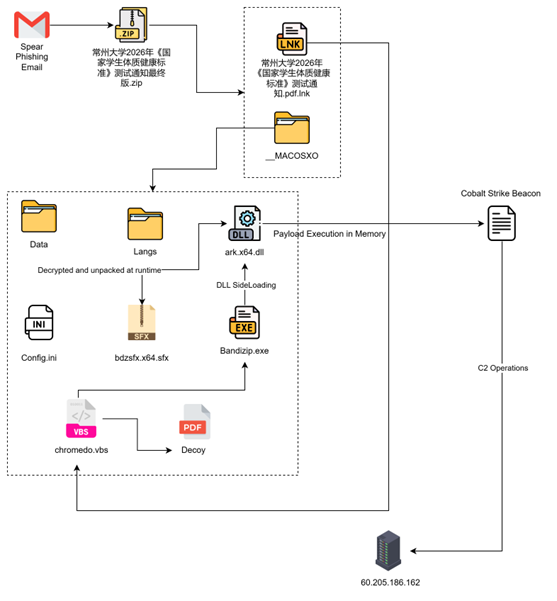
Seqrite Labs identified a targeted spear-phishing campaign against Changzhou University that used a fake 2026 fitness testing notice to trick students and staff into opening a malicious ZIP archive. The infection chain used a disguised LNK file, obfuscated VBScript, DLL sideloading via Bandizip, and a final Cobalt Strike Beacon that connected to infrastructure on Alibaba Cloud. #ChangzhouUniversity #Bandizip #CobaltStrike #UNG0002
Keypoints
- Seqrite Labs tracked a global spear-phishing campaign that specifically targeted Changzhou University in Mainland China.
- The lure impersonated the university’s mandatory 2026 National Student Physical Fitness and Health Standards testing notice.
- The malicious ZIP archive contained a double-extension LNK file that initiated the execution chain.
- The payload used VBScript to open a decoy PDF while silently launching Bandizip.exe in the background.
- Bandizip.exe loaded a malicious DLL, ark.x64.dll, through DLL sideloading and anti-analysis checks.
- The final payload was a Cobalt Strike Beacon decrypted in memory and used for C2 communication.
- Infrastructure, DNS artifacts, and TTP overlap led Seqrite to attribute the activity to UNG0002 and link it to Operation Cobalt Whisper.
MITRE Techniques
- [T1566.001] Spearphishing Attachment – The attack began with a malicious ZIP sent as an email attachment to lure the victim into opening it (‘delivers a ZIP attachment named…’).
- [T1204.002] User Execution: Malicious File – The victim had to click the disguised LNK/PDF file to trigger the infection chain (‘clicking it triggers the entire execution chain’).
- [T1059.005] Command and Scripting Interpreter: Visual Basic – A VBScript file orchestrated the decoy opening and malicious execution (‘which contains the following code’).
- [T1036] Masquerading – The LNK file masqueraded as a PDF document and the campaign used official-looking university content (‘displaying a PDF icon and carrying a .pdf filename’).
- [T1564.001] Hidden Files and Directories – The payload was buried in four nested folders to evade inspection (‘Four levels of nested folders’).
- [T1574.002] DLL Side-Loading – Bandizip.exe loaded the attacker-controlled ark.x64.dll from its local directory (‘loaded the malicious DLL named ark.x64.dll’).
- [T1027] Obfuscated Files or Information – Strings and payloads were decrypted at runtime to hinder analysis (‘memory regions allocated via VirtualAlloc, combined with custom decryption loops’).
- [T1622] Debugger Evasion – The DLL used checks like CheckRemoteDebuggerPresent and IsDebuggerPresent to resist analysis (‘implementing multiple anti-debugging techniques’).
- [T1497] Virtualization/Sandbox Evasion – The malware checked for analysis environments and stopped if monitoring tools were present (‘avoid running inside monitored or researcher-controlled environments’).
- [T1497.001] System Checks – It enumerated processes and compared them against a blacklist of tools (‘enumerates running processes’).
- [T1218] Signed Binary Proxy Execution – The actor abused the legitimate explorer.exe binary and Bandizip.exe to execute payloads (‘Abuses the legitimate explorer.exe binary’).
- [T1106] Native API – The malware relied on Windows APIs such as CreateToolhelp32Snapshot and Process32First/Next (‘Windows APIs including CreateToolhelp32Snapshot’).
- [T1057] Process Discovery – The DLL enumerated active processes to identify analysis tools (‘To identify analysis environments, the DLL enumerates running processes’).
- [T1129] Shared Modules – The malicious DLL was loaded as a shared module by the legitimate Bandizip process (‘loaded into memory under a legitimate process context’).
- [T1620] Reflective Code Loading – The SFX payload was dynamically loaded into memory and executed without disk persistence (‘loaded into process memory and executed directly without disk persistence’).
- [T1071.001] Application Layer Protocol: Web Protocols – The Beacon attempted to establish outbound command-and-control communication (‘attempted to establish command-and-control (C2) communication’).
- [T1105] Ingress Tool Transfer – The staged payloads and final Beacon were unpacked and loaded into memory during execution (‘decrypted the final-stage component entirely in memory’).
- [T1005] Data from Local System – The document lure and local execution chain leveraged system files and local decoy content (‘opens the decoy PDF’).
Indicators of Compromise
- [File names] Malicious archive, decoy document, and loader components – 常州大学2026年《国家学生体质健康标准》测试通知最终版.zip, 常州大学2026年《国家学生体质健康标准》测试通知.pdf, ark.x64.dll
- [File hashes] Identified samples and final payload – e7aff6a55a7866776272d9913dfbf9d7db33fc9de6aced22f2a195feebb0e85f, 35a478f53f64bd412f374c65360fdba0518749537193669a8fe08d14bed65a2a, and other 3 hashes
- [IP address] Command-and-control infrastructure for the Beacon – 60[.]205[.]186[.]162, and other related Alibaba Cloud-hosted infrastructure
- [Email artifact] Spear-phishing sender and message – [email protected], eb14d9e35a3bf0a933297f861bee0be9e6b9061fe4573a81ac92b71d55b6474f
- [Executable name] Legitimate sideloading binary used in the chain – Bandizip.exe, with the malicious DLL loaded from its directory