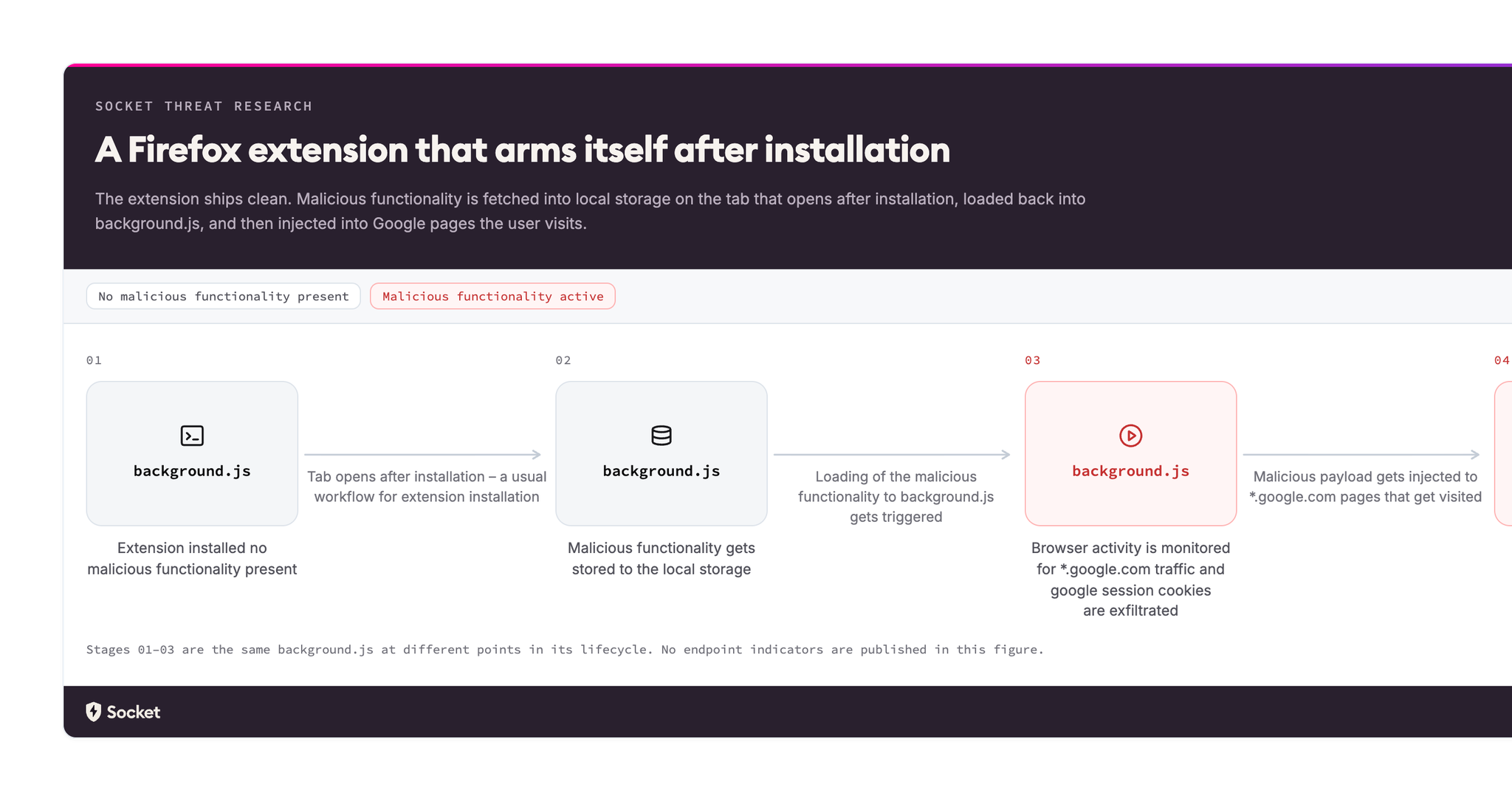
Socket identified a malicious Firefox extension, [email protected], that stays clean until after installation and then downloads a remote payload to automate Google account takeover. The campaign targets Portuguese- and Spanish-speaking users by hijacking Google sessions, stealing oauth_token cookies, and, when needed, forcing password resets through attacker-controlled infrastructure. #[email protected] #pdf.gusercontent.com #accounts.google.com
Keypoints
- The Firefox extension [email protected] was published on September 3, 2026, and its malicious functionality appeared in version 1.4 on September 11, 2026.
- The add-on ships without hardcoded malicious logic, target URLs, or exfiltration endpoints, making static review appear benign.
- After installation, it fetches configuration and payloads from attacker-controlled pdf.gusercontent.com infrastructure.
- The extension uses a message bridge and webRequest monitoring to activate only after it is armed at runtime.
- It injects code into real accounts.google.com pages to automate Google account takeover and capture session cookies.
- If Google forces a password reset, the script sets a new attacker-known password, providing durable account access.
- Socket assessed the campaign’s current scale as low, but highlighted its strong detection-evasion design and Portuguese/Spanish targeting.
MITRE Techniques
- [T1195 ] Supply Chain Compromise – The extension is delivered through the Firefox Add-ons store and only becomes malicious after installation, abusing trusted software distribution (‘published to the Firefox Add-ons store’ and ‘the extension fetches its malicious configuration and payload from attacker infrastructure only after installation’).
- [T1056 ] Input Capture – The script intercepts and manipulates authentication-related inputs, including password-reset handling and session-related data (‘capturing both the victim’s Google session cookie and, when Google prompts for one, a password reset value’).
- [T1110 ] Brute Force – The takeover flow repeatedly retries and drives Google authentication steps, including password-reset and passkey challenge handling (‘forcing the passkey/security-key challenge’ and ‘detecting and retrying around Google’s own bot-detection block page’).
- [T1552.001 ] Credentials in Files – The extension stores attacker-controlled configuration and victim identifiers in browser storage for later use (‘browser.storage.local.set’ and ‘stores {leadId, email} into the config object’).
- [T1204.002 ] Malicious File Execution – The operator injects and executes attacker-supplied JavaScript inside a legitimate Google page (‘browser.tabs.executeScript’ and ‘injects the fetched load-addon.js directly into that real Google page’).
- [T1059.007 ] JavaScript – The payload is executed as JavaScript in the browser context to automate account takeover (‘load-addon.js’ and ‘script that will later be injected into accounts.google.com tabs’).
- [T1027 ] Obfuscated Files or Information – The extension avoids detection by shipping generic dispatcher logic and receiving malicious behavior only as data (‘contains no hardcoded malicious logic’ and ‘The malicious behavior … is data, not code’).
- [T1105 ] Ingress Tool Transfer – The extension downloads a remote payload and configuration after installation (‘fetches its malicious configuration and payload from attacker infrastructure’).
- [T1539 ] Steal Web Session Cookie – The webRequest listener captures Google session cookies from responses and exfiltrates them (‘watches all https://*.google.com/* responses for a Set-Cookie header containing oauth_token’).
- [T1185 ] Browser Session Hijacking – The campaign captures the victim’s authenticated Google session and uses it to gain account access (‘stolen, valid oauth_token session cookie’ and ‘turns the victim’s own authenticated browser session into a remote-controlled account-takeover bot’).
Indicators of Compromise
- [Extension identifier ] malicious Firefox add-on – [email protected]
- [Domain / URL ] attacker infrastructure and landing pages – pdf.gusercontent.com, pdf.gusercontent.com/oninstalled
- [Domain / URL ] payload and collection endpoints – pdf.gusercontent.com/loginSdk/load-addon.js, pdf.gusercontent.com/api/accounts/collect/?leadId=&email=&data=
- [Domain / URL ] telemetry and redirect endpoints – pdf.gusercontent.com/api/extlog, pdf.gusercontent.com/reload
- [File names / scripts ] malicious loader and takeover script – index-BhOgWOaO.js, load-addon.js
- [File hashes ] malicious payload hashes – f1b8329075b1cbd1ae0a5dc947bd00f94642cb166a86c2455a1d0b10aee9f2b1, 16447c70f8e3c99de95b92846460214a661915c89f5c10965bf18da4c279880a, and 1 more hash
- [Targeted system / domain ] account takeover target – accounts.google.com
Read more: https://socket.dev/blog/firefox-google-account-takeover