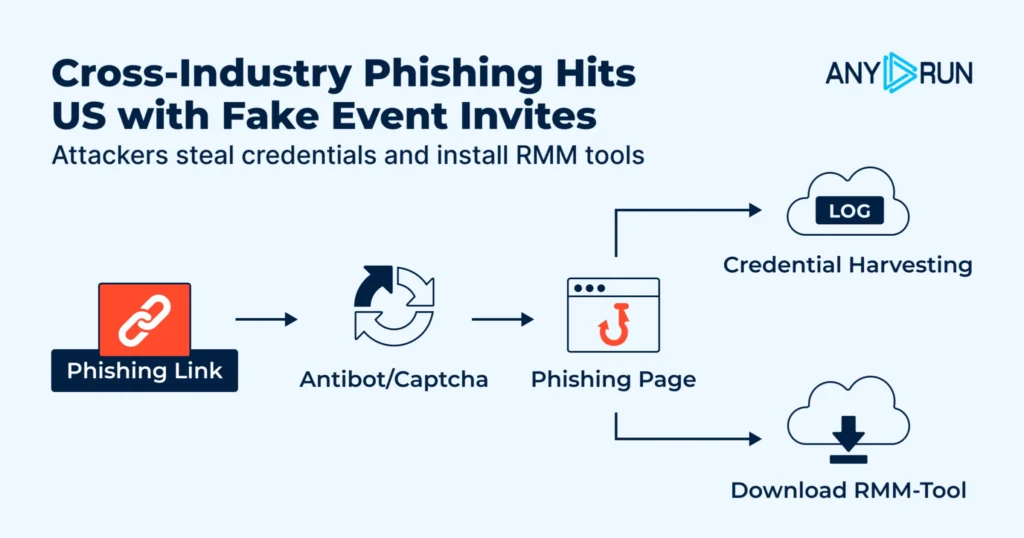
May 2026 campaigns showed attackers hiding phishing, credential theft, OTP interception, fileless execution, and remote access abuse inside routine business workflows to delay detection and increase business exposure. #ANY.RUN #AgentTesla #BlobPhish #ClickFix #ScreenConnect
Keypoints
- ANY.RUN observed multiple May 2026 attack campaigns that blended into normal business activity to evade detection.
- Fake invitation phishing targeted U.S. organizations and could lead to credential theft, OTP interception, and remote access tool delivery.
- An Agent Tesla campaign used business-document lures against Latin American enterprises, putting finance, procurement, and payroll credentials at risk.
- Compromised B2B websites were abused to deliver fileless malware through injected scripts, PowerShell, in-memory payloads, and C2 communication.
- A large OTP phishing campaign impersonated a U.S. financial institution and reused hundreds of related phishing domains.
- Fake Word Online / OneDrive pages redirected users into a ScreenConnect-based remote access chain disguised as document access.
- BlobPhish used browser-generated blob objects to hide Microsoft 365 and webmail credential theft from traditional visibility controls.
MITRE Techniques
- [T1566.002] Phishing: Spearphishing Link – Used fake invitation flows, banking portals, and document lures to send victims to credential-harvesting pages [‘users followed an invitation that felt familiar’; ‘redirected users to a fake Word Online / OneDrive-style page’]
- [T1056.003] Input Capture: Web Portal Capture – Collected usernames, passwords, OTP codes, and verification data through phishing pages [‘collect usernames, passwords, OTP codes, and email verification data’]
- [T1556.004] Modify Authentication Process: Multi-Factor Authentication Interception – Intercepted OTPs in real time to bypass MFA protection [‘credential theft, OTP interception’]
- [T1105] Ingress Tool Transfer – Delivered remote access tools and installers during phishing chains [‘possible remote access tool delivery’; ‘moved through software installation stages’]
- [T1059.001] Command and Scripting Interpreter: PowerShell – Used PowerShell execution as part of fileless delivery from compromised websites [‘move users toward PowerShell execution’]
- [T1204.002] User Execution: Malicious File – Relied on users opening business-themed files such as invoices, purchase orders, and payroll documents [‘purchase orders, invoices, payroll files, and procurement requests’]
- [T1218] System Binary Proxy Execution – Used legitimate-looking tools and workflows to run attacker activity while blending in with normal administration or support behavior [‘remote access through tools that may look similar to normal IT or support activity’]
- [T1219] Remote Access Software – Deployed ScreenConnect and RMM-style access for hands-on control of victim systems [‘led to remote access through ScreenConnect’; ‘RMM deployment’]
- [T1027] Obfuscated Files or Information – Hid malicious activity with blob-generated pages, in-memory payloads, and concealment activity [‘generated the page directly inside the browser using blob objects’; ‘kept the malicious content in memory’]
- [T1055] Process Injection – Mentioned as part of fileless activity where malicious code may run in memory with fewer visible artifacts [‘process injection’]
- [T1102.001] Web Service: Dead Drop Resolver – Used legitimate or compromised web infrastructure to stage malicious content and redirect victims [‘compromised websites and injected scripts’]
- [T1071.001] Application Layer Protocol: Web Protocols – Enabled outbound command-and-control communication over web traffic [‘outbound C2 communication’]
- [T1078] Valid Accounts – Stolen email, browser, banking, and session data could be reused for unauthorized access [‘stolen email, browser, banking, and session data can open the door to BEC, fraud, SaaS compromise’]
Indicators of Compromise
- [File names] Business-themed lures used to trick employees – purchase orders, invoices, payroll files, and procurement requests
- [Domain names] Large OTP phishing infrastructure with reusable templates – hundreds of related phishing domains
- [URLs / web pages] Fake login and document portals used in campaigns – fake invitation pages, fake Word Online / OneDrive-style page, banking portals
- [Tools / software] Remote access and endpoint tooling seen in attack chains – ScreenConnect, RMM tools
- [Malware families] Named malware observed in one campaign – Agent Tesla, BlobPhish
Read more: https://any.run/cybersecurity-blog/major-cyber-attacks-may-2026/