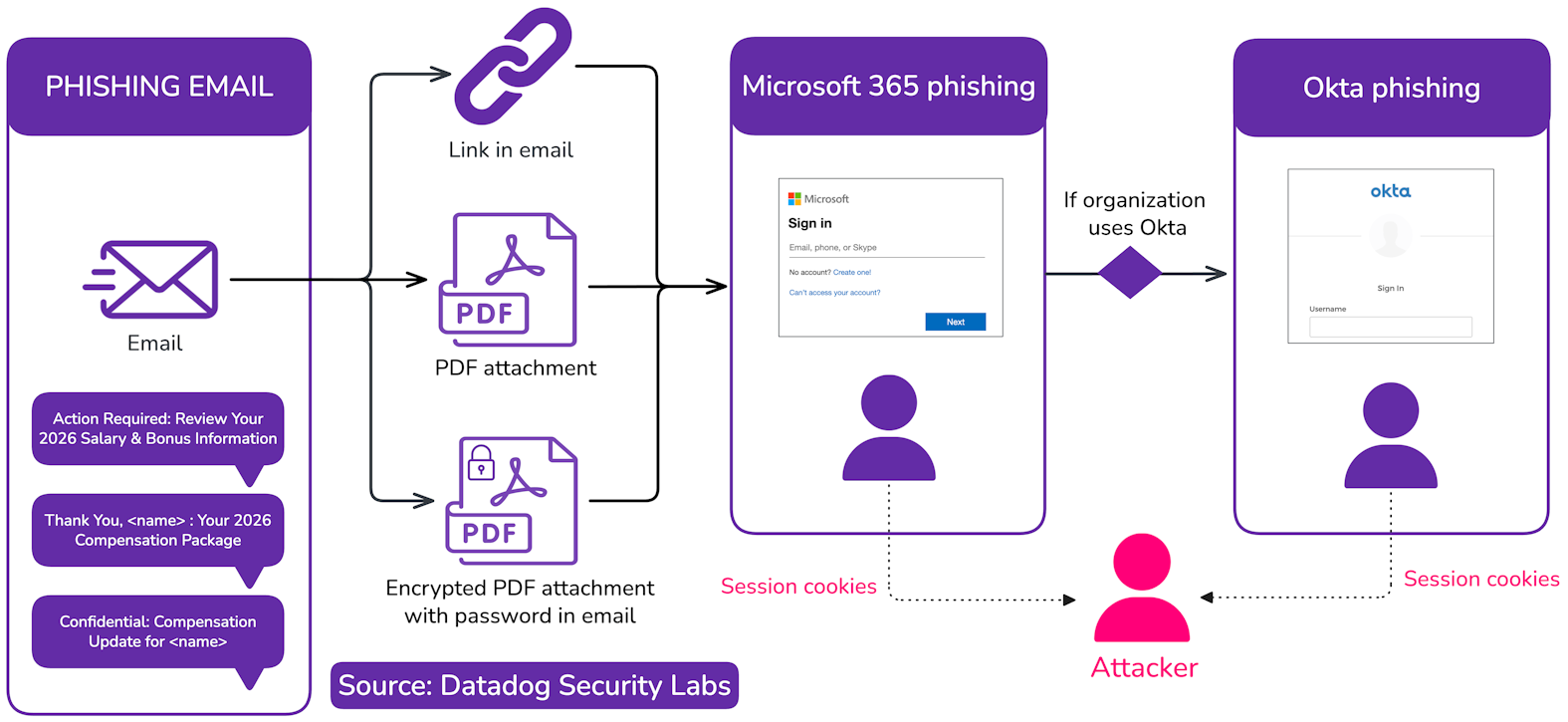
Datadog analyzed an active phishing campaign that impersonates Microsoft 365 and Okta pages to hijack SSO flows, capture credentials and session cookies, and bypass non-phishing-resistant MFA. The campaign uses lookalike Okta domains, two-stage phishing pages, on-page JavaScript that hooks fetch/XHR to rewrite federation redirects and exfiltrate cookies, and a variety of phishing infrastructure and lures such as benefits-themed emails and PDFs #Okta #Microsoft365
Keypoints
- The campaign impersonates Okta and Microsoft 365 login flows using lookalike domains (e.g., sso.oktasecure[.]io, okta-cloud[.]com) to proxy traffic and preserve legitimate page customizations.
- Attackers inject client-side JavaScript that hooks window.fetch and xhr.onreadystatechange to rewrite URLs, modify FederationRedirectUrl responses, and redirect victims to second-stage Okta phishing pages.
- Injected scripts capture usernames via DOM events, persist them to storage/cookies, monitor for changes to cookies every second, and exfiltrate “critical” Okta session cookies (e.g., idx, JSESSIONID) to the attacker.
- Phishing delivery includes malicious links and password-protected PDFs, use of compromised mailboxes (Salesforce/ExactTarget evidence) and Amazon SES for sending, plus link shorteners and Cloudflare-hosted pages with turnstiles for evasion.
- Datadog provides detection guidance for Okta and Microsoft 365 logs (e.g., FastPass auth events, policy.evaluate_sign_on challenges, Cloudflare-sourced activity, and mail access queries for observed subject lines).
MITRE Techniques
- [T1566] Phishing – Campaign uses targeted phishing emails linking to credential-harvesting pages: ‘We identified a phishing campaign targeting organizations that use Microsoft 365 and Okta…’
- [T1566.002] Spearphishing Link – Malicious emails contain links (often hidden via shorteners) that redirect to first-stage phishing domains: ‘Link shortener services were used to hide the domains like lnk[.]ie.’
- [T1566.001] Spearphishing Attachment – Some phishing messages include password-protected PDFs that contain links to phishing pages: ‘phishing emails where the link to the phishing page is stored in a PDF file, encrypted with a password that’s shared in the phishing email.’
- [T1056] Input Capture – Client-side script captures typed usernames via DOM events and stores them in cookies/localStorage: ‘the script tracks when the victim types in their username using the change and submit DOM events… document.cookie = ‘okta_captured_username=’ + encodeURIComponent(e.target.value) …’
- [T1539] Steal Web Session Cookie – The injected JavaScript enumerates and exfiltrates Okta session cookies deemed “critical” for session impersonation: ‘const CRITICAL_COOKIES = [“idx”,”JSESSIONID”,”proximity_”,”DT”,”sid”];’ and it posts them to ‘/log_cookie’.
- [T1078] Valid Accounts – Attackers use stolen session cookies and compromised mailboxes to impersonate users and send phishing: ‘the compromised mailboxes appear to be associated with Salesforce Marketing Cloud’ and stolen cookies are stored server-side for reuse by the attacker.
Indicators of Compromise
- [Domain ] First-stage phishing landing pages – employee-hr-portal[.]com, secure-hr-portal[.]com, and 24 more domains (e.g., mybenefits-portal[.]com, benefitsviewportal[.]com, office365mailsecurity[.]com).
- [Domain ] Second-stage Okta lookalike domains used to proxy Okta tenants – okta-secure[.]io, okta-access[.]com, and 6 more domains (e.g., okta-cloud[.]com, oktasecure[.]io).
- [Email Subject ] Observed phishing email subjects used as lures – “Action Required: Review Your 2026 Salary & Bonus Information”, “Thank You, : Your 2026 Compensation Package”, and 1 more subject.
- [Email Address ] Malicious senders or display names observed – [email protected], mocked [email protected] (spoofed display name) as seen in campaign emails.
- [Hosting/Infrastructure ] Cloud services used to host and send phishing content – Cloudflare hosted phishing pages (turnstiles used) and Amazon SES for sending malicious emails.
- [Redirector ] Shortener/redirect domains used to hide final landing pages – lnk[.]ie (example) used to obfuscate the phishing URL.
Read more: https://securitylabs.datadoghq.com/articles/investigating-an-aitm-phishing-campaign-m365-okta/