Fake tax-document and DocuSign lures are being used to deliver a custom HVNC backdoor to banking and financial organizations across Latin America. The malware provides hidden remote access, keystroke and browser-data theft, and Startup-folder persistence while disguising itself as Windows Update Assistant and using infrastructure tied to GHOSTnet GmbH and Azure staging hosts. #DocuSign #NFe #UpdateAssistant #GHOSTnetGmbH #Azure
Keypoints
- The campaign targets banking and financial services organizations in Latin America with fake tax documents and DocuSign-style phishing lures.
- The infection chain is multi-stage, moving from a spoofed download page to a ZIP archive, a malicious LNK shortcut, a PowerShell downloader, an NSIS loader, and finally the HVNC backdoor.
- The final payload is a custom 64-bit backdoor masquerading as Windows Update Assistant and signed as Microsoft Corporation in metadata while remaining unsigned.
- The malware supports hidden remote desktop control, screen capture, simulated mouse and keyboard input, and keystroke monitoring.
- It steals Firefox cookies, browsing history, and permissions data, increasing the risk of credential and session compromise.
- Persistence is achieved through a Startup-folder shortcut that relaunches a renamed copy of the malware after reboot.
- The campaign uses anti-analysis checks, AV/EDR discovery, XOR-obfuscated configuration, and rotating infrastructure to reduce visibility and complicate detection.
MITRE Techniques
- [T1592 ] Gather Victim Host Information – The lure page fingerprints the visitor before delivery, collecting browser and system details (‘silent background request also fingerprints the visitor’s browser, OS, timezone and screen size’).
- [T1566.002 ] Phishing: Spearphishing Link – The attack begins with a fake DocuSign notification and NFe tax-document page (‘Fake DocuSign and NFe delivery-notice page as the entry vector’).
- [T1027 ] Obfuscated Files or Information – The campaign uses ZIP-in-disguise delivery and XOR-obfuscated configuration (‘nested single-byte XOR string obfuscation with context-specific keys’).
- [T1036.005 ] Masquerading: Match Legitimate Name or Location – The malware pretends to be legitimate software and documents (‘UpdateAssistant.exe claims Microsoft Corporation while unsigned’).
- [T1518.001 ] Security Software Discovery – The backdoor checks for more than 20 AV/EDR processes to adjust behavior (’20+ hardcoded AV/EDR process names’).
- [T1204.002 ] User Execution: Malicious File – The victim must open the disguised LNK shortcut to start execution (‘Victim double-clicks the disguised .lnk’).
- [T1059.001 ] Command and Scripting Interpreter: PowerShell – A hidden PowerShell one-liner downloads the second stage (‘Hidden, execution-policy-bypassed PowerShell one-liner’).
- [T1105 ] Ingress Tool Transfer – PowerShell retrieves the loader from staging infrastructure (‘Invoke-WebRequest pulling the NSIS loader from the Azure staging host’).
- [T1573 ] Encrypted/Obfuscated Configuration – The C2 host is stored as XOR-protected bytes inside the payload (‘XOR-protected C2 host string embedded in the final payload’).
- [T1571 ] Non-Standard Port – The malware communicates over TCP/27015 or 27017 instead of web protocols (‘Raw TCP C2 on port 27015’).
- [T1095 ] Non-Application Layer Protocol – The backdoor uses a custom raw-TCP protocol for operator communication (‘Custom raw-TCP protocol rather than HTTP/WebSocket’).
- [T1113 ] Screen Capture – The HVNC component captures the screen using GDI and OpenCV-backed frames (‘GDI BitBlt/GetDIBits + OpenCV-backed frame queue’).
- [T1056.001 ] Input Capture: Keylogging – The malware polls keyboard state to record input (‘GetAsyncKeyState/GetKeyboardState polling imports’).
- [T1539 ] Steal Web Session Cookie – Firefox cookies are explicitly targeted (‘Hardcoded targeting of Firefox cookies.sqlite’).
- [T1217 ] Browser Information Discovery – Firefox browsing data files are targeted to gather browser information (‘Hardcoded targeting of Firefox places.sqlite / permissions.sqlite’).
- [T1219 ] Remote Access Software – The hidden desktop and input simulation function as an unauthorized remote-access channel (‘Hidden-desktop + SendInput architecture’).
- [T1547.001 ] Boot or Logon Autostart Execution: Startup Folder – Persistence is established through a shortcut in the user’s Startup folder (‘AppUpdateHelper.lnk dropped into the current user’s … Startup folder’).
Indicators of Compromise
- [SHA-256 ] Malicious ZIP and payload samples – e4d637f884f5babea6525266e1cb6ab332a16a446d6084dd51b4222540c1f16c, 5fbfc7929858c3c3d79637db857525695db3c0f41b9bf2a7b964c26b7226bde3, and other hashes
- [Filename ] Stage-2 archive and loader names – DANFE_SAMSUNG_ELET_AM_CNPJ…zip, MOTOROLA_MOB_COM_NFe_2026-07-16_217816240.zip, and NF_Eletronica999147237654.lnk
- [Filename ] Final payload and persistence artifacts – UpdateAssistant.exe, AppUpdateHelper.exe, and AppUpdateHelper.lnk
- [SHA-256 ] Relocated persistence copy and support DLLs – debf48e690abd4288e5f76fa7e9f98a9fb3411171eba82906ef0d2bf1ef2dd6d, d1f4225df2cd877dbf130d5668a021dce3f94118455ff5ec952061c30afc9ce7, and 2 more hashes
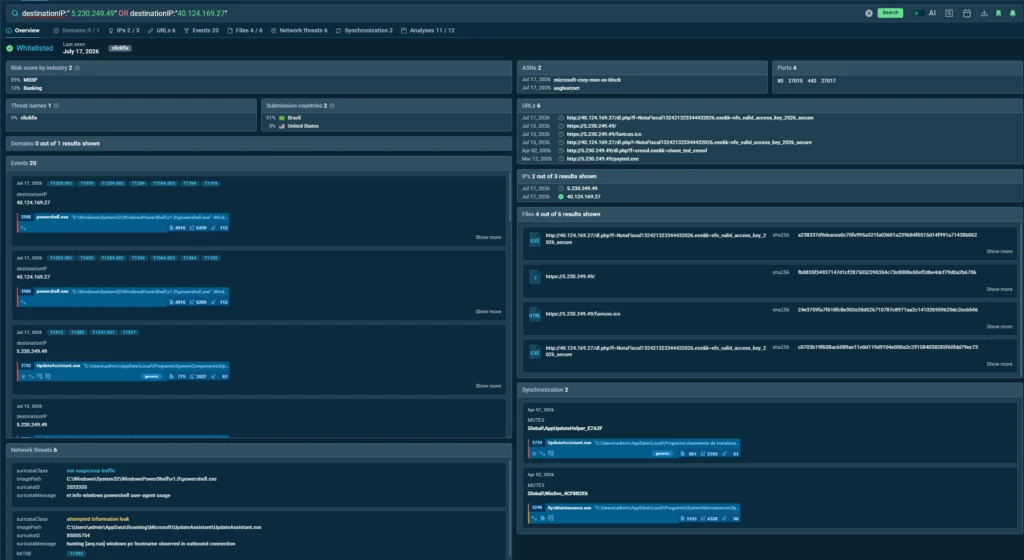
- [IPv4 ] Staging and C2 infrastructure – 40.124.169.27, 5.230.249.49, and 5.230.54.41
- [IP:Port ] Live HVNC command-and-control endpoint – 5.230.249.49:27015 and 5.230.249.49:27017
- [Domain ] Phishing and banking-clone infrastructure – receitafederal.digital, gerenciadorcaixa.digital, and aapj.digital
- [URL ] Stage-2 delivery endpoints on the C2 host – http://5.230.249.49/dl.php?f=cresol.exe&k=chave_tecl_cresol, http://5.230.249.49/dl.php?f=payed.exe, and http://40.124.169.27/dl.php?f=NotaFiscal…&k=nfe_valid_access_key_2026_secure
- [URL parameter values ] Delivery tokens used by the kit – nfe_valid_access_key_2026_secure and chave_tecl_cresol
- [HTML comment string ] Phishing-kit marker embedded in the DocuSign lure – 0a4b2aff1c2ebf8b
- [Host artifact ] Builder and persistence traces – servee, %APPDATA%RoamingProgramsCommonAppUpdateHelper.exe, and %APPDATA%RoamingMicrosoftWindowsStart MenuProgramsStartupAppUpdateHelper.lnk
Read more: https://any.run/cybersecurity-blog/hvnc-backdoor-targets-latam/