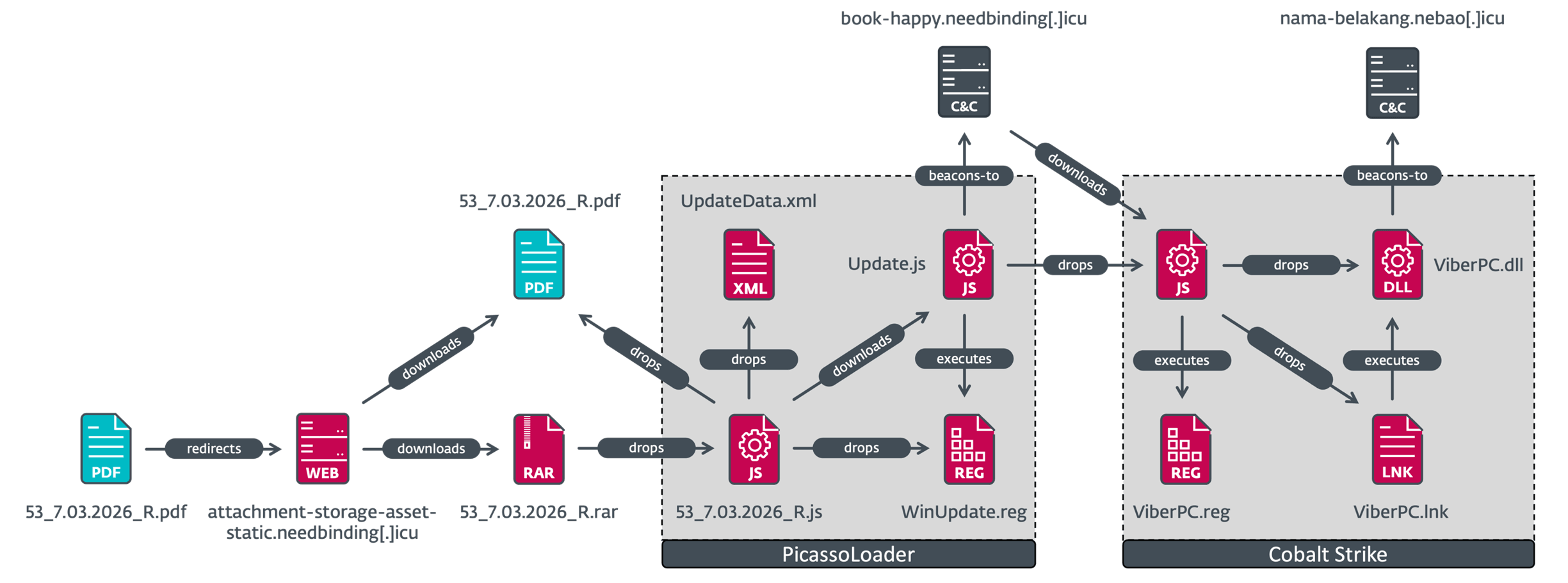
The report describes newly observed FrostyNeighbor activity against governmental organizations in Ukraine, including a March 2026 compromise chain that uses spearphishing PDFs, JavaScript-based PicassoLoader, and a final Cobalt Strike payload. The actor continues to evolve its tooling, apply server-side victim validation, and rely on infrastructure such as needbinding[.]icu and nebao[.]icu to deliver payloads only to selected targets. #FrostyNeighbor #PicassoLoader #CobaltStrike #Ukraine
Keypoints
- FrostyNeighbor is a long-running cyberespionage group also known as Ghostwriter, UNC1151, UAC-0057, TA445, PUSHCHA, and Storm-0257.
- The group primarily targets governmental, military, and other key sectors in Eastern Europe, with strong focus on Ukraine, Poland, and Lithuania.
- New activity observed since March 2026 targets Ukrainian governmental organizations using malicious PDFs delivered through spearphishing.
- The latest compromise chain uses a JavaScript version of PicassoLoader to stage and deliver a Cobalt Strike beacon.
- Victim validation is performed server-side using geography, IP, and collected fingerprint data before the final payload is sent.
- The actor uses multiple delivery and evasion methods, including decoy PDFs, scheduled tasks, registry persistence, and masquerading as legitimate files.
- FrostyNeighbor has also used credential-harvesting phishing pages and exploited vulnerabilities in WinRAR and Roundcube in related campaigns.
MITRE Techniques
- [T1583 ] Acquire Infrastructure – The group acquires domains and rents C&C servers for its operations (‘acquires domain names and rents C&C servers’).
- [T1608 ] Stage Capabilities – Final payloads are hosted on attacker-controlled servers before delivery (‘hosts the final payload on a C&C server’).
- [T1588.002 ] Obtain Capabilities: Tool – The actors obtained a leaked Cobalt Strike version to generate payloads (‘obtained a leaked version of Cobalt Strike to generate payloads’).
- [T1566.001 ] Phishing: Spearphishing Attachment – Weaponized lure documents are delivered as email attachments (‘sends a weaponized lure document in email attachments’).
- [T1204.002 ] User Execution: Malicious File – Victims are tricked into opening documents or archives to trigger code execution (‘tricks its victims into opening or editing a document to gain code execution’).
- [T1053.005 ] Scheduled Task/Job: Scheduled Task – Scheduled tasks are used to trigger persistence and execution (‘uses scheduled tasks to achieve persistence’).
- [T1059 ] Command and Scripting Interpreter – JavaScript, Visual Basic, and PowerShell are used to run malicious logic (‘uses scripting languages such as JavaScript, Visual Basic, and PowerShell’).
- [T1060 ] Registry Run Keys / Startup Folder – Registry Run keys are used for persistence (‘uses the registry Run key and the Startup Folder to achieve persistence’).
- [T1027 ] Obfuscated Files or Information – Scripts and binaries are obfuscated to hinder analysis (‘obfuscates scripts and compiled binaries’).
- [T1027.009 ] Obfuscated Files or Information: Embedded Payloads – Later-stage payloads are embedded inside initial lure content (’embeds next stages or payloads inside the initial lure document’).
- [T1036.005 ] Masquerading: Match Legitimate Resource Name or Location – Malicious files are dropped with common Microsoft-style names and paths (‘drops malicious files using common Microsoft filenames and locations’).
- [T1057 ] Process Discovery – PicassoLoader collects running process information (‘collects the list of running processes’).
- [T1082 ] System Information Discovery – PicassoLoader gathers user and system details (‘collects system and user information’).
- [T1071.001 ] Application Layer Protocol: Web Protocols – HTTPS is used for command-and-control and delivery (‘uses HTTPS for C&C communication and payload delivery’).
- [T1041 ] Exfiltration Over C2 Channel – Data is sent over the C2 channel with Cobalt Strike (‘uses HTTPS with Cobalt Strike’).
Indicators of Compromise
- [SHA-1 hashes ] malicious files and payload samples – 776A43E46C36A539C916ED426745EE96E2392B39, B65551D339AECE718EA1465BF3542C794C445EFC, and other 8 items
- [File names ] lure documents, droppers, and beacons – 53_7.03.2026_R.pdf, 53_7.03.2026_R.js, and other 8 items
- [Domains ] C&C and delivery infrastructure – attachment-storage-asset-static.needbinding[.]icu, book-happy.needbinding[.]icu, and other 5 items
- [URLs ] downloader and payload retrieval endpoints – https://book-happy.needbinding[.]icu/wp-content/uploads/2023/10/1GreenAM.jpg, https://book-happy.needbinding[.]icu/employment/documents-and-resources, and other 1 item
- [Registry/file paths ] persistence and dropped payload locations – %AppData%WinDataScopeUpdate.js, %ProgramData%ViberPC.dll, and other 2 items
- [Vulnerability IDs ] exploited weaknesses referenced in the campaign – CVE-2023-38831, CVE-2024-42009
Read more: https://www.welivesecurity.com/en/eset-research/frostyneighbor-fresh-mischief-digital-shenanigans/