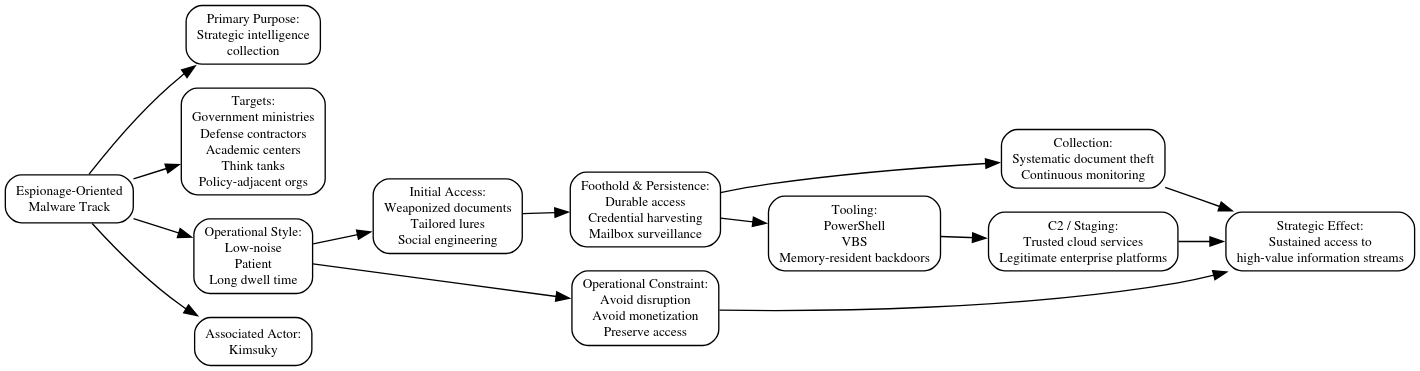
North Korea’s cyber program is a deliberately fragmented, mission-aligned malware ecosystem that treats toolchains as consumable assets to enable parallel espionage, revenue generation, and disruptive operations. This compartmentalized portfolio model increases operational resilience, complicates attribution, and prioritizes rapid tool churn over long-lived platforms #Lazarus #Kimsuky
Keypoints
- The DPRK has organized its cyber capability into parallel, mission-aligned tracks (espionage, financial, disruptive) rather than a single monolithic platform.
- Compartmentalization and high tool churn are intentional design features that enable loss tolerance: exposed tools are burned and replaced without collapsing other mission tracks.
- Espionage operations favor low-noise, script-heavy loaders (PowerShell/VBS), memory-resident backdoors, and abuse of trusted cloud services for stealthy persistence and C2.
- Financial operations prioritize rapid monetization using wallet stealers, browser injectors, clipboard hijacking, and supply-chain compromises to scale theft from crypto ecosystems.
- Disruptive campaigns use wipers/ransomware-like payloads and rapid lateral movement for high-impact, time-bound signaling, accepting short dwell times and burned infrastructure.
- Despite operational diversity, common technical invariants (cryptographic routines, loader architectures, registrar/hosting preferences, and social-engineering reliance) indicate centralized standards and shared developer playbooks.
MITRE Techniques
- [T1566.001 ] Spearphishing Attachment – Weaponized documents and tailored lures are a primary initial access vector. (‘Initial access commonly relies on weaponized documents or carefully crafted lures tailored to the professional context of the target’)
- [T1059.001 ] PowerShell – Script-heavy loaders frequently use PowerShell to blend with administrative activity. (‘Malware associated with espionage missions favors script-heavy loaders, most commonly PowerShell or VBS that blend into normal administrative activity’)
- [T1059.005 ] Visual Basic (VBS) – VBS is used as an alternative script loader to reduce large on-disk artifacts. (‘Malware associated with espionage missions favors script-heavy loaders, most commonly PowerShell or VBS’)
- [T1055 ] Process Injection / In-memory Execution – Backdoors and secondary payloads are frequently memory-resident to minimize on-disk artifacts and complicate forensics. (‘Backdoors are frequently memory-resident, minimizing on-disk artifacts and complicating forensic recovery’)
- [T1195 ] Supply Chain Compromise – Operators embed malicious code into open-source packages or trojanize updates to convert trusted tooling into scalable access vectors. (‘Increasingly, operators have demonstrated sophistication in compromising trust boundaries within the developer ecosystem itself, embedding malicious code into open-source packages or trojanizing software updates’)
- [T1078 ] Valid Accounts – Credential harvesting and abuse of trusted accounts and session tokens are central to maintaining access across tracks. (‘credential harvesting, mailbox surveillance…depend on credential abuse and trusted account usage rather than exploit-driven compromise’)
- [T1071.001 ] Application Layer (Web Protocols) – Trusted cloud services and common enterprise platforms are abused for command-and-control and staging to hide malicious traffic. (‘trusted cloud services are routinely abused for command-and-control and staging’)
- [T1555.003 ] Credentials from Web Browsers – Wallet stealers and browser injectors target credentials and private keys stored or processed in browsers. (‘Wallet stealers and browser injectors are used to intercept credentials, private keys, and transaction workflows directly at the user layer’)
- [T1485 ] Data Destruction (Wiping) – Disruptive payloads include wipers and ransomware-like tools designed for rapid, visible impact and domain-wide execution. (‘Payloads frequently take the form of wipers or ransomware-like tools capable of inflicting widespread disruption across enterprise environments’)
Indicators of Compromise
- [SHA256 Hashes ] Representative known sample hashes from multiple DPRK-linked clusters – 7dee2bd4e317d12c9a2923d0531526822cfd37eabfd7aecc74258bb4f2d3a643 (Dozer), d2359630e84f59984ac7ddebdece9313f0c05f4a1e7db90abadfd86047c12dd6 (Brambul), and 30+ other SHA256 exemplars cited in the appendix.
- [Malware Family Names ] Government- and vendor-published family labels linked to DPRK activity – BLINDINGCAN, Joanap, Manuscrypt, AppleJeus, and many additional families documented by CISA/industry.
- [Analysis URLs ] Public sample lookup / analysis references for hunting and triage – VirusTotal: https://www.virustotal.com/gui/file/7dee2bd4e317d12c9a2923d0531526822cfd37eabfd7aecc74258bb4f2d3a643, ANY.RUN: https://any.run/search/?query=4fe3c853ab237005f7d62324535dd641e1e095d1615a416a9b39e042f136cf6b (examples linking to Dozer and Joanap entries).
Read more: https://dti.domaintools.com/research/dprk-malware-modularity-diversity-and-functional-specialization