CVE-2024-1086 is a decade-old use-after-free vulnerability in the Linux kernel’s netfilter (nftables) component that allows attackers to gain root privileges and is being actively exploited in ransomware campaigns. Public PoC availability and default-enabled features like unprivileged user namespaces have expanded the attack surface, putting legacy and cloud Linux systems at high risk. #CVE-2024-1086 #nftables
Keypoints
- CVE-2024-1086 is a use-after-free (double-free) vulnerability in nft_verdict_init() of the Linux kernel’s netfilter (nftables) component that enables privilege escalation to root (CVSS 7.8).
- The bug was introduced in February 2014 and affects kernels from 3.15 through 6.8-rc1, with urgent patching recommended for v5.14 through v6.6; patched releases include v5.15.149+, v6.1.76+, and v6.6.15+.
- Exploitation leverages unprivileged user namespaces, malformed SKBs and nf_tables to trigger a double-free, overwrite modprobe_path, and obtain a root shell.
- Default-enabled configurations on major distributions (Debian, Ubuntu) and many cloud images expand the vulnerable population, especially multi-tenant and container-host environments.
- CISA confirmed active use of CVE-2024-1086 in ransomware campaigns, enabling post-compromise escalation, defense evasion, and lateral movement for groups targeting Linux such as RansomHub, Akira, and LockBit.
- Public proof-of-concept code has been available since March 2024, lowering the barrier to exploitation for moderately skilled attackers.
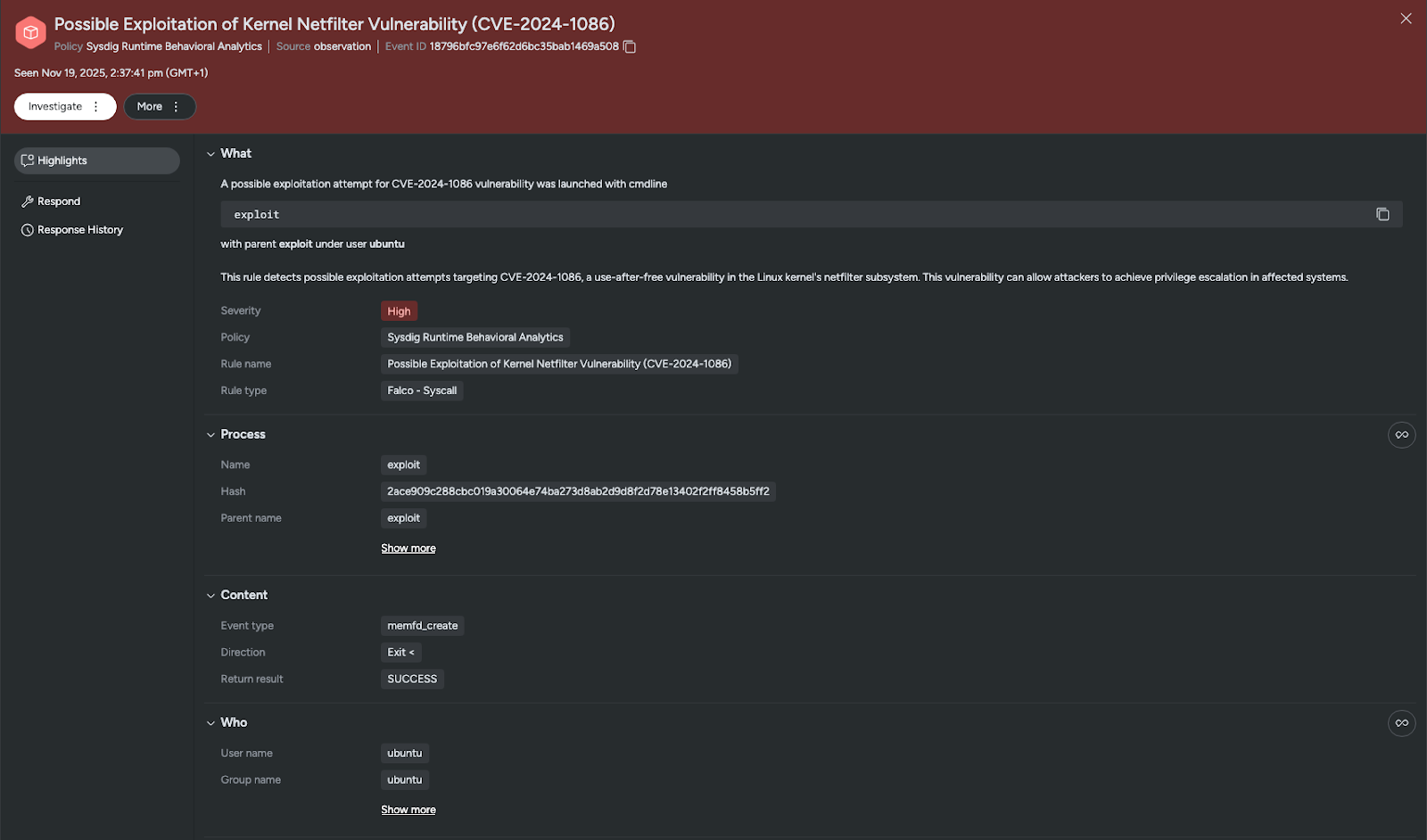
- Mitigations prioritize patching affected kernels and deploying runtime threat detection (e.g., Sysdig rules) to detect exploitation attempts and ransomware behaviors before and after compromise.
MITRE Techniques
- [T1068] Exploitation for Privilege Escalation – The article describes exploiting a kernel double-free to gain root privileges: “…the double-free vulnerability can be triggered, allowing attackers to run malicious code in the kernel… The exploit then finds and overwrites modprobe_path, which enables attackers to execute a root shell.”
- [T1548] Abuse Elevation Control Mechanism – Exploit leverages unprivileged user namespaces to access nf_tables and escalate privileges: “…leverages unprivileged user namespaces in order to access the nf_tables component… Unprivileged user namespaces accessible (sysctl kernel.unprivileged_userns_clone = 1).”
- [T1036] Masquerading / Defense Evasion – With root access attackers can disable security tools and clear logs to evade detection: “…Root access allows attackers to disable security tools, clear logs, and establish persistence.”
- [T1078] Valid Accounts (initial access enabling exploitation) – The article notes initial access via vulnerable services or stolen credentials precedes use of the vulnerability: “Once initial access is gained through vulnerable services or stolen credentials, CVE-2024-1086 provides the elevated privileges necessary…”
- [T1486] Data Encrypted for Impact (Ransomware) – The vulnerability is used by ransomware operators to perform system-wide encryption after escalation: “CVE-2024-1086 provides the elevated privileges necessary for system-wide encryption and data exfiltration operations.”
Indicators of Compromise
- [Vulnerability ] affected kernel versions – Kernels from 3.15 to 6.8-rc1 are vulnerable; urgent patching for v5.14–v6.6, patched releases include v5.15.149+, v6.1.76+, v6.6.15+.
- [Configuration ] exploit prerequisites – Unprivileged user namespaces enabled (sysctl kernel.unprivileged_userns_clone = 1), nf_tables module enabled.
- [Malware / Threat Actors ] ransomware groups observed using the vulnerability – RansomHub, Akira, LockBit (RansomHub noted for 600+ attacks using GoLang-based Linux malware).
- [Proof-of-Concept ] public exploit code – PoC available since March 2024 (public PoC lowered barrier to entry).