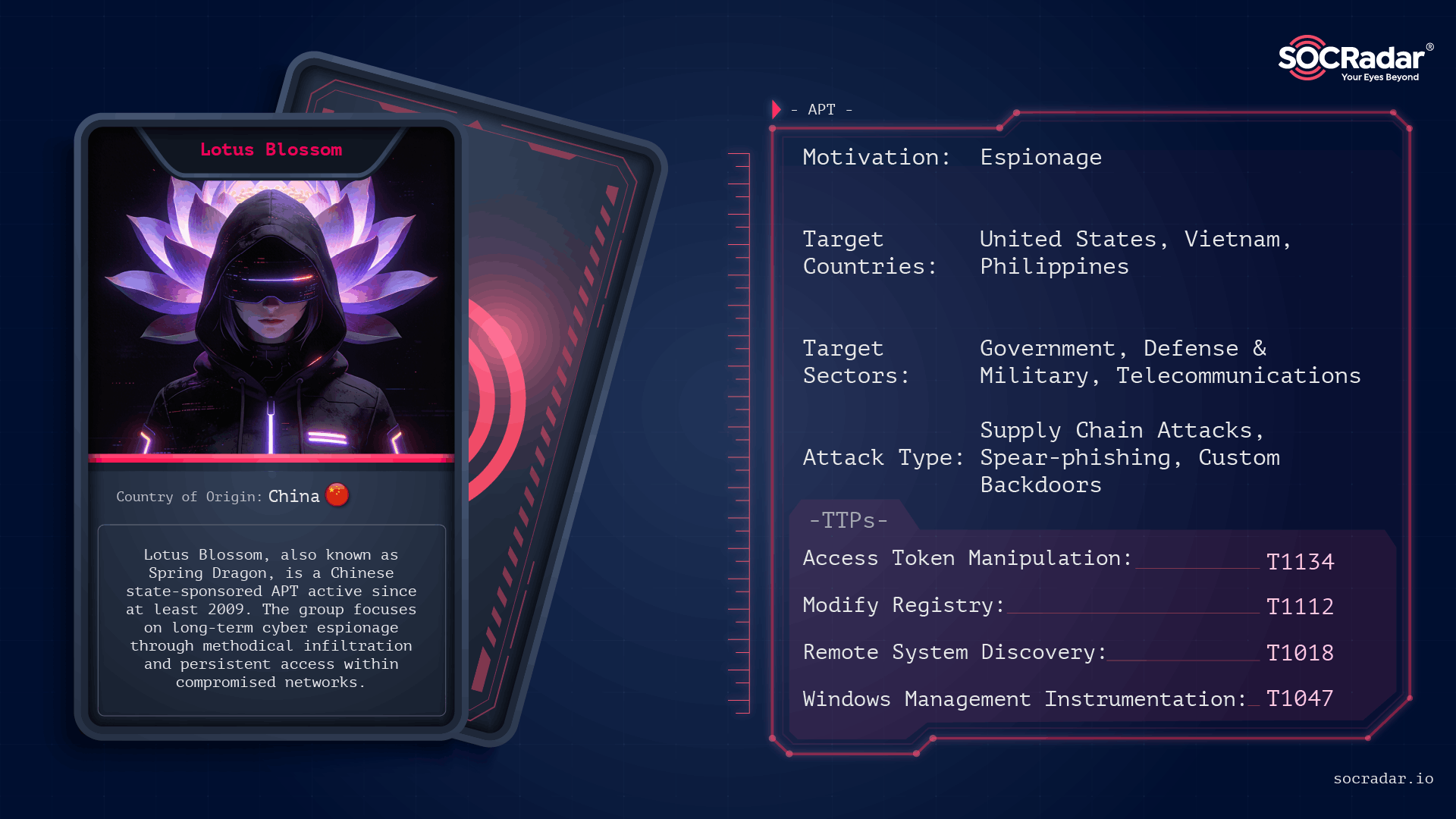
Lotus Blossom is a long-running, China-attributed APT that evolved from spear-phishing and watering-hole campaigns into sophisticated supply-chain compromises and targeted espionage using custom implants like Elise, Sagerunex, Hannotog, and Chrysalis. The group’s Notepad++ update-channel compromise and prior attacks against diplomatic, military, and maritime infrastructure demonstrate a “low-and-slow” intelligence collection approach emphasizing DLL sideloading, living-off-the-land techniques, and clandestine persistence. #LotusBlossom #Chrysalis
Keypoints
- Lotus Blossom (also tracked as Billbug/Spring Dragon/Thrip) is a Chinese state‑linked APT active since at least 2009 that focuses on long‑term intelligence collection rather than disruptive operations.
- The group evolved from Office‑document spear‑phishing (e.g., exploits like CVE‑2012‑0158) and watering‑hole campaigns to sophisticated supply‑chain intrusion tactics, notably compromising Notepad++ update infrastructure in 2025–2026.
- Custom implants—Elise, Emissary, Sagerunex, Hannotog, and the Chrysalis backdoor—are central to the actor’s persistence and modular C2 capabilities, often delivered via DLL sideloading or service-based installers.
- Lotus Blossom extensively abuses legitimate administrative utilities (PowerShell, WMI, PsExec, AdFind, Mimikatz) to move laterally, harvest credentials, and blend activity into normal enterprise behavior.
- Targets include government, military, telecommunications, manufacturing, critical infrastructure, and maritime/logistics entities across Southeast Asia and increasingly globally (Djibouti, Europe, Americas, USA).
- Mitigations emphasize software integrity checks, supply‑chain monitoring, MFA, constrained native tool usage, registry/service auditing, network segmentation, and threat‑hunting aligned to the actor’s ATT&CK profile.
MITRE Techniques
- [T1566.001] Spearphishing Attachment – Lotus Blossom used targeted phishing documents to gain initial access: ‘spear‑phishing emails delivering weaponized Office documents…’
- [T1189] Drive‑by Compromise (Watering Hole) – The group compromised trusted regional websites to deliver malware: ‘watering hole attacks by compromising trusted regional websites.’
- [T1195] Supply Chain Compromise – Operators tampered with software update infrastructure to deliver implants: ‘tampered with a legitimate software update channel… compromised the Notepad++ update infrastructure.’
- [T1574.001] DLL Search Order Hijacking (DLL sideloading) – Attackers loaded malicious components through legitimate updaters via DLL sideloading: ‘used DLL sideloading to load a malicious component through a legitimate updater process.’
- [T1543.003] Create or Modify System Process: Windows Service – Persistence and loaders were deployed as services: ‘Installed as a service… persistence is typically achieved through Windows services.’
- [T1547.001] Boot or Logon Autostart Execution: Registry Run Keys/Startup Folder – Registry autorun entries were used for persistence: ‘registry-based autorun entries.’
- [T1047] Windows Management Instrumentation (WMI) – WMI was used as a living‑off‑the‑land lateral movement mechanism: ‘Tools such as WMI… are used to move laterally.’
- [T1059.001] Command and Scripting Interpreter: PowerShell – PowerShell was abused to execute and move laterally: ‘PowerShell are used to move laterally.’
- [T1021] Remote Services (PsExec) – PsExec was used for remote execution and lateral movement: ‘Tools such as… PsExec… are used to move laterally.’
- [T1087] Account Discovery / Active Directory Discovery – Active Directory reconnaissance was performed with utilities like AdFind: ‘Active Directory reconnaissance with AdFind…’
- [T1003] OS Credential Dumping – Credential harvesting via Mimikatz and similar utilities was observed: ‘credential harvesting via utilities like Mimikatz have been documented.’
- [T1055] Process Injection / In‑memory Execution – In‑memory techniques and process injection reduced forensic artifacts: ‘in‑memory execution… process injection.’
- [T1071.001] Application Layer Protocol: Web Protocols (HTTP/S) – Backdoors communicated over HTTP/S and legitimate web services: ‘Custom backdoors maintain communication through both traditional HTTP/S channels…’
- [T1090] Proxy – Proxy chaining and custom relays were used to obfuscate routing: ‘Proxy chaining tools and custom relays have also been observed.’
- [T1027.002] Obfuscated Files or Information: Encrypted Files – Attackers used encrypted payloads to hide implant contents: ‘encrypted payloads… remain common persistence techniques.’
- [T1070.006] Indicator Removal on Host: Timestomping – Timestamp manipulation was used to hinder forensic timelines: ‘timestamp manipulation remain common persistence techniques.’
- [T1218.011] Signed Binary Proxy Execution: rundll32.exe – Legitimate binaries like rundll32 were used to execute malicious modules: ‘Emissary… was often executed through legitimate Windows binaries such as rundll32.’
Indicators of Compromise
- [CVE ] Exploited vulnerabilities used as initial access vectors – CVE-2025-15556, CVE-2012-0158, and 7 more CVEs (e.g., CVE-2018-0802, CVE-2017-11882).
- [Malware / Backdoor ] Actor implants and loaders observed in campaigns – Chrysalis, Sagerunex (and Elise, Hannotog).
- [File names / paths ] Example binaries and debug artifacts tied to tooling – trojanized update.exe (Notepad++ updater), debug path ‘d:lstudioprojectslotuselisereleaseeliseDLL.pdb’.
- [Binaries / Loaders ] Legitimate executables abused to run payloads – rundll32, WinGUp updater (Notepad++ update mechanism).
- [Tools / Utilities ] Dual‑use admin utilities frequently observed during intrusions – AdFind, PsExec (lateral movement), PowerShell, Mimikatz (credential harvesting).
- [Affected software / services ] Compromised platforms or high‑value targets used in campaigns – Notepad++ update channel, a regional Certificate Authority (targeting attempt in 2022).
Read more: https://socradar.io/blog/dark-web-profile-lotus-blossom/