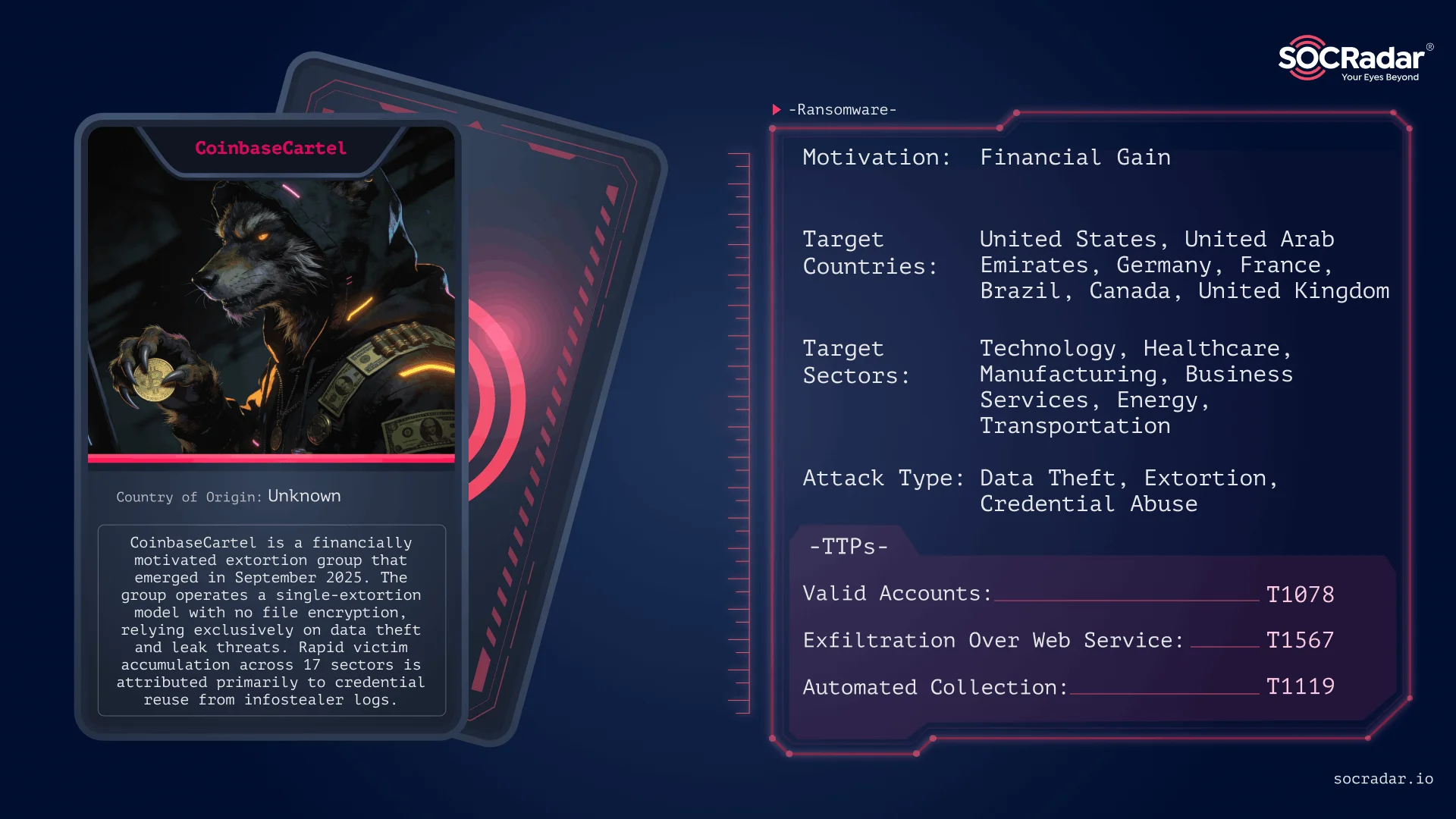
CoinbaseCartel is a financially motivated single-extortion threat actor that emerged in September 2025, stealing data instead of encrypting systems and threatening to leak it unless victims pay. It has claimed more than 160 victims worldwide by reusing stolen credentials and is linked by researchers to groups and tools including ShinyHunters, Scattered Spider, Lapsus$, and the shinysp1d3r alias. #CoinbaseCartel #ShinyHunters #ScatteredSpider #Lapsus$ #shinysp1d3r
Keypoints
- CoinbaseCartel emerged in mid-September 2025 with a Tor-based leak site and an unusually aggressive debut of 10 to 17 victim listings.
- The group uses a single-extortion model: it steals data, threatens publication on its leak site, and does not encrypt victim systems.
- Researchers say CoinbaseCartel has claimed more than 160 victims across 36 countries and 17 industry verticals, with technology, healthcare, and logistics among the top targets.
- Its operations are strongly associated with reused stolen credentials from infostealer logs, along with compromised VPN/RDP access, OAuth abuse, and cloud-service exploitation.
- The group is active in partnerships and affiliate recruitment, but it is not a traditional RaaS operation; it offers fixed-fee and revenue-sharing arrangements.
- CoinbaseCartel has advertised a budget above $2 million USD for zero-day exploits, suggesting strong underground financial resources.
- Researchers have linked the group to the alias shinysp1d3r and hypothesized overlaps with ShinyHunters, Scattered Spider, and Lapsus$, though attribution remains unconfirmed.
MITRE Techniques
- [T1078 ] Valid Accounts – The group reuses stolen credentials from infostealer logs to access corporate cloud environments and services (‘Credentials harvested by malware families such as RedLine, Lumma, and Vidar are reused’).
- [T1078.004 ] Valid Accounts: Cloud Accounts – Stolen cloud credentials are used to authenticate to cloud environments and management consoles (‘authenticate against corporate cloud environments’).
- [T1199 ] Trusted Relationship – CoinbaseCartel is linked to use of initial access brokers and trusted access paths (‘linked to the use of Initial Access Brokers’).
- [T1566.004 ] Phishing: Spearphishing Voice – The MITRE table lists voice phishing as an observed initial access technique (‘Phishing: Spearphishing Voice’).
- [T1059.004 ] Command and Scripting Interpreter: Unix Shell – The group uses built-in admin tools and shell activity for low-noise operations (‘built-in operating system administrative tools’).
- [T1059.006 ] Command and Scripting Interpreter: Python – Custom Python tooling is used to mimic legitimate data export behavior (‘custom Python tooling designed to mimic the legitimate Salesforce Data Loader’).
- [T1136 ] Create Account – Persistence may be established by creating accounts (‘Create Account’).
- [T1098 ] Account Manipulation – The group modifies or abuses accounts for persistence (‘Account Manipulation’).
- [T1003 ] OS Credential Dumping – Listed in the ATT&CK mapping as a privilege escalation method (‘OS Credential Dumping’).
- [T1003.001 ] OS Credential Dumping: LSASS Memory – The table specifically names LSASS memory dumping (‘OS Credential Dumping: LSASS Memory’).
- [T1070 ] Indicator Removal – The group truncates logs and removes traces to hinder investigation (‘truncates log files in bulk’).
- [T1562.002 ] Impair Defenses: Disable Windows Event Logging – CoinbaseCartel disables logging and audit functions (‘disables syslog forwarding, and manipulates system-wide audit settings’).
- [T1090.003 ] Proxy: Multi-hop Proxy – The ATT&CK table lists multi-hop proxying for concealment (‘Multi-hop Proxy’).
- [T1036 ] Masquerading – The table indicates masquerading to blend in with legitimate activity (‘Masquerading’).
- [T1555.003 ] Credentials from Password Stores: Web Browsers – The group targets credentials stored in browsers (‘Credentials from Password Stores: Web Browsers’).
- [T1528 ] Steal Application Access Token – OAuth application abuse is used to obtain tokens for persistent access (‘grant persistent access to cloud environments’).
- [T1580 ] Cloud Infrastructure Discovery – The group identifies cloud assets and repositories to target (‘Cloud Infrastructure Discovery’).
- [T1018 ] Remote System Discovery – It searches for systems and repositories of high value (‘Remote System Discovery’).
- [T1069.002 ] Permission Groups Discovery: Domain Groups – The table lists discovery of privileged groups (‘Permission Groups Discovery: Domain Groups’).
- [T1021.004 ] Remote Services: SSH – Attackers use SSH for lateral movement (‘Remote Services: SSH’).
- [T1021.001 ] Remote Services: Remote Desktop Protocol – RDP is used to move laterally after access (‘Remote Services: Remote Desktop Protocol’).
- [T1021.002 ] Remote Services: SMB/Windows Admin Shares – SMB/admin shares are used for lateral movement (‘Remote Services: SMB/Windows Admin Shares’).
- [T1213 ] Data from Information Repositories – The group collects data from CRM and other repositories (‘Data from Information Repositories’).
- [T1119 ] Automated Collection – Bulk CRM exports and scripted collection are used to gather data (‘enabling bulk CRM exports’).
Indicators of Compromise
- [Malware Families ] Credential sources referenced in the article – RedLine, Lumma, and Vidar
- [Cloud / Platform Services ] Infrastructure used for exfiltration or access – AWS, Google Cloud, Cloudflare, Salesforce, Microsoft 365, and Google Workspace
- [File Transfer / Remote Access Services ] Targeted services for credential reuse – SFTP, FTP, VPN, and RDP
- [Threat Actor Aliases ] Names associated with the group or hypothesized overlaps – shinysp1d3r, ShinyHunters, Scattered Spider, and Lapsus$
- [Data / File Artifacts ] Collected data is staged before theft – large compressed archives, Salesforce Data Loader, and infostealer logs
- [Network / Delivery Channels ] Delivery and concealment channels mentioned – Tor-based leak site, Tor exit nodes, and commercial VPN services
- [Time / Campaign Markers ] Activity timeline and windows referenced – September 15–16, 2025, April 2026, and early 2026
Read more: https://socradar.io/blog/dark-web-profile-coinbasecartel/