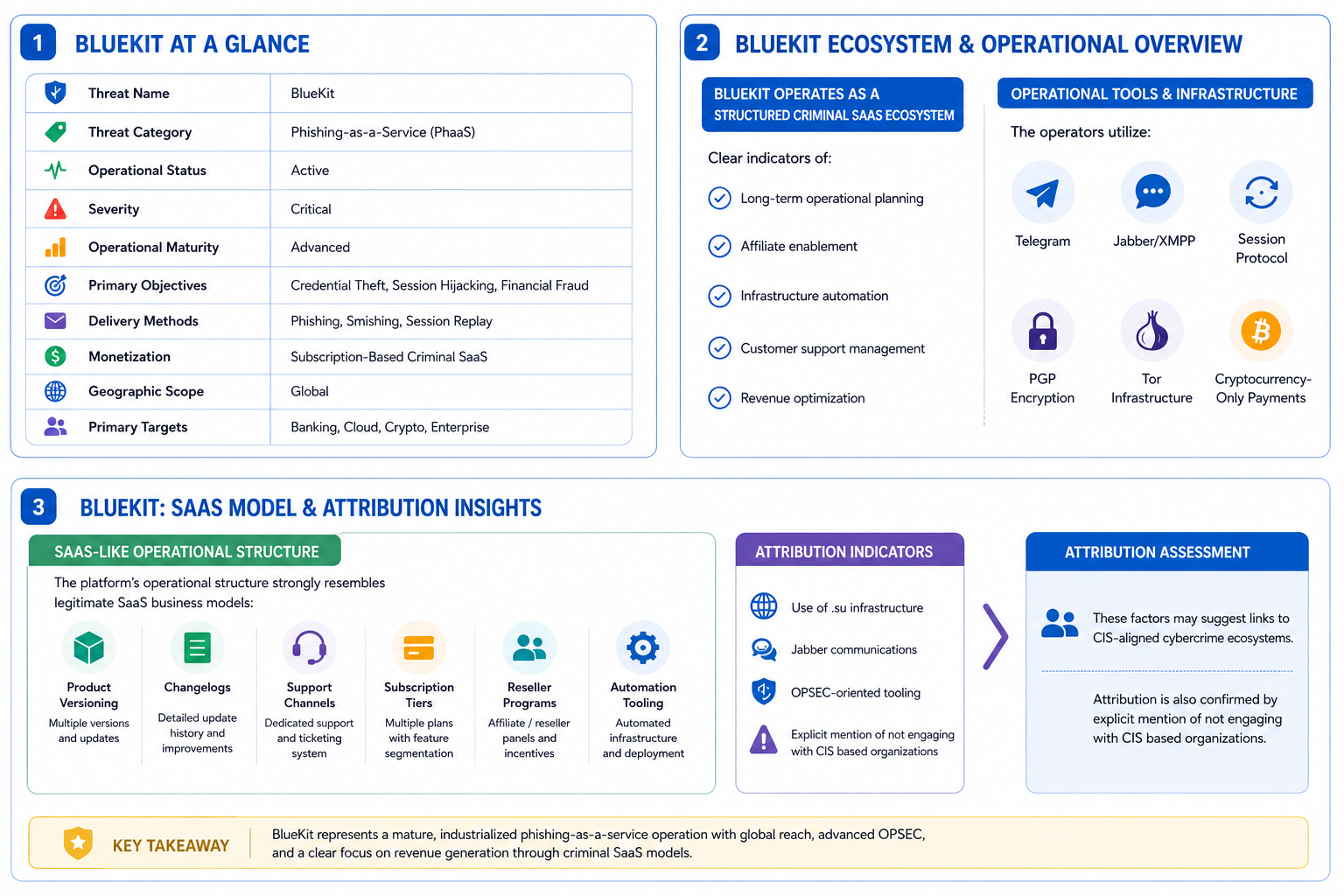
CloudSek TRIAD identified BlueKit, a commercially operated PhaaS platform that provides phishing kits, session hijacking, smishing, and automated account takeover tooling against major cloud, financial, crypto, and e-commerce brands worldwide. The platform uses P2P page rendering, anti-detection controls, reseller support, and cryptocurrency-only monetization to evade analysis and scale operations, with notable exposure across victim data, operator accounts, and payment infrastructure. #BlueKit #CloudSekTRIAD #OctoBrowser #CapSolver #NanoGPT
Keypoints
- BlueKit is an actively operated Phishing-as-a-Service platform discovered through CloudSek TRIAD dark web monitoring.
- The platform targets financial institutions, cloud providers, cryptocurrency services, and major e-commerce brands with phishing templates for global companies.
- BlueKit offers subscription tiers, automated deployment, centralized dashboards, reseller support, and anti-detection tooling to lower the barrier for affiliates.
- A recent P2P phishing page rendering model hides backend infrastructure and makes IOC-based detection and attribution more difficult.
- The platform supports session hijacking, account takeover, smishing, and post-compromise automation such as password resets and passkey enrollment.
- Investigation exposed sensitive platform data, including operator credentials, victim records, WebAuthn credentials, and cryptocurrency payment records.
- BlueKit accepts only cryptocurrency payments and uses infrastructure, communications, and OPSEC patterns that may align with CIS-linked cybercrime ecosystems.
MITRE Techniques
- [T1566 ] Phishing – BlueKit uses phishing kits and brand impersonation to harvest credentials and session data through email, cloud, and smishing lures. [‘phishing templates for multiple global brands’]
- [T1185 ] Browser Session Hijacking – The platform captures session cookies and imports them into anti-detect browser workflows to replay authenticated sessions. [‘captures credentials, authentication tokens, and session cookies’]
- [T1110 ] Brute Force – Not directly brute force against accounts, but the platform supports credential harvesting at scale and automated post-capture workflows to exploit stolen logins. [‘large-scale credential harvesting’]
- [T1071.001 ] Web Protocols – BlueKit uses web-based phishing infrastructure and centralized dashboards to deliver and manage campaigns over HTTP/S-like web traffic. [‘centralized management dashboards’, ‘phishing page rendering model’]
- [T1090 ] Proxy – The platform stores configured proxy lists and uses proxy/VPN blocking to control access and obscure operator or victim traffic. [‘Configured proxy list’, ‘proxy/VPN blocking flag’]
- [T1583.001 ] Acquire Infrastructure: Domains – BlueKit operates multiple clearnet domains and a Tor onion service to host its phishing ecosystem. [‘Clearnet domains: bluekit[.]ws, bluekit[.]cc, bluekit[.]su, bluekit[.]pk’]
- [T1583.006 ] Acquire Infrastructure: Web Services – The operators rely on Cloudflare, Luxhost, CapSolver, NanoGPT, and Octo Browser as part of the phishing service stack. [‘DNS Provider Cloudflare’, ‘Registrar Integration Luxhost’, ‘CAPTCHA Solver CapSolver’]
- [T1027 ] Obfuscated Files or Information – The P2P rendering approach is designed to hide backend phishing infrastructure and evade conventional analysis. [‘obscure the phishing server origin from browser developer tools’]
- [T1650 ] Acquire Access via Application API – Reseller and distributor records expose API credentials and third-party service integrations used to run the platform. [‘platform-level API credentials’, ‘LuxHost API key’]
- [T1056.001 ] Keylogging – BlueKit collects identifiers, passwords, URLs, and credential artifacts from victim workflows, consistent with credential capture behavior. [‘latestIdentifier’, ‘latestPassword’, ‘latestUrl’]
- [T1552.001 ] Credentials in Files – The exposed database includes stored passwords, WebAuthn credentials, and operator authentication artifacts. [‘Argon2id password hash’, ‘Raw WebAuthn credential’]
- [T1113 ] Screen Capture – The article references victim dashboards and automated workflow views, but this is not directly evidenced; therefore the closest relevant behavior is credential and session capture. [‘victim data’, ‘authentication artifacts’]
Indicators of Compromise
- [Domains] BlueKit clearnet and Tor infrastructure – bluekit[.]ws, bluekit[.]cc, bluekit[.]su, bluekit[.]pk, bluekitsmi6sd5mjurh3l7n7oeizbedoe2hw2lsljtb5nbxiul6hzkqd[.]onion
- [DNS/Nameservers] Cloudflare-hosted nameservers for the platform – fish.ns.cloudflare.com, osmar.ns.cloudflare.com
- [Tokens/IDs] Platform and analytics identifiers exposed in infrastructure – 2f08ce5a60ec42ffaaac4c46ba18bac8, si5xclgoe0pl5yd5zsfaik8k
- [API Keys/Credentials] Reseller and service credentials exposed in distributor records – LuxHost API key, Capsolver API key, NanoGPT API key
- [File/Template IDs] Phishing template and wallet workflow identifiers – z8di9wjjsl6qn402zu3zfz9y, zk5ixc0p1qiqhd1qpr03l4ej, zd0dqf1yxwggrxjqegmm0dqu
- [Usernames/Service Handles] Operator communication and support channels – Telegram, Jabber/XMPP, PGP encryption, Tor infrastructure
- [Databases/Tables] Exposed platform tables and datasets – mammoths, customers, sites_settings, webauthn_credentials, deposits, distributors
Read more: https://www.cloudsek.com/blog/bluekit-phishing-as-a-service-phaas