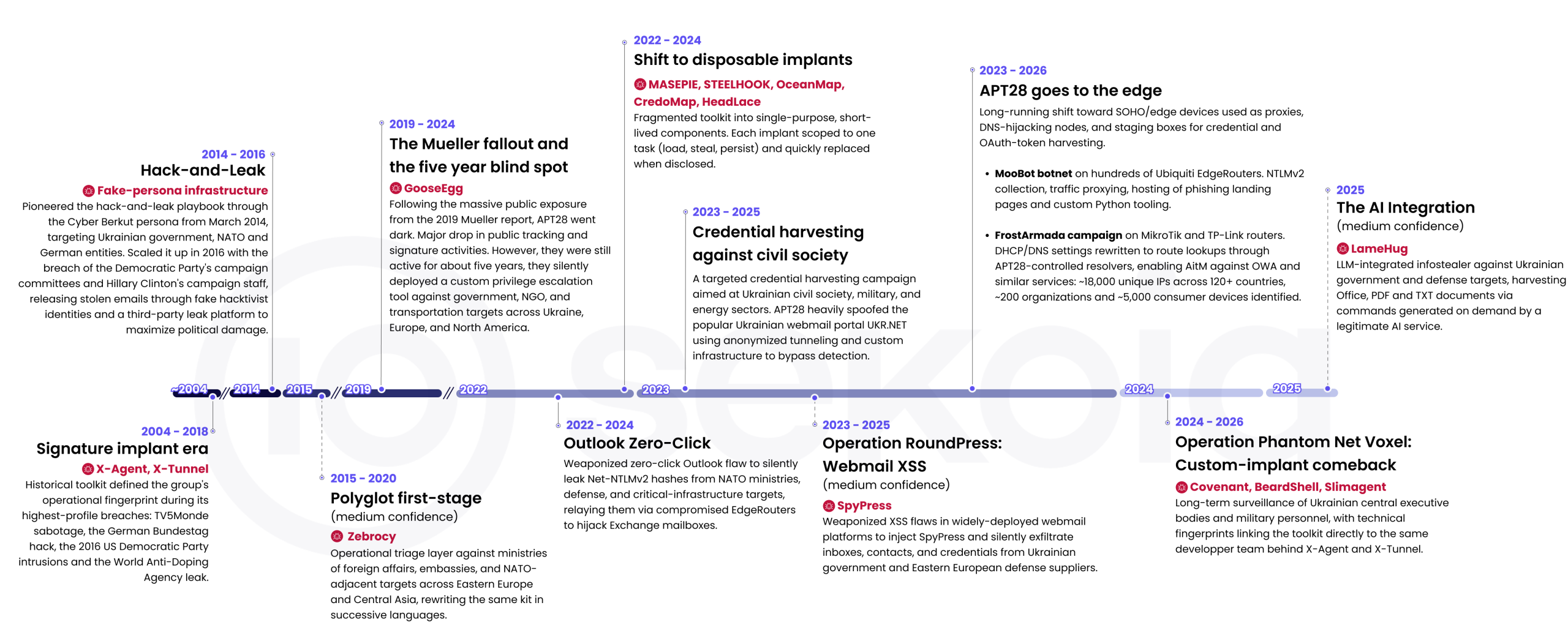
APT28, also known as Fancy Bear and linked to GRU Unit 26165, has evolved over two decades from the X-Agent/X-Tunnel implant era into fragmented disposable modules, edge-router infrastructure, cloud-based C2, and even an LLM-driven infostealer. The report highlights major campaigns such as Operation Phantom Net Voxel, RoundPress, FrostArmada, and LameHug, showing sustained targeting of Ukrainian, NATO, government, defense, and critical-infrastructure victims. #APT28 #FancyBear #GRUUnit26165 #OperationPhantomNetVoxel #RoundPress #FrostArmada #LameHug
Keypoints
- APT28 has operated for more than two decades and is publicly attributed to GRU Unit 26165.
- Its early tradecraft centered on the X-Agent and X-Tunnel toolkit, used in major intrusions such as TV5Monde, Bundestag, and the 2016 US election-related breaches.
- The group popularized a hack-and-leak playbook, using fake personas like Cyber Berkut to amplify political damage.
- Between 2022 and 2024, APT28 shifted to disposable single-purpose implants and exploited Outlook CVE-2023-23397 to steal Net-NTLMv2 hashes.
- The actor increasingly used compromised edge devices, including Ubiquiti, MikroTik, and TP-Link routers, for proxying, phishing, and credential harvesting.
- Operation Phantom Net Voxel marked a return to custom implants, cloud-based command-and-control, and direct lineage to older APT28 tooling.
- LameHug shows APT28 experimenting with AI-assisted malware that delegates command generation to an LLM.
MITRE Techniques
- [T1566.001] Spearphishing Attachment – Delivered malware and lures through malicious email attachments and documents, including Office files and PDFs (‘spear phishing campaigns… delivered the Seduploader first stage’ and ‘weaponised Office documents through private Signal Desktop chats’).
- [T1190] Exploit Public-Facing Application – Used webmail XSS flaws and Outlook flaws to gain access or trigger exfiltration (‘weaponized XSS flaws in widely-deployed webmail platforms’ and ‘weaponised the zero-click Outlook flaw CVE-2023-23397’).
- [T1055] Process Injection – Deployed Covenant in memory during the Phantom Net Voxel chain (‘stages a customised Covenant framework deployment in memory’).
- [T1021.006] Remote Services: Windows Remote Management / SMB-based authentication abuse – Forced Outlook clients to authenticate to attacker-controlled SMB shares and relayed hashes (‘Crafted Outlook reminders force the client to authenticate to attacker-controlled SMB shares’).
- [T1110] Brute Force – Harvested and reused credentials at scale through credential-stealing operations (‘credential harvesting campaign’ and ‘harvesting credentials for later reuse’).
- [T1003] OS Credential Dumping – Used Mimikatz and harvested Net-NTLMv2 hashes and browser credentials (‘Mimikatz for credential theft’ and ‘capture Net-NTLMv2 hashes’).
- [T1041] Exfiltration Over C2 Channel – Exfiltrated stolen data, inbox contents, and credentials to attacker infrastructure (‘silently exfiltrate inboxes, contacts, and credentials’ and ‘exfiltrated over SFTP or HTTP’).
- [T1027] Obfuscated Files or Information – Used encoded prompts and multi-language rewrites to conceal payload logic (‘base64-encoded natural-language prompts’ and ‘rewritten across many languages’).
- [T1090] Proxy – Relayed traffic and hashes through compromised routers and EdgeRouters (‘relaying them via compromised EdgeRouters’ and ‘traffic proxying’).
- [T1098] Account Manipulation – Enabled IMAP and stored app passwords after 2FA bypass (‘validates the second factor, enables IMAP, stores the new app password’).
- [T1105] Ingress Tool Transfer – Downloaded and staged components such as loaders, backdoors, and Python scripts (‘Python downloader’ and ‘staging custom Python scripts’).
- [T1546.007] Event Triggered Execution: Netsh Helper DLL / WMI? – Not explicitly present; omitted.
- [T1053] Scheduled Task/Job – Not explicitly mentioned in the article; omitted.
Indicators of Compromise
- [Malware / Tool names ] APT28 implant and loader families – X-Agent, X-Tunnel, and GooseEgg
- [Malware / Tool names ] Disposable modules and newer tooling – MASEPIE, STEELHOOK, OceanMap, CredoMap, HeadLace, SpyPress, Covenant, BeardShell, Slimagent, LameHug
- [Vulnerabilities ] Exploited flaws and CVEs – CVE-2023-23397, CVE-2022-38028
- [Cloud / Web services ] C2, exfiltration, and collection endpoints – Koofr, icedrive, Filen, Hugging Face Inference API, Pipedream, Webhook.site
- [Router / edge infrastructure ] Abused devices and platforms – Ubiquiti EdgeRouters, MikroTik routers, TP-Link routers
- [Organizations / platforms ] Targeted services and organizations – UKR.NET, Microsoft Exchange, Outlook, Roundcube, Horde, MDaemon, Zimbra
- [Campaign names ] Named operations – Operation Phantom Net Voxel, Operation RoundPress, FrostArmada, Operation Dying Ember
- [File / artifact names ] Delivered or referenced artifacts – Office documents, PDFs, TXT documents, PDF with shortened URLs
Read more: https://blog.sekoia.io/apt28-an-evolution-of-tradecraft/