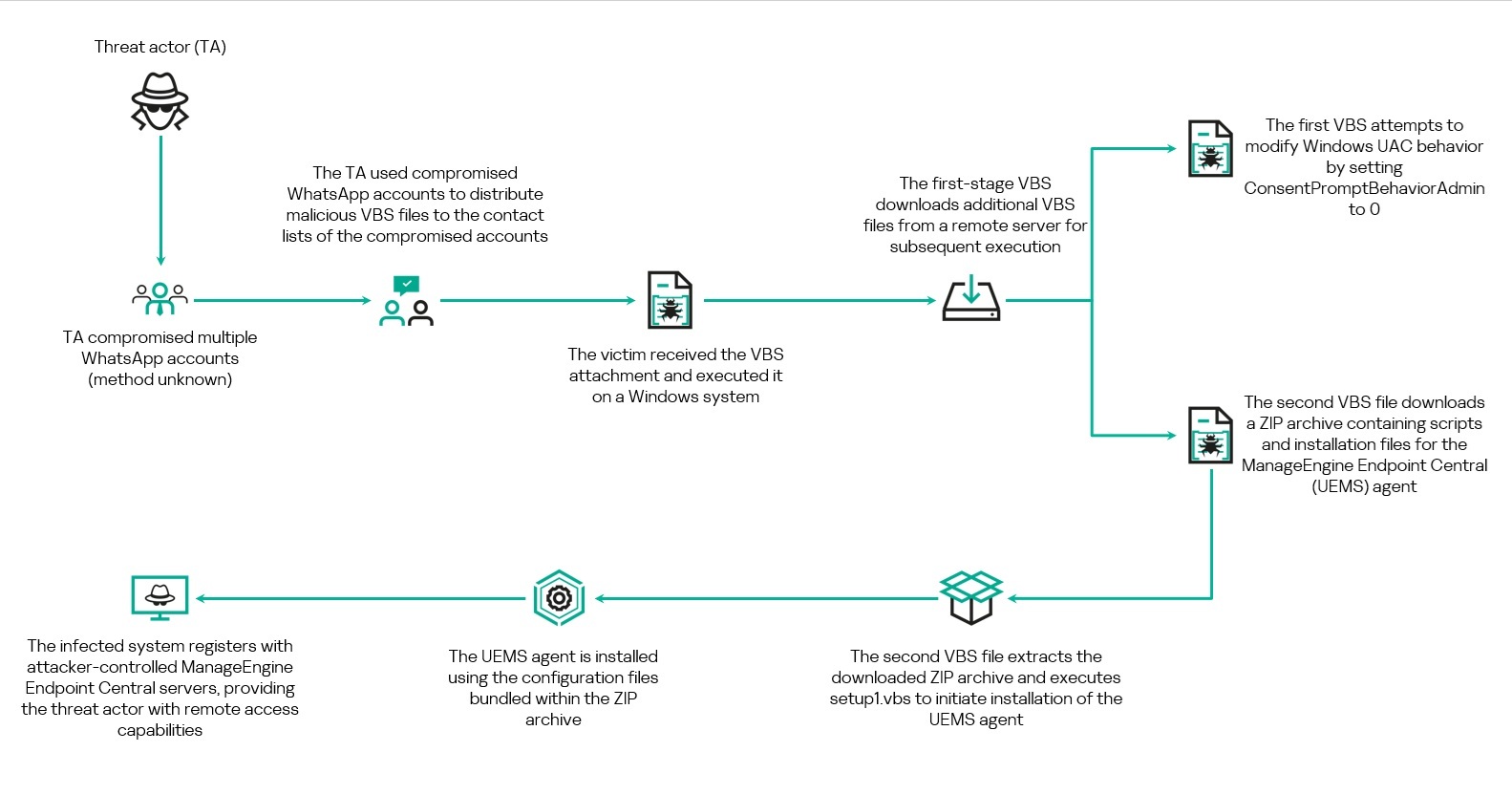
A June 2026 campaign spread malicious VBScript attachments through WhatsApp direct messages to users in multiple countries, with Malaysia seeing the highest number of victims. The scripts used financial-themed lures and a multi-stage infection chain that ended with the silent installation of ManageEngine Endpoint Central for remote access. #WhatsApp #ManageEngineEndpointCentral
Keypoints
- Malicious VBScript files were distributed through WhatsApp direct messages in an active June 2026 campaign.
- Victims were observed across Malaysia, Brazil, India, Mexico, Singapore, the UK, Spain, Taiwan, Australia, Russia, and Vietnam, with the largest share in Malaysia.
- The threat actor used deceptive, finance-related file names such as invoices, statements, debt notices, and payment records to trick users into opening attachments.
- Initial execution was triggered through WhatsApp Desktop or WhatsApp Web, with WScript.exe launching the first-stage script.
- The infection chain downloaded additional VBScript payloads, attempted UAC-related registry changes, and ultimately installed a ZIP-bundled ManageEngine Endpoint Central agent.
- Several artifacts, including Chinese comments and infrastructure overlap with ValleyRAT/Gh0st RAT-associated IPs, suggest possible Chinese-speaking involvement but no firm attribution.
- The campaign abused compromised WhatsApp accounts to send attachments to contacts, and it remained active at the time of reporting.
MITRE Techniques
- [T1204.002 ] User Execution: Malicious File – The user had to open the attachment in WhatsApp Desktop or WhatsApp Web for the infection to begin, using deceptive file names like “Financial Reports.vbs” and “Debt confirmation.vbs” (‘When the user first clicks the attachment…it is downloaded to their machine’ and ‘deceptive file names designed to appear as legitimate business and financial documents’).
- [T1059.005 ] Command and Scripting Interpreter: Visual Basic – The campaign relied on VBScript/VBE files as the primary malware format and execution method (‘the script creates a working directory…downloads two additional VBScript payloads’ and ‘the malware was being distributed…malicious VBScript files’).
- [T1105 ] Ingress Tool Transfer – Stage 1 and Stage 2 scripts downloaded additional payloads and ZIP content from attacker-controlled infrastructure (‘downloads two additional VBScript payloads from a remote infrastructure’ and ‘downloads a ZIP archive, extracts its contents’).
- [T1027 ] Obfuscated Files or Information – The scripts used string concatenation, encoded VBScript, randomized variable names, junk content, and heavy obfuscation to hide functionality (‘string concatenation, encoded VBScript, randomized variable names, and large amounts of junk content’).
- [T1218.011 ] System Binary Proxy Execution: Rundll32/Windows Script Host? – The malware used Windows Script Host to execute script files (‘the VBScript is launched through Windows Script Host (WScript.exe)’).
- [T1036 ] Masquerading – The files and comments impersonated legitimate business documents and Windows Update components (‘appears as legitimate business and financial documents’ and ‘mimic legitimate Microsoft Windows Update components’).
- [T1112 ] Modify Registry – One Stage 2 script repeatedly attempted to change the ConsentPromptBehaviorAdmin registry value to weaken UAC prompts (‘attempting to modify the ConsentPromptBehaviorAdmin registry value’).
- [T1548.002 ] Abuse Elevation Control Mechanism: Bypass User Account Control – The script used runas and registry changes in an attempt to enable administrative actions without consent prompts (‘ShellExecute method with the runas verb’ and ‘set…value to 0, thus enabling administrative actions without displaying a consent prompt’).
- [T1574.002 ] Hijack Execution Flow: DLL Search Order Hijacking? – Not clearly supported.
- [T1053 ] Scheduled Task/Job – Not mentioned.
- [T1113 ] Screen Capture – Not mentioned.
- [T1219 ] Remote Access Software – The final stage installed the legitimate ManageEngine Endpoint Central RMM agent to provide remote access and administration (‘installation of remote monitoring and management software’ and ‘enabling remote access to the victim’s system’).
- [T1505.001 ] Server Software Component: SQL Stored Procedures? – Not mentioned.
- [T1110 ] Brute Force – Not mentioned.
- [T1555 ] Credentials from Password Stores – Compromised WhatsApp accounts were used, but no direct credential theft method was described (‘the threat actor had gained access to several WhatsApp accounts’).
- [T1078 ] Valid Accounts – The campaign used compromised WhatsApp accounts to send malicious attachments to contacts (‘had gained access to several WhatsApp accounts and used them to distribute the malicious VBScript files’).
Indicators of Compromise
- [File names ] Malicious WhatsApp attachments and staged scripts – Financial Reports.vbs, Debt confirmation.vbs, and other themed VBS/VBE/TXT payload names
- [File paths ] Execution and staging locations – C:UsersPublicDocuments, C:WindowsSystem32WScript.exe, and WhatsApp Desktop transfer directories under AppDataLocalPackages5319275A.WhatsAppDesktop_cv1g1gvanyjgm
- [IP addresses ] Endpoint Central management infrastructure and related overlap – 202.61.160[.]208, 202.61.160[.]201, and 38.55.151[.]63
- [Domains ] Attacker-controlled download infrastructure – temu.baskwms[.]top, invoice.msopsa[.]top, and baoxis[.]cc
- [Archives and installers ] Stage 3 deployment package – UEMSAgent.msi, UEMSAgent.mst, and setup1.vbs within the ZIP archive
- [Certificates and config files ] Endpoint Central package contents – DMRootCA.crt, DMRootCA-Server.crt, and DCAgentServerInfo.json
- [Executable names ] Download and execution utilities – curl.exe, bitsadmin.exe, certutil, msiexec.exe, and explorer.exe
- [Hashes ] Numerous sample hashes were provided for VBS files – c7f38cbb99c8b74fa0465293feeba700, b7cd06c71465038b658a6dc1f273a507, and 2 more hashes
Read more: https://securelist.com/whatsapp-vbs-rmm-campaign/120290/