ESET discovered CVE-2025-8088, a WinRAR path traversal zero-day abused in spearphishing campaigns by the Russia-aligned group RomCom to deploy backdoors (Mythic agent, SnipBot variant, RustyClaw/MeltingClaw) to targets in Europe and Canada. WinRAR patched the issue in version 7.13 after disclosure; users and software relying on UnRAR components should update immediately. #CVE-2025-8088 #RomCom #Mythic #SnipBot #RustyClaw #MeltingClaw
Keypoints
- ESET discovered a WinRAR zero-day (CVE-2025-8088) on July 18, 2025, exploiting alternate data streams for path traversal.
- The vulnerability allowed malicious ADSes in RAR archives to silently deploy DLLs and LNK files when extracted.
- RomCom (aka Storm-0978/UNC2596) used spearphishing RAR attachments targeting finance, manufacturing, defense, and logistics in Europe and Canada.
- Delivered payloads included a Mythic agent, a SnipBot variant, and RustyClaw/MeltingClaw downloaders, using COM hijacking, LNK persistence, and various C2 domains.
- ESET advised immediate updating to WinRAR 7.13 and warned that UnRAR.dll/source-dependent software is also affected.
- RomCom has a history of exploiting zero-days (CVE-2023-36884, CVE-2024-9680/CVE-2024-49039) and was attributed with high confidence based on TTPs and malware.
- IoCs include multiple malicious archive hashes, filenames (msedge.dll, ApbxHelper.exe, Complaint.exe, install_module_x64.dll), and C2 domains/IPs such as srlaptop[.]com, campanole[.]com, gohazeldale[.]com.
MITRE Techniques
- [T1583 ] Acquire Infrastructure – RomCom sets up VPSes and registers domains to support C2 and delivery (“RomCom sets up VPSes and buys domain names.”).
- [T1587.001 ] Develop Capabilities: Malware – RomCom develops malware in multiple languages (“RomCom develops malware in multiple programming languages.”).
- [T1587.004 ] Develop Capabilities: Exploits – RomCom may develop exploits used for initial compromise (“RomCom may develop exploits used for initial compromise.”).
- [T1588.005 ] Obtain Capabilities: Exploits – RomCom may acquire exploits used for initial compromise (“RomCom may acquire exploits used for initial compromise.”).
- [T1588.006 ] Obtain Capabilities: Vulnerabilities – RomCom may obtain vulnerability information for targeting (“RomCom may obtain information about vulnerabilities that it uses for targeting victims.”).
- [T1608 ] Stage Capabilities – RomCom stages malware on multiple delivery servers (“RomCom stages malware on multiple delivery servers.”).
- [T1566.001 ] Phishing: Spearphishing Attachment – Campaigns delivered weaponized RAR attachments as CV/spearphishing (“RomCom compromises victims with a malicious RAR attachment sent via spearphishing.”).
- [T1204.002 ] User Execution: Malicious File – Victims are lured to open a RAR that exploits WinRAR to run malicious files (“RomCom lures victims into opening a weaponized RAR archive containing an exploit.”).
- [T1547.001 ] Boot or Logon Autostart Execution: Registry Run Keys / Startup Folder – LNK files are placed in the Startup folder for persistence (“For persistence, RomCom stores a LNK file in the Startup folder.”).
- [T1546.015 ] Event Triggered Execution: Component Object Model Hijacking – COM hijacking via CLSID/InprocServer32 to load msedge.dll (“RomCom hijacks CLSIDs for persistence.”).
- [T1497 ] Virtualization/Sandbox Evasion – Samples check RecentDocs count before executing shellcode to evade sandboxes (“RomCom detects virtual environments by checking for enough RecentDocs.”).
- [T1480 ] Execution Guardrails – Malware checks hardcoded domain and other guards to avoid non-targets (“RomCom stops execution if running in a virtual environment. It also checks for a hardcoded domain name before executing.”).
- [T1036.001 ] Masquerading: Invalid Code Signature – Actors use invalid code-signing certificates to appear legitimate (“RomCom tries to appear more legitimate to users and security tools that improperly handle digital signatures.”).
- [T1027.007 ] Obfuscated Files or Information: Dynamic API Resolution – Malware decrypts and resolves APIs dynamically (“RomCom decrypts and resolves API dynamically.”).
- [T1027.013 ] Obfuscated Files or Information: Encrypted/Encoded File – Shellcode and strings are encrypted/encoded and decrypted at runtime (“RomCom decrypts shellcode based on filename and machine artifacts.”).
- [T1555.003 ] Credentials from Password Stores: Credentials from Web Browsers – Backdoor collects passwords/cookies via a browser stealer module (“The RomCom backdoor collects passwords, cookies, and sessions using a browser stealer module.”).
- [T1552.001 ] Unsecured Credentials: Credentials In Files – Backdoor collects credentials from files during reconnaissance (“The RomCom backdoor collects passwords using a file reconnaissance module.”).
- [T1087 ] Account Discovery – Backdoor collects usernames, computer, and domain data (“The RomCom backdoor collects username, computer, and domain data.”).
- [T1518 ] Software Discovery – Backdoor enumerates installed software and versions (“The RomCom backdoor collects information about installed software and versions.”).
- [T1021 ] Remote Services – Backdoor creates SSH tunnels for lateral movement (“The RomCom backdoor creates SSH tunnels to move laterally within compromised networks.”).
- [T1560 ] Archive Collected Data – Collected data is packaged into ZIP archives for exfiltration (“The RomCom backdoor stores data in a ZIP archive for exfiltration.”).
- [T1185 ] Man in the Browser – Backdoor steals browser cookies, history, and saved passwords (“The RomCom backdoor steals browser cookies, history, and saved passwords.”).
- [T1005 ] Data from Local System – Backdoor collects files by extension from the local system (“The RomCom backdoor collects specific file types based on file extensions.”).
- [T1114.001 ] Email Collection: Local Email Collection – Backdoor collects .msg/.eml/.email files (“The RomCom backdoor collects files with .msg, .eml, and .email extensions.”).
- [T1113 ] Screen Capture – Backdoor takes screenshots of the victim’s computer (“The RomCom backdoor takes screenshots of the victim’s computer.”).
- [T1071.001 ] Application Layer Protocol: Web Protocols – C2 uses HTTP/HTTPS for communications (“The RomCom backdoor uses HTTP or HTTPS as a C&C protocol.”).
- [T1573.002 ] Encrypted Channel: Asymmetric Cryptography – Communications encrypted using SSL certificates (“The RomCom backdoor encrypts communication using SSL certificates.”).
- [T1041 ] Exfiltration Over C2 Channel – Data exfiltration occurs over HTTPS C2 channels (“The RomCom backdoor exfiltrates data using the HTTPS C&C channel.”).
- [T1657 ] Financial Theft – Operations target companies for financial gain (“RomCom compromises companies for financial interest.”).
Indicators of Compromise
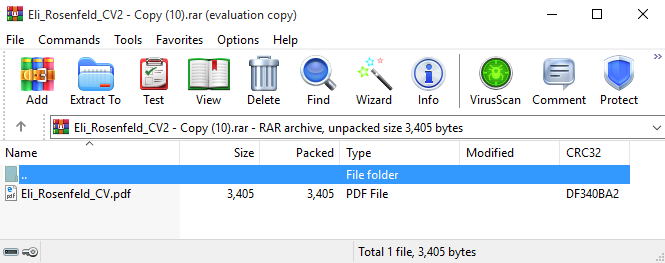
- [File Hash ] Malicious archives and payloads – 371A5B8BA86FBCAB80D4E0087D2AA0D8FFDDC70B (Adverse_Effect_Medical_Records_2025.rar), F77DBA76010A9988C9CEB8E420C96AEBC071B889 (Eli_Rosenfeld_CV2 – Copy (10).rar), and other hashes listed.
- [File Name ] Deployed binaries used in chains – msedge.dll (Mythic agent), ApbxHelper.exe (SnipBot variant), Complaint.exe (RustyClaw), install_module_x64.dll (MeltingClaw, SHA-1 01D32FE88ECDEA2B934A00805E138034BF85BF83).
- [Domain ] C2 and download hosts – srlaptop[.]com (Mythic C2), campanole[.]com (SnipBot variant), gohazeldale[.]com / 162.19.175[.]44 (MeltingClaw C2), and 85.158.108[.]62 (melamorri[.]com RustyClaw C2).
- [IP Address ] Hosting for C2 infrastructure – 162.19.175[.]44 (gohazeldale[.]com OVH SAS), 194.36.209[.]127 (srlaptop[.]com), and 185.173.235[.]134 (campanole[.]com).
- [Filename in Archive ] LNK persistence artifacts – Updater.lnk, Display Settings.lnk, Settings.lnk used to trigger DLL/EXE execution from Startup or %LOCALAPPDATA%.