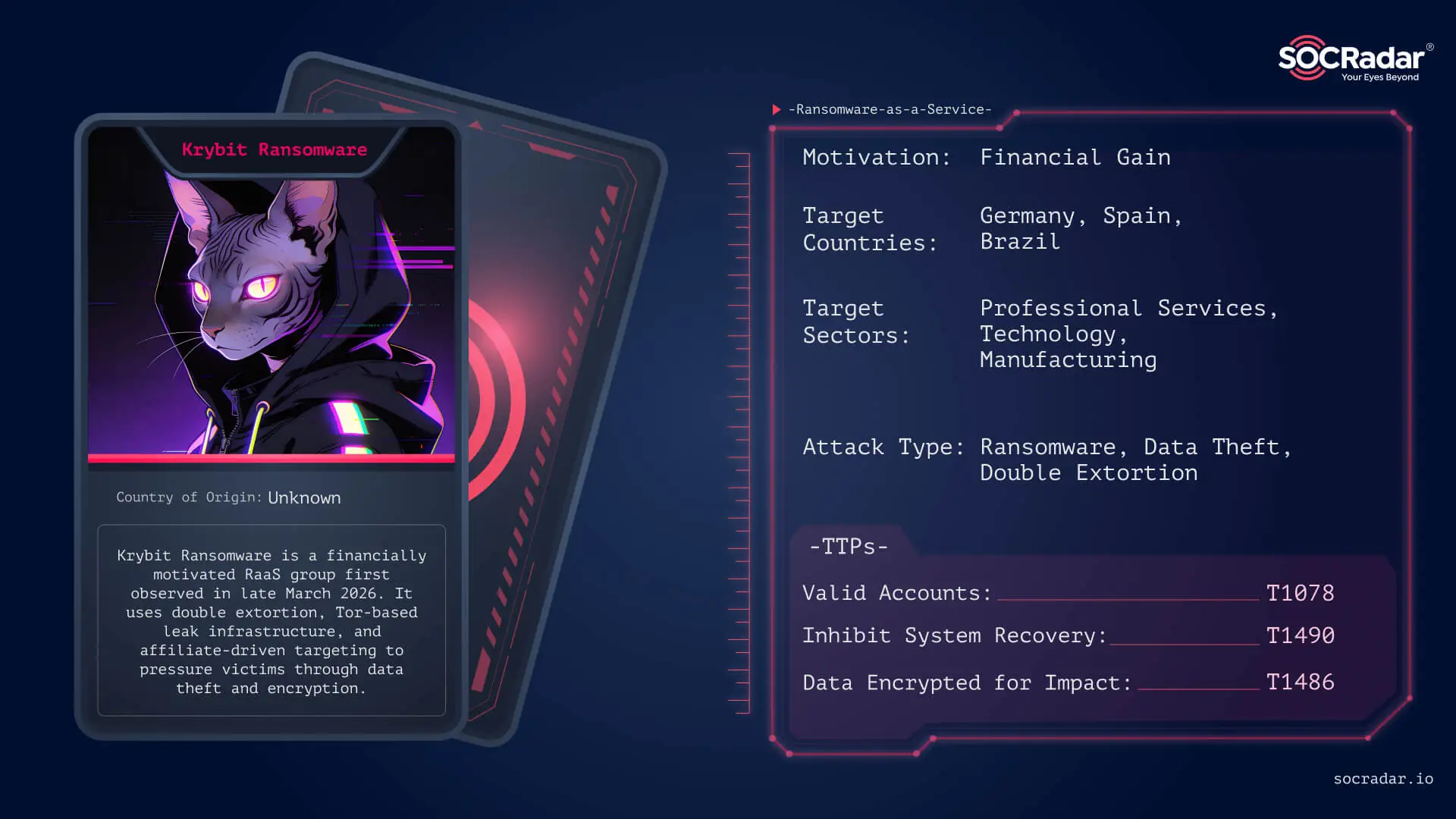
Krybit is a young Ransomware-as-a-Service operation that uses double extortion, Tor-based infrastructure, and a broad affiliate model to target organizations across many countries and industries. Its early exposure through a feud with 0APT revealed leaked panel data, wallet addresses, and Tox IDs, while the group continued posting victims and operating after the clash. #Krybit #0APT #Babuk #Tor #Tox
Keypoints
- Krybit first appeared in late March 2026 and was independently detected on April 3, 2026.
- The group runs a Ransomware-as-a-Service program with an 80/20 revenue split favoring affiliates.
- Krybit uses double extortion, stealing data before encrypting systems and pressuring victims through a Tor-based data leak site.
- A rival operator, 0APT, breached Krybit’s affiliate panel in April 2026 and exposed internal data, including credentials, wallets, and user roles.
- Krybit retaliated by compromising 0APT’s server and defacing its leak site, turning the incident into a public ransomware-on-ransomware conflict.
- The group targets organizations broadly across 43 countries and multiple sectors, including Professional Services, Technology, and Manufacturing.
- Despite the leak, Krybit continued operating and had 70 attributed victims listed in live tracking by the time of reporting.
MITRE Techniques
- [T1078 ] Valid Accounts – Affiliates use compromised credentials to gain access, with reporting noting ‘compromised credentials’ and ‘Valid Accounts’ as common entry points.
- [T1021.001 ] Remote Services: Remote Desktop Protocol – Initial access is often through RDP, described as ‘Remote Desktop Protocol (RDP) as common entry points.’
- [T1059 ] Command and Scripting Interpreter – Krybit uses script-based execution, with researchers noting ‘script-based execution.’
- [T1547 ] Boot or Logon Autostart Execution – Persistence is achieved through ‘Boot or Logon Autostart Execution.’
- [T1037 ] Boot or Logon Initialization Scripts – Persistence also uses ‘Boot or Logon Initialization Scripts.’
- [T1562 ] Impair Defenses – Research describes ‘obfuscation, process injection, and abuse of legitimate system processes’ to evade defenses.
- [T1071 ] Application Layer Protocol – Victim communications and leak-site activity are routed through Tor hidden services, using ‘Application Layer Protocol’ for control and communication.
- [T1105 ] Ingress Tool Transfer – Krybit uses Tor-based infrastructure to move data and tools, mapped to ‘Ingress Tool Transfer.’
- [T1041 ] Exfiltration Over C2 Channel – Staged victim data is exfiltrated through the command-and-control channel, with ’10–250GB of staged data per victim’ documented.
- [T1490 ] Inhibit System Recovery – Before encryption, Krybit runs ‘vssadmin.exe delete shadows /all /quiet’ to delete shadow copies.
- [T1486 ] Data Encrypted for Impact – The payload encrypts files and appends the ‘.KRYBIT’ extension, described as ‘Data Encrypted for Impact.’
Indicators of Compromise
- [File names / extensions ] Victim encryption artifacts – .KRYBIT, RECOVER-README.txt
- [Tor domains ] Krybit data leak sites – krybieodq754vlwufrsuxaswxb5zpxyibaawmed2jaduoz2e5m56hmid[.]onion, krybitqsdzwmhnitvwuhvsntfgf2wrhxveyxroxpc44c6gkft2cqldyd[.]onion, and other 3 .onion domains
- [Bitcoin wallet addresses ] Wallets identified in the leaked panel database – bc1ql2f3mhw6yxammrs9ufklpqf9qlcwrr85u72v4h, bc1q5fvym0l0vvzhenhynzduf3qyp85zjdsrn7j8ju, and other 3 wallets
- [Tox messenger IDs ] Operator and affiliate communications – F65E1621B7A5DC0139FE108B9CD48404082951E7E7F421A07A7B88A8E8111C13C552EA2B0C4C, 48B547A7A6195593B9158E4B6160ED0310B2F9AD080992D44EA299878DCCD0551CC7CAD168CD, and other 5 IDs
Read more: https://socradar.io/blog/dark-web-profile-krybit-ransomware/