Multi-factor authentication (MFA) is widely adopted and effective but not foolproof against modern cyber threats like phishing and social engineering. Organizations are increasingly turning to advanced, phishing-resistant authentication methods and identity threat detection to strengthen security. #FIDO2 #YubiKey…
Tag: CRITICAL INFRASTRUCTURE

These vulnerabilities in Rockwell Automation Verve Asset Manager could allow attackers to access sensitive data stored in environment variables and during playbook execution. The issues impact various versions and are associated with insecure storage practices—highlighting the importance of securing industrial control systems. #RockwellAutomation #VerveAssetManager…

The UK’s NCSC warns that Russian-aligned hacktivist groups are intensifying their disruptive cyberattacks on British organizations, particularly targeting critical infrastructure and local government. Organizations are advised to strengthen their defenses against denial-of-service (DoS) attacks and improve resilience through practical mitigation measures. #NoName05716 #DDoSia #UKNCSC…

SentinelLABS’ analysis finds that current LLM benchmarks from major players reduce continuous, collaborative security work to isolated, static tasks and therefore do not measure the operational outcomes defenders need. Benchmarks such as Microsoft’s ExCyTIn-Bench, Meta’s CyberSOCEval/CyberSecEval 3, and CTIBench show LLMs struggle with multi-hop investigations, poor calibration on severity, and evaluation loops that rely on vendor models to judge vendor models. #ExCyTIn-Bench #CyberSOCEval

The European Commission has proposed new cybersecurity legislation aimed at removing high-risk foreign suppliers and enhancing defenses against cyber threats targeting critical infrastructure. This legislation seeks to strengthen Europe’s technological sovereignty and improve the security of ICT supply chains and telecommunications networks. #Huawei #ZTE #ENISA #CybersecurityAct #EUCriticalInfrastructure

Two critical vulnerabilities in the open-source chatbot framework Chainlit could allow attackers to access sensitive data, including API keys and internal files. These flaws impact versions prior to 2.9.4 and pose risks of data leaks, privilege escalation, and lateral movement within cloud environments. #CVE-2026-22218 #CVE-2026-22219 #Chainlit #CloudSecurity…
The European Union plans to phase out equipment from high-risk countries, likely targeting Chinese companies like Huawei and ZTE, from critical infrastructure within three years. These measures aim to strengthen cybersecurity and reduce dependency on foreign technology amid geopolitical concerns. #Huawei #ZTE…
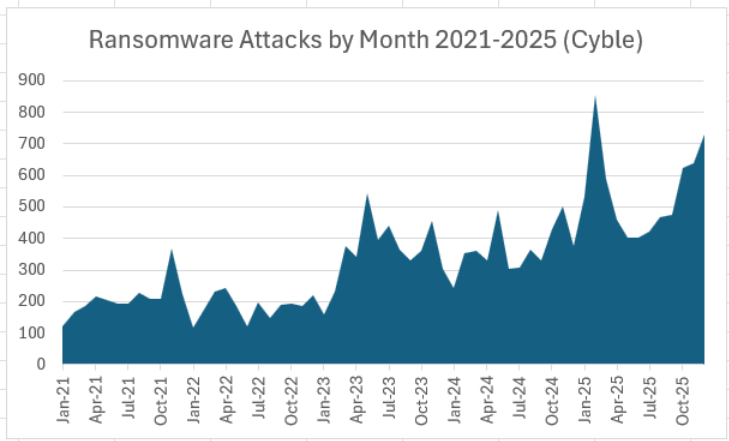
Ransomware and supply chain attacks reached record levels in 2025, with significant increases indicating increasing cyber threats for 2026. The rise in attack sophistication and new threat groups highlights the need for enhanced cybersecurity measures. #Qilin #SupplyChainAttacks…

The U.K. government warns of ongoing DDoS attacks linked to Russian-aligned hacktivist groups targeting critical infrastructure and government services. Despite law enforcement disruptions, these hackers remain active, posing significant operational threats. #NoName057(16) #OperationEastwood

Cyble’s 2025 Threat Landscape Report highlights the resilience and evolution of cybercriminal ecosystems, particularly in ransomware operations, despite increased law enforcement efforts. The report emphasizes the shift towards extortion-only tactics, AI-assisted automation, and supply chain exploitation, affecting diverse sectors worldwide. #RansomwareEvolution #SupplyChainAttacks…

A major data leak from KnownSec reveals its role as a key player in China’s cyber espionage activities, blending commercial security services with offensive intelligence operations. The leaked documents detail its sophisticated tools and extensive target databases used for global reconnaissance and long-term surveillance. #KnownSec #GhostX #ZoomEye #PassiveRadar #ChineseCyberEspionage…
![Cybersecurity News | Daily Recap [17 Jan 2026]](https://www.hendryadrian.com/tweet/image/DailyRecap.png "Cybersecurity News | Daily Recap [17 Jan 2026]")
Daily Recap, Gootloader now uses 1,000-part ZIP archives to evade detection and deliver payloads, while the Kimwolf botnet has infected roughly 2 million devices. Daily Recap, DeadLock leverages Polygon smart contracts to rotate proxies and obscure infrastructure, with further coverage on Modular DS WordPress exploits, AWS CodeBuild misconfigurations, StackWarp on AMD processors, Reprompt attacks against Microsoft Copilot, RedVDS seizures, Grubhub breach, and leadership shifts around the RSA Conference. #Gootloader #DeadLock

An advanced China-linked threat actor, UAT-8837, has been targeting North American critical infrastructure by exploiting vulnerabilities, including a recent zero-day in Sitecore. Researchers link this activity to broader Chinese espionage efforts, with tools aimed at credential theft and network reconnaissance. #UAT-8837 #SitecoreCVE2025-53690

A threat actor linked to China is actively targeting North American critical infrastructure using advanced tactics, including zero-day exploits and open-source tools. This group demonstrates a high level of sophistication, potentially enabling future supply chain attacks and persistent infiltration. #UAT-8837 #ChinaNexus…

This cybersecurity roundup covers recent vulnerabilities, cyberattacks, data breaches, and regulatory actions affecting various organizations and sectors. Notable topics include the BodySnatcher AI hijacking, Fortinet FortiSIEM exploitation, and the Russian-backed cyberattack on Poland’s power system. #BodySnatcher #FortiSIEM #PolandCyberattack…