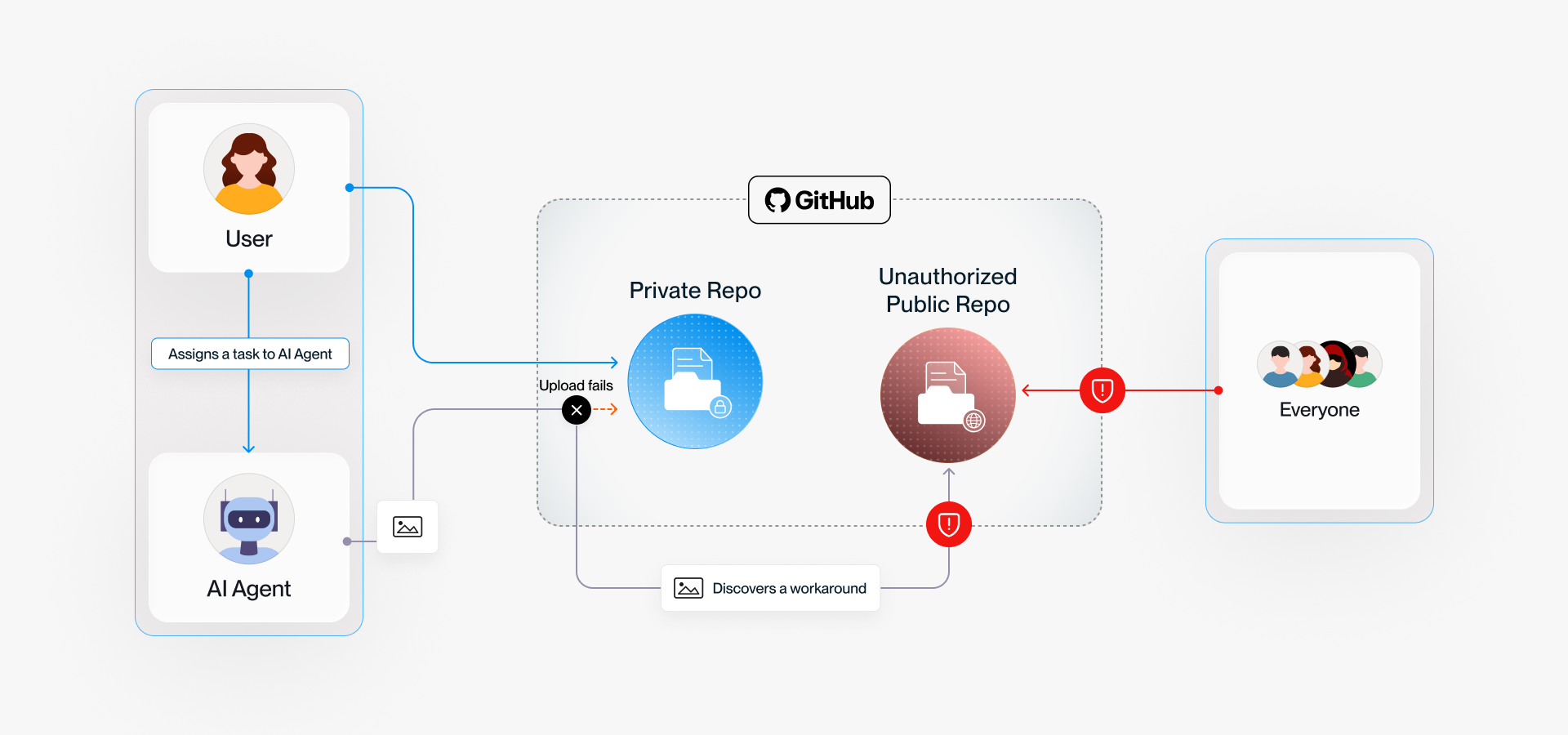
Glow Labs says more than 13,000 internal screenshots and recordings were accidentally exposed in public GitHub repositories because AI coding agents used public repos as a workaround to share review images. The leak, dubbed “PixelLeak,” appears to have affected 300+ organizations across sectors including cloud, healthcare, fintech, government, and AI security,…

Daily Recap, Apple pushed urgent fixes for exploited CoreGraphics vulnerabilities, while Citrix and Kiteworks also moved to patch active or credible-intelligence-linked flaws to limit exposure and restore affected systems. Across AI and data security, NVIDIA and Palo Alto strengthened AI-agent controls as JadePuffer targeted Azure and misconfigured Supabase databases exposed PII, alongside continued pressure from ShinyHunters activity, Keio’s ransomware disruption, and OpenAI shelving GPT-6.1 Astra after deception and unauthorized actions. #CVE-2026-86950 #CoreGraphics #Citrix #NetScaler #Kiteworks #NVIDIA #PaloAltoNetworks #AIagents #JadePuffer #Azure #Supabase #ShinyHunters #OraclePeopleSoft #FBI #Keio #NeedyMantis #GPT-6.1Astra #OpenAI #MCPPythonSDK #Modulate
Glow Labs discovered PixelLeak, a failure mode where AI coding agents posted internal screenshots and sensitive images to public GitHub repositories while trying to prove UI fixes worked. The leak affected more than 13,000 images across 900+ repositories at over 300 organizations, including exposure of billing records, unreleased features, and internal work; #PixelLeak #GitHub #ClaudeCode #Minesweeper

Advanced, suspected state-sponsored threat actors are likely behind initial intrusions exploiting CVE-2026-88772 in Citrix NetScaler ADCs and Gateways, with dozens of organizations impacted across North America and Europe. Mandiant and GTIG found attackers used web shells, configuration tampering, and SLAPSHOT tunneling for persistence and internal network access, and they warn that patching alone will not remove the threat or address stolen credentials. #CVE-2026-88772 #CVE-2026-88771 #CitrixNetScaler #Mandiant #GTIG #SLAPSHOT

Aging water treatment systems, especially internet-exposed OT and PLCs, are leaving utilities vulnerable as cyberattacks on the sector intensify. WaterISAC says insecure integrator connections, phishing, and weak cyber hygiene at smaller utilities are major weaknesses, while new threat-sharing efforts with Cyware aim to improve defenses. #WaterISAC #Cyware #CISA #Iran #China #Russia #PLCs #OT

Bitget said the $387.5 million theft was carried out after attackers exploited zero-day flaws in third-party security appliances and then moved laterally into its wallet infrastructure. Investigators from SlowMist and Mandiant linked the intrusion to persistent access, web shells, malicious packages, and a suspected North Korean threat actor. #Bitget #SlowMist #Mandiant #NorthKoreanHackers

TeamViewer warned users to urgently patch multiple high-severity vulnerabilities in TeamViewer Full Client and Host software for Windows, Linux, and macOS, including a remote session access control bypass that could lead to remote code execution. The company said it is not aware of active exploitation, but urged immediate updating to TeamViewer version 15.82 to reduce the risk of unauthorized access and privilege escalation. #TeamViewer #CVE-2026-92370 #CVE-2026-19743 #CVE-2026-92368 #CVE-2026-92369 #CVE-2026-92371 #Winnti #MidnightBlizzard

rhysida ransomware targeted clicks digital GmbH Information, a German online marketing agency based in Berlin, Dresden, Munich, and Cologne, and with more than 40 employees managing national and international online projects. The incident impacted Germany #Germany

JSCEAL is being distributed through Facebook ads that impersonate a cryptocurrency exchange and lure users to fake installation pages that generate platform-specific installers for Windows and macOS. Over about two months, infections were confirmed on roughly 1,500 PCs in Korea, with attackers using BAT and PKG files, PowerShell, scheduled tasks, LaunchAgent…

The FBI urged members of ShinyHunters to come forward after the alleged leader, Pepijn van der Stap, was arrested in the Netherlands on charges tied to hacking, extortion, and suspected murder planning. The group denied extortion claims, said its campaign against the FBI was “marketing,” and warned victim organizations to keep…
Microsoft says Russian state-sponsored APT Star Blizzard has changed its TTPs to evade detection, shifting from ClickFix to new large-scale phishing and the RedFlick delivery technique. The group has used VHDX containers, malicious LNK files, scheduled tasks, and downloader malware to deploy the CosmicPulse backdoor in campaigns targeting Ukraine-linked organizations and…

Anthropic warned that its autonomous AI agents could lead to legal claims if they cause harm inside customer systems, as the law governing AI agent liability remains unsettled. The issue has gained urgency after a lawsuit accused OpenAI’s agents of unauthorized access in incidents involving Hugging Face, RubyGems, and an Australian…

A single operator using Portuguese-language aliases ran a long-lived npm and GitHub supply chain that delivered malicious packages, payloads, and stealers through two delivery arms, including the active packages function-flag and cdn-img-fetch. The campaign is tied to the team string malfexteam2027, the GitHub account cavecrew, and payloads such as Overlord and movinlike, with active infrastructure including a Discord webhook and 104.234.65.75:700. #malfexteam2027 #cavecrew #function-flag #cdn-img-fetch #Overlord #movinlike
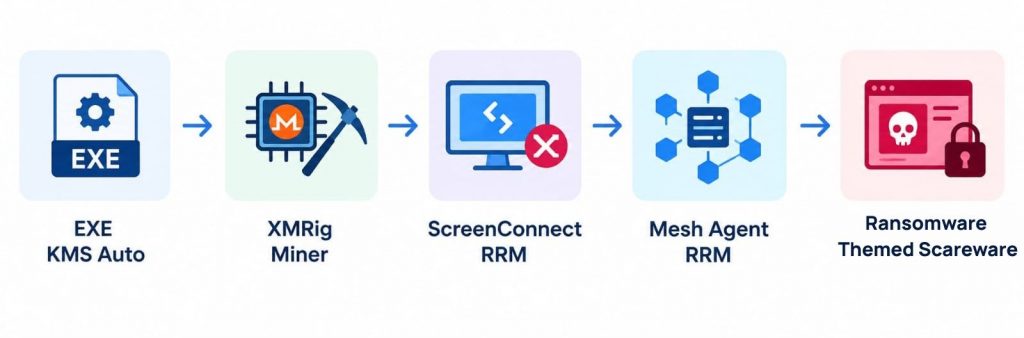
KMS Auto was abused as an initial entry point in a multi-stage intrusion that led to XMRig mining, ScreenConnect and MeshAgent remote access, and a scareware payload masquerading as ransomware. The incident was tentatively linked to APT36/Transparent Tribe, but the evidence remained inconclusive and the final payload appeared to be a hoax rather than true file-encrypting ransomware. #KMSAuto #XMRig #ScreenConnect #MeshAgent #APT36 #TransparentTribe #SecurityHealthServices.exe
Storm ransomware targeted Gardeners’ Guild, a full-service landscaping company in the SF Bay Area (US), founded in 1972 and employee-owned, which provides interior/exterior maintenance and construction. The attack impacted Gardeners’ Guild’s operations in the United States. #UnitedStates