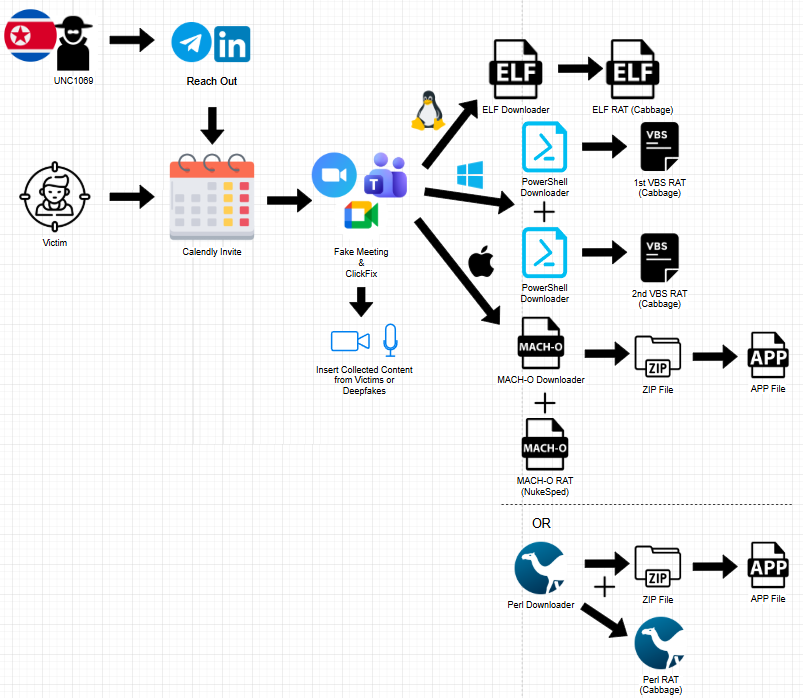
The UNC1069 campaign lures cryptocurrency and Web3 professionals into highly convincing fake meetings that capture audio/video and persuade victims to execute OS-specific downloaders, which then deploy updated variants of Cabbage RAT and other RATs. The operation uses lookalike meeting domains, Calendly scheduling links, and social engineering lures (ClickFix prompts, fake SDK/driver updates) to deliver payloads and stream or record media for later reuse. #UNC1069 #CabbageRAT
Keypoints
- UNC1069 (North Korean actor) targets crypto and Web3 professionals using fabricated venture-capital personas and out-of-band contact via LinkedIn and Telegram.
- Victims are invited to attacker-controlled fake meeting platforms impersonating Zoom, Google Meet, or Microsoft Teams and are pressured with audio/video “fix” prompts to run commands.
- Browser-based JavaScript captures microphone and camera via navigator.mediaDevices.getUserMedia and streams/records media over WebRTC/WebSocket to attacker servers for immediate use or later social engineering.
- Initial lures deliver OS-specific downloaders (PowerShell/VBS on Windows, Mach-O/Perl on macOS, ELF on Linux) that fetch and execute secondary RAT payloads, notably updated Cabbage/CageyChameleon variants and NukeSped.
- Windows VBS variants implement persistence via a .lnk in the Startup folder and added capabilities such as Chrome extension enumeration to locate crypto wallet extensions.
- Extensive attacker infrastructure includes numerous lookalike meeting domains and shared hosting IPs (e.g., 45.61.157[.]248), discovered via DNS pivots and regex-based lookalike searches.
MITRE Techniques
- [T1566 ] Phishing – Use of out-of-band contacts and scheduled links to lure targets into fake meetings (‘They build rapport with targets and share scheduling links (e.g., via Calendly) to arrange meetings.’)
- [T1059.001 ] PowerShell – Delivery and execution of PowerShell downloaders on Windows to retrieve and run VBS payloads (‘they are then prompted to paste and execute a set of commands that retrieve and run two distinct PowerShell scripts.’)
- [T1059.005 ] Visual Basic – Execution of VBS-based RAT stages and in-memory execution of secondary VBS payloads (‘The retrieved VBS payload appears to be an updated variant of CageyChameleon (Cabbage RAT)’)
- [T1059.004 ] Unix Shell – Instructing macOS and Linux victims to run terminal commands that fetch and execute Mach-O/Perl or ELF binaries (‘victims are instructed to press Cmd (⌘) + Space, search for Terminal, and execute a series of commands.’ / ‘victims are instructed to press Ctrl + Alt + T… paste and execute … fetching and running an ELF downloader.’)
- [T1105 ] Ingress Tool Transfer – Downloading ZIP-compressed payloads, binaries, and secondary stages from attacker-controlled servers (‘download ZIP-compressed payloads and perform beaconing via curl’ / ‘downloads a ZIP archive … disguised as a Zoom application.’)
- [T1071.001 ] Application Layer Protocol: Web Protocols – C2 and media communications over HTTP(S) POST and WebSocket/WebRTC channels (‘transmits them in real time using WebRTC-based streaming… via a WebSocket signaling channel’)
- [T1041 ] Exfiltration Over C2 Channel – Exfiltration of host telemetry and captured media to attacker-controlled servers (‘The RAT communicates with its command-and-control (C2) server to: Exfiltrate collected host data’)
- [T1547.001 ] Startup Folder – Persistence via creation of a .lnk shortcut in the Windows Startup folder to re-execute the VBS payload on logon (‘the malware creates a shortcut (.lnk) file in the Windows Startup folder, ensuring execution upon user logon.’)
- [T1036 ] Masquerading – Use of lookalike meeting domains and impersonation of legitimate meeting services to appear authentic (‘fake meeting platforms hosted on attacker-controlled infrastructure, designed to closely mimic legitimate services like Google Meet, Zoom, and Microsoft Teams.’)
- [T1057 ] Process Discovery – Enumeration of running processes by the RAT (‘The RAT communicates with its command-and-control (C2) server to: Enumerate running processes (getProc)’)
- [T1123 ] Audio Capture – Browser-initiated microphone access and capture via navigator.mediaDevices.getUserMedia (‘The script initiates media capture through the browser’s “navigator.mediaDevices.getUserMedia” API, explicitly requesting access to both the microphone and camera.’)
- [T1125 ] Video Capture – Browser-based camera capture and local recording via the MediaRecorder API for reuse in later social engineering (‘the script also implements local recording capabilities through the MediaRecorder API, potentially allowing the actors to store audio and video data for later use’)
Indicators of Compromise
- [File Hashes ] Malware and downloader samples – 8445652beedba94a586e23bfc6af49d98d76845d178314212058258e68e515001, 5cdec83048aba45a5a635f470c602c0f29fadeef5d3d5e7dc88291b1588b8dcc, and 10 more hashes
- [Domains ] Attacker-controlled fake meeting and VC domains – zoom.05ukweb[.]uk, web05meet[.]us, and 40+ other domains (e.g., zoom.web05meet[.]us, meet.googleapps[.]eu[.]org)
- [IP Addresses ] Infrastructure hosting C2 and payloads – 45.61.157[.]248 (embedded in a Perl downloader), 104.168.143[.]111, and 5 more IPs
Read more: https://www.validin.com/blog/i_cant_hear_you_unc1069/