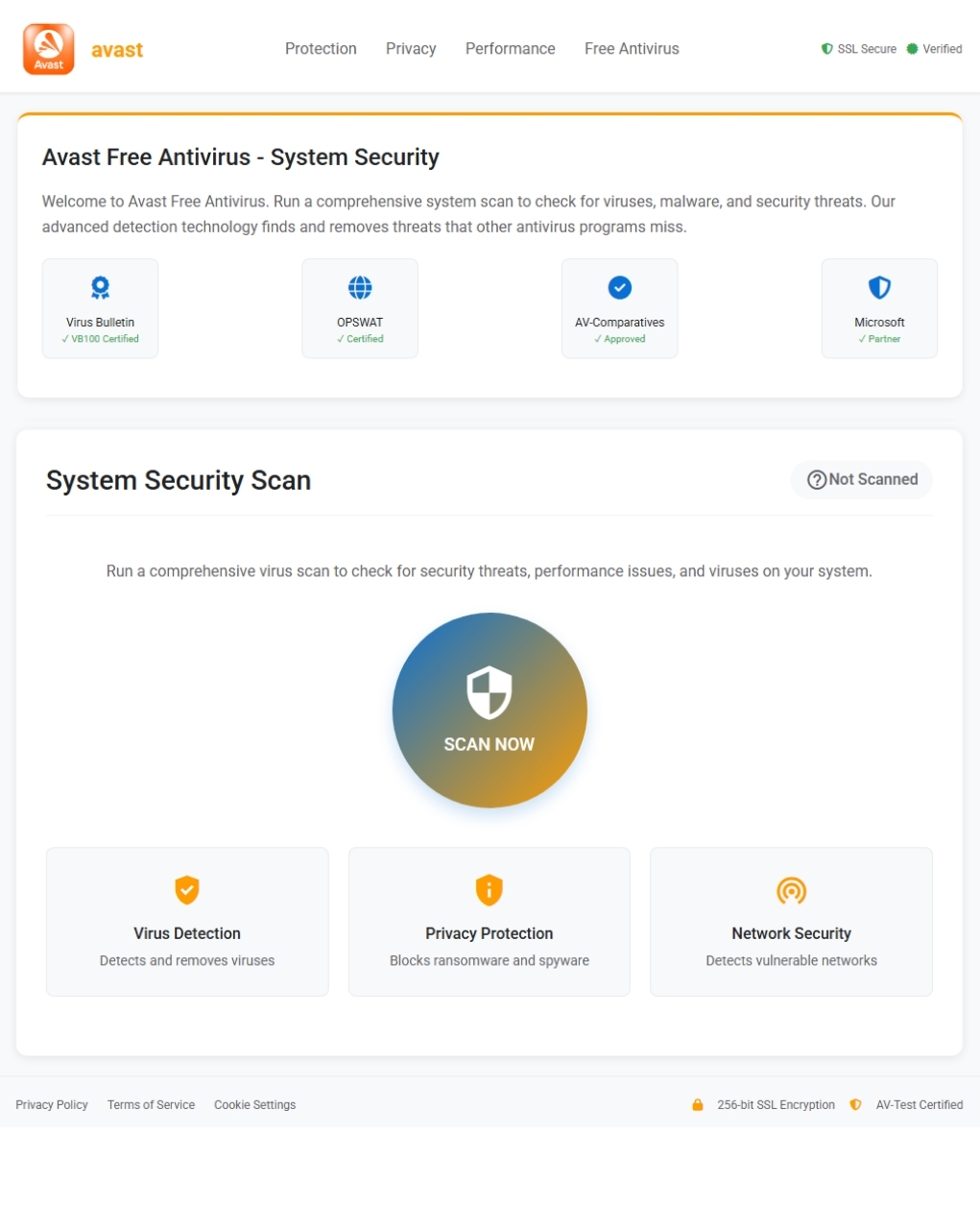
A fake Avast-branded website performs a staged “virus scan” that prompts users to download a malicious file (Avast_system_cleaner.exe) which is actually Venom Stealer, a data-stealing payload that harvests browser credentials, session cookies, and cryptocurrency wallet data. The malware masquerades as a Chrome service (v20svc.exe), is packed with a crypter to evade detection, and exfiltrates stolen data over HTTP to app-metrics-cdn[.]com. #VenomStealer #Avast
Keypoints
- Attackers cloned the Avast website UI to stage a fake scan that always reports infections and prompts the user to download “Avast_system_cleaner.exe” (the malicious payload).
- The delivered binary copies itself to C:Program FilesGoogleChromeApplicationv20svc.exe to masquerade as a legitimate Chrome service and uses the –v20c flag to mark second-stage execution.
- The sample is packed with a crypter (PDB path ‘crypter_stub.pdb’) and only ~27% of VirusTotal engines flagged it at analysis time, enabling widespread AV evasion.
- Venom Stealer harvests browser-stored credentials and session cookies (including active sessions for services like Google, Microsoft, Netflix, Facebook, and more), captures screenshots, and targets desktop cryptocurrency wallets.
- All stolen data is exfiltrated over unencrypted HTTP to a single C2 domain (app-metrics-cdn[.]com → 104.21.14.89) via structured POST endpoints and a heartbeat loop.
- The malware employs multiple anti-analysis and evasion techniques: direct/indirect system calls, debugger checks, sleep loops, system and process enumeration, and memory guard pages.
MITRE Techniques
- [T1036.005 ] Masquerading – The binary is named and placed to look like a legitimate Chrome component to avoid casual inspection: ‘copies itself into a location designed to blend in with legitimate software: C:Program FilesGoogleChromeApplicationv20svc.exe.’
- [T1027.002 ] Software Packing – The sample was packed with a crypter to evade signature detection: ‘the PDB path reads crypter_stub.pdb, indicating the executable was packed using a crypter.’
- [T1204.002 ] User Execution: Malicious File – The attack relies on a user downloading and executing a deceptive installer presented as a fix: ‘the victim is then prompted to download the cure: a file called Avast_system_cleaner.exe.’
- [T1555.003 ] Credentials from Web Browsers – The malware harvests stored browser credentials and cookies from browser files and process memory: ‘Behavioral analysis confirms the malware harvests saved credentials and session cookies.’
- [T1539 ] Steal Web Session Cookie – Stolen session cookies for many services were observed in memory, enabling session hijacking: ‘Process memory also contained fully-formed JSON structures with stolen cookie data… including active sessions for Netflix, YouTube, Reddit, Facebook…’
- [T1113 ] Screen Capture – The stealer captures the victim’s desktop as evidence or additional data: ‘it captures a screenshot of the victim’s desktop, saved temporarily as C:UsersAppDataLocalTempscreenshot_5sIczFxY95t2IQ5u.jpg.’
- [T1071.001 ] Application Layer Protocol: Web Protocols (HTTP) – Stolen data and telemetry are exfiltrated over plain HTTP to C2 endpoints: ‘A multipart form-data POST to /api/upload… a second POST to /api/upload-json… confirmation POST to /api/upload-complete.’
- [T1041 ] Exfiltration Over Command and Control Channel – The campaign uses a C2 domain for structured data theft and periodic heartbeat checks: ‘exfiltrated to a single command-and-control domain: app-metrics-cdn[.]com… the malware then enters a heartbeat loop, periodically checking in at /api/listener/heartbeat.’
- [T1106 ] Native API (Direct System Calls) – The malware invokes kernel functions directly to evade user-mode hooks and endpoint detection: ‘use of direct and indirect system calls… invokes Windows kernel functions directly rather than routing through the standard ntdll.dll library.’
- [T1497 ] Virtualization/Sandbox Evasion – The sample performs environment checks and anti-debugging to detect analysis environments: ‘The malware also checks whether it is being debugged, queries CPU vendor and model information, reads the volume serial number… creates guard pages in memory… and enumerates running processes.’
- [T1057 ] Process Discovery – The malware enumerates running processes as part of its anti-analysis and environment discovery routines: ‘enumerates running processes.’
Indicators of Compromise
- [File Hash ] Malicious binaries – SHA-256: ecbeaa13921dbad8028d29534c3878503f45a82a09cf27857fa4335bd1c9286d, MD5: 0a32d6abea15f3bfe2a74763ba6c4ef5
- [Domain ] Command-and-control / exfiltration endpoint – app-metrics-cdn[.]com
- [IP Address ] Infrastructure observed during analysis – 104.21.14.89
- [C2 URLs ] Exfiltration and beacon endpoints – http://app-metrics-cdn[.]com/api/upload, http://app-metrics-cdn[.]com/api/upload-json, and other endpoints ( /api/upload-complete, /api/listener/heartbeat )
- [File Names / Paths ] Dropped and staged files observed on infected hosts – Avast_system_cleaner.exe (installer), C:Program FilesGoogleChromeApplicationv20svc.exe (dropped payload), C:UsersAppDataLocalTempscreenshot_*.jpg (temporary screenshot), and C:UsersPublicNTUSER.dat (marker file)