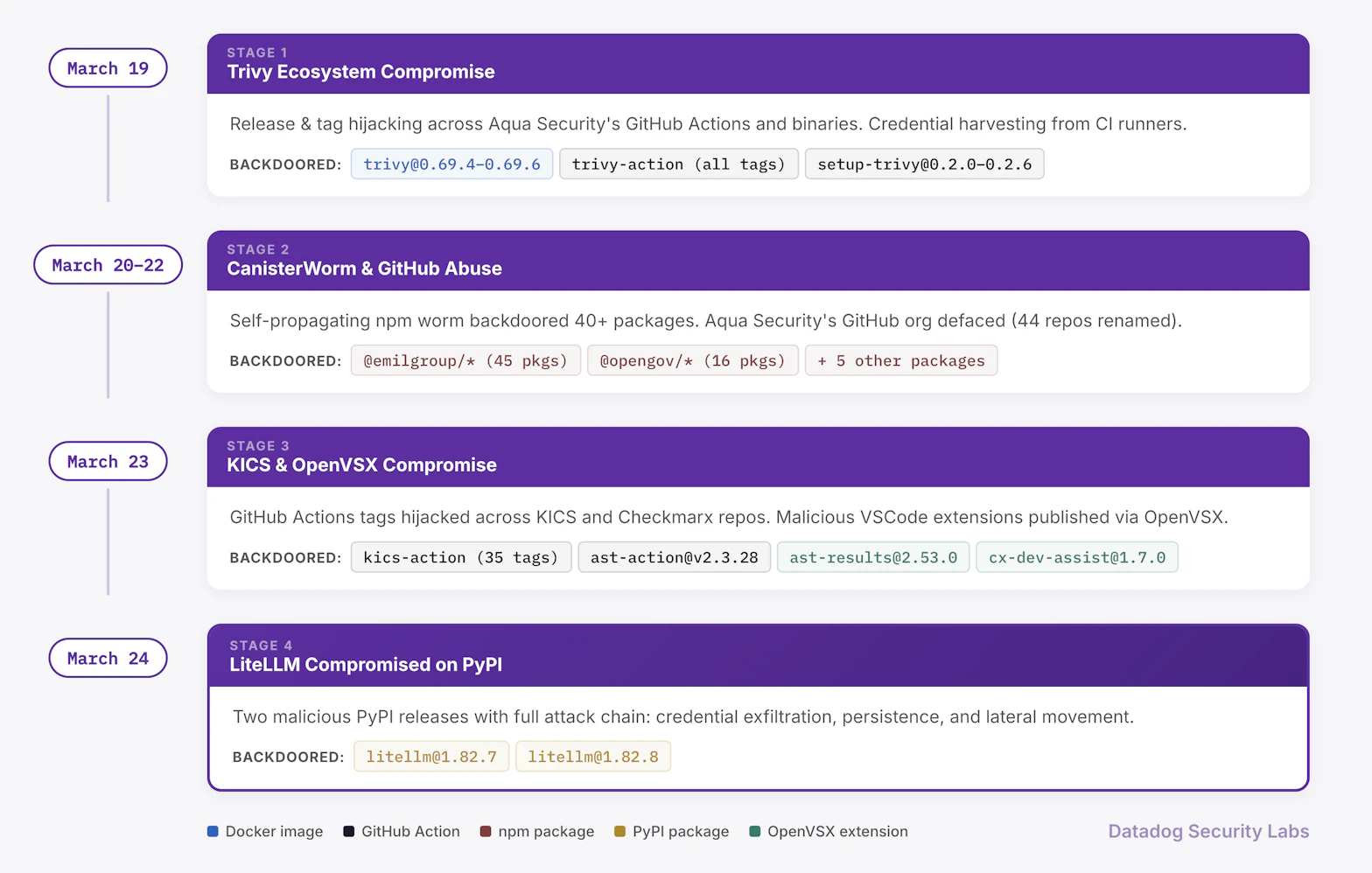
On March 24, 2026, legitimate LiteLLM PyPI releases 1.82.7 and 1.82.8 were compromised and distributed malicious payloads that collected credentials, installed persistence, and exfiltrated data. Datadog links the LiteLLM incident to a five-day TeamPCP supply-chain campaign that began with the Trivy compromise and spread through npm, Checkmarx, and other ecosystems; treat any host or CI that installed these versions as a full-credential exposure. #LiteLLM #TeamPCP
Keypoints
- Two real LiteLLM PyPI releases (1.82.7 and 1.82.8) were backdoored on March 24, 2026 and later quarantined by PyPI.
- Datadog attributes the LiteLLM compromise to a multi-stage TeamPCP supply-chain campaign that began with a malicious Trivy release on March 19 and moved through npm and Checkmarx artifacts.
- The malicious LiteLLM payload collected a wide range of secrets (env vars, SSH keys, cloud creds, Kubernetes tokens), encrypted them with AES-256 + RSA-4096, and exfiltrated them to attacker-controlled endpoints (e.g., models.litellm[.]cloud).
- Version 1.82.7 had injected code inside litellm/proxy/proxy_server.py (executes when imported); 1.82.8 included a malicious litellm_init.pth that executes automatically at Python interpreter startup.
- The payload installed persistence (user systemd unit sysmon.service and ~/.config/sysmon/sysmon.py), polled follow-on C2 (checkmarx[.]zone/raw), and could create privileged node-setup-* pods or DaemonSets to spread or destroy Kubernetes hosts.
- Response guidance: treat installs as full-credential exposures, scope hosts/CI/workloads, rotate reachable credentials, hunt for persistence and outbound connections, remove compromised versions, and rebuild from known-good images.
MITRE Techniques
- [T1195 ] Supply Chain Compromise – Compromised legitimate projects and published malicious releases across registries and vendor tooling. [‘…a compromise of the real litellm project on PyPI…’]
- [T1003 ] Credential Dumping – Malicious workflows and payloads dumped Runner.Worker memory and scraped common credential locations to harvest tokens, keys, and secrets. [‘…dumped Runner.Worker memory, scraped common credential locations…’]
- [T1027 ] Obfuscated Files or Information – Attackers embedded base64-encoded payloads inside package source files to hide malicious logic. [‘…Malicious base64-encoded payload injected into proxy_server.py…’]
- [T1546 ] Event Triggered Execution – The adversary used a Python .pth startup hook to execute code automatically at interpreter startup. [‘…includes a new litellm_init.pth file inside the wheel…executable lines in .pth files run during interpreter startup.’]
- [T1543.003 ] Create or Modify System Process: Systemd Service – The payload installed a user systemd unit named sysmon.service to maintain persistence. [‘…installs a user systemd unit called sysmon.service.’]
- [T1071.001 ] Application Layer Protocol: Web Protocols – Malware polled and exfiltrated data over HTTP(S) to attacker-controlled domains and endpoints. [‘…the data is then sent to models.litellm[.]cloud using the header X-Filename: tpcp.tar.gz.’ ‘…polls https://checkmarx[.]zone/raw…’]
- [T1567 ] Exfiltration Over Web Service – Encrypted archives of harvested secrets were sent to attacker web endpoints and, as a fallback, uploaded to public repos. [‘…exfiltrated the data to scan.aquasecurtiy[.]org…uploaded the stolen data there instead.’]
- [T1485 ] Data Destruction – On targets identified as Iranian the campaign deployed a kamikaze container that deleted the host filesystem and force-rebooted nodes. [‘…ran a container named kamikaze that deleted the host filesystem and force-rebooted the node.’]
Indicators of Compromise
- [Domain ] Exfiltration and C2 endpoints – models.litellm[.]cloud, checkmarx[.]zone/raw, and several related domains and Cloudflare tunnel subdomains (e.g., *.trycloudflare[.]com, aquasecurtiy[.]org).
- [Package / Version ] Compromised releases and affected packages – litellm==1.82.7, litellm==1.82.8 (confirmed compromised); Trivy v0.69.4 and many npm packages were also abused in the campaign.
- [File / Path ] Persistence and staged payload artifacts – litellm_init.pth, ~/.config/sysmon/sysmon.py, ~/.config/systemd/user/sysmon.service, /tmp/pglog, /tmp/.pg_state.
- [HTTP Header ] Exfiltration marker – X-Filename: tpcp.tar.gz observed in exfiltration to attacker-controlled endpoints.
- [Container / Pod names ] Kubernetes indicators – node-setup-* privileged pod naming pattern, container names kamikaze and provisioner (used for destructive or backdoor paths).
- [GitHub / Repo/Tag ] Repository and tag manipulation – tpcp-docs public repo used as a fallback exfiltration store; aquasecurity/trivy-action tags and other GitHub tags were force-pushed to malicious commits.
Read more: https://securitylabs.datadoghq.com/articles/litellm-compromised-pypi-teampcp-supply-chain-campaign/