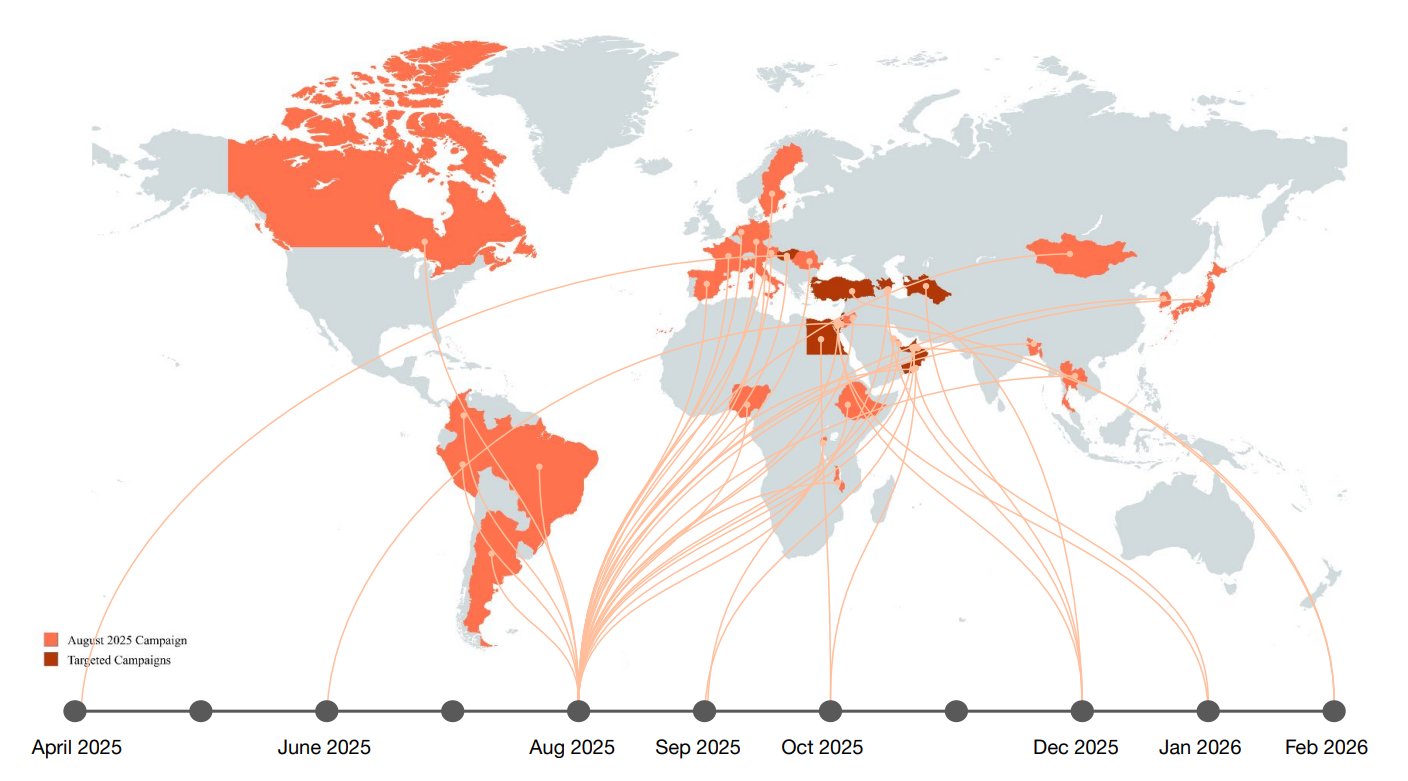
Boggy Serpens, an Iranian state-aligned cyberespionage group, has evolved its tradecraft to combine trusted-relationship compromises with AI-assisted and Rust-based tooling to target diplomatic and critical infrastructure worldwide, highlighted by a four-wave campaign against a UAE marine and energy company. Their toolkit and techniques include BlackBeard, LampoRAT, UDPGangster, Nuso and GhostBackDoor, use of hijacked internal accounts, HTTP/Telegram C2 channels, VBA macro droppers and process hollowing for persistence. #BoggySerpens #BlackBeard
Keypoints
- Boggy Serpens (aka MuddyWater) is attributed to Iran’s MOIS and has prioritized long-term espionage against government, maritime, energy, telecom and finance sectors across the Middle East and beyond.
- The group shifted from high-volume, noisy spear-phishing to targeted trusted-relationship compromises using hijacked internal accounts to bypass reputation-based defenses.
- Multiple custom malware families were identified and linked to the actor’s development pipeline: BlackBeard (Rust), LampoRAT (Rust, Telegram C2), UDPGangster (UDP C2), Nuso (HTTP status-code driven backdoor) and GhostBackDoor.
- A sustained, multi-wave campaign (Aug 2025–Feb 2026) against a UAE marine and energy company demonstrates tailored lures (engineering, finance, travel, consumption reports) and iterative payload evolution.
- Tooling and implant delivery rely on VBA macro builders (Phoenix lineage and UDPGangster builders), AI-assisted code generation, Rust binaries, process hollowing and custom persistence via registry file associations and startup artifacts.
- Observed infrastructure and IOCs include custom mass-email platforms, C2 domains/IPs, hardcoded Telegram bot tokens, PDB metadata linking variants, and numerous SHA256 hashes for documents and payloads.
MITRE Techniques
- [T1566.001 ] Spearphishing Attachment – Delivery of malicious Office documents with embedded macros to targets. (‘the lure document was blurred in order to deceive targets into clicking “Enable Content,” thereby triggering the execution of the embedded macro.’)
- [T1204.002 ] User Execution: Malicious File – Coercion of users to enable Office macros to launch droppers and payloads. (‘Once the user clicks “Enable Content,” the VBA macro’s initial routine is to delete this overlay and reveal the clear, legible document underneath.’)
- [T1078 ] Valid Accounts – Hijacking and misuse of legitimate internal and government mailboxes to bypass filters and deliver lures. (‘Boggy Serpens systematically hijacked official government and corporate accounts to bypass standard email filtering’)
- [T1218 ] Living Off The Land / Signed Binary Proxy Execution – Abuse of legitimate RMM tools and publicly available utilities to facilitate access and lateral movement. (‘abusing legitimate remote monitoring and management (RMM) tools like Atera, ScreenConnect and SimpleHelp, alongside publicly available utilities such as LaZagne and CrackMapExec.’)
- [T1055 ] Process Injection – Use of RunPE/process hollowing in the intermediate stager to execute Rust payloads in memory. (‘The stager decrypts the final Rust payload using a hardcoded XOR key and executes it in memory using process hollowing (RunPE).’)
- [T1547.001 ] Registry Run Keys / Startup Folder – Persistence by registering file associations and dropping startup files to ensure execution on reboot. (‘The payload registers the nonexistent .wdlp extension in the HKCUSoftwareClasses.wdlp registry… The malware drops a file named Oregon.wdlp into the startup folder’)
- [T1071.001 ] Application Layer Protocol: Web Protocols – C2 communications over HTTP/S for Nuso and BlackBeard beaconing and command semantics driven by HTTP status codes. (‘Nuso beacons over HTTP/S’ and ‘communicates with stratioai[.]org using the reqwest Rust crate.’)
- [T1102 ] Web Service – Use of Telegram Bot API as a C2 channel for LampoRAT. (‘The malware leverages the Telegram Bot API for command and control… hardcoded bot token (8398566164:AAEJbk6EOirZ_…)’)
- [T1497.001 ] Virtualization / Sandbox Evasion – Anti-analysis techniques and time-loop stalling to detect and evade research environments and automated analysis. (’employs multiple anti-analysis techniques to detect research environments’ and ‘a mathematical “time-loop” (function laylay) that forces the CPU to execute over 100 million operations’)
- [T1003 ] Credential Dumping – Use of credential dumping tools and techniques as part of early operational tradecraft. (‘publicly available utilities such as LaZagne and CrackMapExec’)
- [T1041 ] Exfiltration Over C2 Channel – Exfiltration of system information via custom HTTP headers and encrypted payloads to C2 servers. (‘exfiltrating system information via bit-rotated custom headers like X-Computer-Name and X-Username’ and AES-256-GCM encryption for system data)
Indicators of Compromise
- [Phishing Document Filenames & Document Hashes ] targeted lure documents used to deliver macros – examples: ‘Consumption Report (Jan 21 2025 – Feb 20 2026).xls’ (SHA256: 4d2958d9…), ‘Cybersecurity.doc’ (SHA256: f38a56b8…), and 13 more malicious document hashes.
- [Domains ] C2 and infrastructure domains used by multiple malware families – examples: stratioai[.]org, screenai[.]online, and 8 more domains (bootcamptg[.]org, codefusiontech[.]org, etc.).
- [IP Addresses ] Host and C2 IPs observed in infrastructure and UDP traffic – examples: 157.20.182[.]75 (mass-email platform host), 64.7.198[.]12 (hardcoded UDPGangster C2), and 3 more IPs (46.101.36[.]39, 159.198.68[.]25, 159.198.66[.]153).
- [SHA256 File Hashes ] Core payload and loader hashes across BlackBeard, LampoRAT, Nuso, Phoenix and UDPGangster – examples: LampoRAT 81a6e6416e…, GhostBackDoor 8d2227f2c5…, and 13 more hashes.
- [Telegram Bot Token ] Hardcoded Telegram C2 token used by LampoRAT – example: 8398566164:AAEJbk6EOirZ_ybm4PJ-q8mOpr1RkZx1H7Q (bot username stager_51_bot).
- [PDB Paths / Build Metadata ] Developer metadata linking variants and targets – examples: C:Usersnusosourcereposhttp_viphttp_vipf*ckAnalyzor.pdb, C:Userspipersourcereposudp_3.0 – Copyx64release_86udp_3.0.pdb, and other PDB paths revealing user profiles and target mappings.
- [Encryption Keys / IVs ] Hardcoded cryptographic artifacts used by Rust payloads – example AES-256-GCM Key ‘kqdkc83pe81zmq709c4npejvto9eg20e’ and IV ‘ft3mqb65h4hc’ associated with file hash 1bcd8d7d…, and an XOR dropper key ‘jfdghkjfdgklhjdfhgsfd09g9045jlkdfjlkgedfg5949045dfjgdflgljkdfgdf’.
Read more: https://unit42.paloaltonetworks.com/boggy-serpens-threat-assessment/