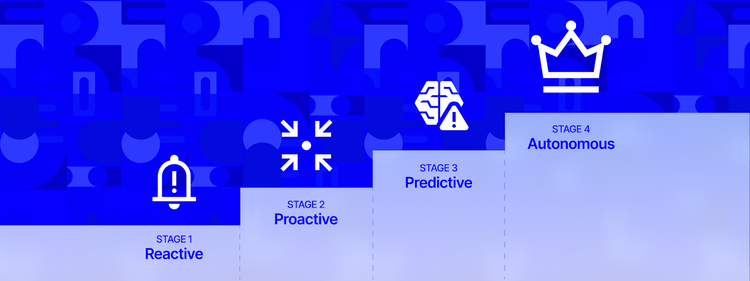
Organizations face information overload from multiple security feeds, which limits their ability to act on threat data; Recorded Future defines a four-stage Threat Intelligence Maturity Model—Reactive, Proactive, Predictive, and Autonomous—to guide operationalizing intelligence into measurable outcomes. #RecordedFuture #ThreatIntelligenceMaturityModel
Keypoints
- Organizations receive vast quantities of alerts and intelligence but often lack the processes and automation to turn that data into timely, actionable responses.
- Recorded Future’s Threat Intelligence Maturity Model describes four stages—Reactive, Proactive, Predictive, and Autonomous—that represent increasing capability, integration, and automation.
- Reactive teams focus on detection and containment, suffering from alert fatigue, siloed tools, and manual enrichment; foundational steps include centralizing feeds and automating enrichment.
- Proactive organizations use intelligence to prioritize vulnerabilities, conduct threat hunting, and inform decision-making, reducing MTTR and unpatched high-risk vulnerabilities.
- Predictive maturity leverages analytics, ML/AI, and combined internal/external telemetry to forecast adversary behavior and inform enterprise risk and investment decisions.
- Autonomous operations rely on AI-driven continuous detection and response, with humans focused on oversight, governance, and strategic planning.
- Progress requires people, processes, integrations, and quality intelligence; success is measured by KPIs like reduced dwell time, increased automated responses, and improved cross-functional reporting.
MITRE Techniques
- [T1087 ] Account Discovery – Used in threat hunting and proactive detection to identify relevant accounts and exposures for prioritization: ‘Establish a repeatable threat hunting process tied to known tactics, techniques and procedures (TTPs).’
- [T1105 ] Ingress Tool Transfer – Automation and enrichment workflows move indicators and contextual data into security tools to enable faster response: ‘Automate enrichment of alerts with high-confidence threat indicators.’
- [T1059 ] Command and Scripting Interpreter – Automation and AI-driven responses create and run playbooks and rules to remediate threats at machine speed: ‘Automate rule creation and response playbooks based on live threat insights.’
- [T1609 ] Container Administration Command – Autonomous stage integration across systems implies orchestration of security controls and environments for continuous response: ‘Expand autonomous intelligence integration across the full security stack.’
- [T1583 ] Acquire Infrastructure – Predictive and proactive stages include monitoring emerging campaigns and vulnerabilities to prioritize patching and reduce exposure: ‘Use intelligence to prioritize vulnerabilities being actively exploited in the wild.’
Indicators of Compromise
- [IP addresses ] general context – examples not specified in article (no explicit IPs provided).
- [Domains ] general context – examples not specified in article (no explicit domains provided).
- [File hashes ] context for high-confidence indicator feeds – example hashes not provided (mentions ‘hashes’ as an IOC type and refers to ‘and other hashes’).
- [File names ] context for alerts and enrichment – specific filenames not provided in article.
Read more: https://www.recordedfuture.com/blog/operational-cyber-threat-intelligence