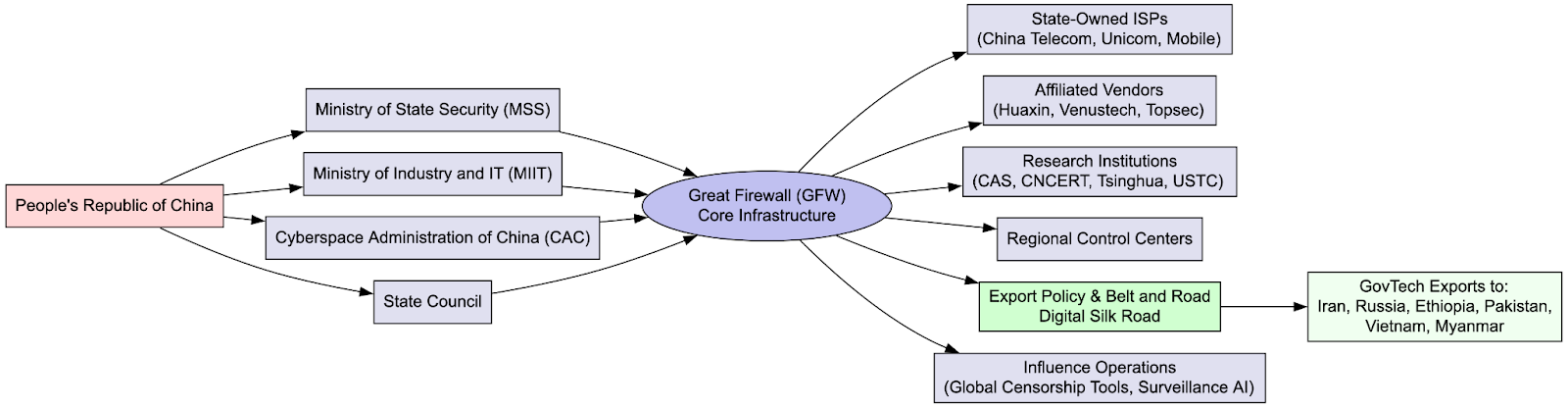
The Great Firewall functions as an integrated governance platform that enforces ideological conformity, facilitates market protection for domestic tech firms, and enables real-time surveillance and adaptive censorship across China’s internet infrastructure. Its design and export through firms like Huawei and initiatives such as the Digital Silk Road are driving a splintering of the global internet and the spread of “internet sovereignty” models to other authoritarian states. #GreatFirewall #Huawei
Keypoints
- The Great Firewall (GFW) is an architectural governance system that combines deep packet inspection, SNI filtering, proxy interception, and centralized orchestration to enable real-time behavioral tracking and adaptive suppression.
- Leaked data shows granular content classification, regionally distributed probe agents, Redis-based blacklist updates, and remote configuration pushes that support scalable, proactive censorship.
- The GFW enforces economic engineering by blocking foreign SaaS and cloud services (e.g., Google Docs, Zoom, Dropbox), accelerating domestic substitution with platforms like Tencent Docs, DingTalk, and Huawei services.
- China exports its digital governance model—through companies such as Huawei and ZTE and initiatives like the Digital Silk Road—encouraging adoption of data retention mandates, DPI, and application whitelisting in partner states.
- Resistance has been persistent and domestically sourced, giving rise to circumvention tools developed inside China (Shadowsocks, V2Ray, Trojan, Brook, Xray) and to cultural evasion tactics on platforms like Weibo and WeChat.
- The GFW contributes to global internet balkanization by normalizing state-mediated connectivity and shaping international norms around “internet sovereignty” via diplomatic forums and infrastructure exports.
- Further intensification of surveillance risks deepening domestic repression and provoking both greater innovation in circumvention and stronger international responses such as export controls or coordinated support for bypass technologies.
MITRE Techniques
- [T1040 ] Network Sniffing – The article describes deep packet inspection and SNI filtering used to inspect traffic: ‘deep packet inspection, SNI filtering, proxy interception’ quoted from the article.
- [T1071 ] Application Layer Protocol – Blocking and shaping of HTTP/TLS and DNS queries to enforce censorship: ‘Every facet of user interaction, from HTTP headers and TLS handshakes to DNS queries and application telemetry, is a potential input for censorship decisions.’ quoted from the article.
- [T1098 ] Account Manipulation – Integration with state-managed platforms and social controls to restrict access and services (Social Credit integration implied): ‘integration of surveillance with economic and social systems, already evident in the Social Credit framework’ quoted from the article.
- [T1110 ] Brute Force (credential access context) – Targeting of foreign software update servers to prevent installation of circumvention tools indicates disruption of software update mechanisms: ‘strategic targeting of: Foreign software update servers, to prevent the installation of tools like Signal or Tor’ quoted from the article.
- [T1204 ] User Execution (Phishing/Delivery) – Use of application-level analytics and content moderation to remove or redact dissident content across platforms: ‘Social commentary … circulates widely on Weibo, Bilibili, and WeChat before deletion’ quoted from the article.
- [T1486 ] Data Encrypted for Impact (conceptual) – Use of regionally adaptive enforcement and memory-optimized blacklist updates to limit data flows and availability of services, effectively encrypting access to certain content via blocking: ‘memory-optimized Redis-based blacklist updates shows a scalable enforcement model’ quoted from the article.
Indicators of Compromise
- [Infrastructure ] Enforcement and monitoring components – examples: Redis-based blacklist update systems, regionally distributed “probe agents”.
- [Services/Platforms ] Targeted services and blocked applications – examples: Google Docs, Zoom, Dropbox, and other foreign SaaS (blocked), leading to domestic alternatives Tencent Docs, DingTalk, Huawei Cloud.
- [Protocols/Traffic Patterns ] Censorship-detection inputs – examples: TLS handshakes and SNI filtering, DNS queries used as signals for suppression.
- [Tools ] Circumvention projects (resistance tooling) – examples: Shadowsocks, V2Ray, Trojan, and forks like Brook and Xray.