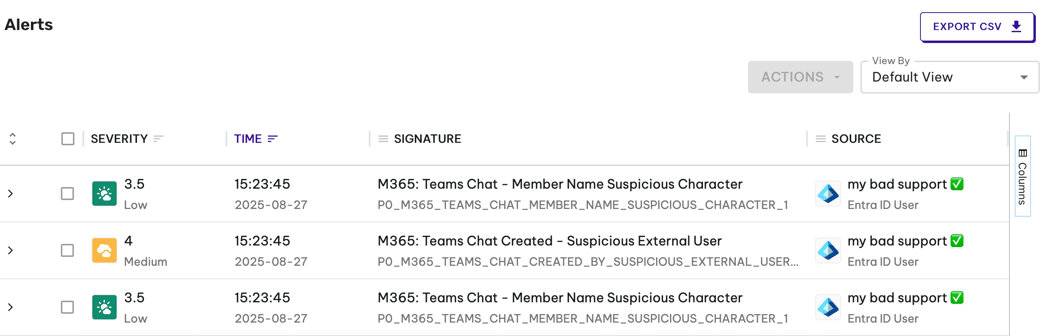
Threat actors are increasingly abusing Microsoft Teams to socially engineer targets into installing remote access tools (QuickAssist, AnyDesk) and executing a PowerShell-based multi-stage payload that performs credential theft, persistence, and encrypted C2 communication. Campaigns have delivered DarkGate and Matanbuchus loader variants, reused static AES parameters linked to EncryptHub/LARVA-208 (Water Gamayun), and hosted payloads at domains such as audiorealteak.com and cjhsbam.com. #DarkGate #Matanbuchus
Keypoints
- Attackers impersonate IT support in Microsoft Teams (display names like “IT SUPPORT✅”, “Help Desk Specialist ✅”) to establish trust and request remote access.
- Initial access is gained by persuading victims to install remote support tools (QuickAssist, AnyDesk) and granting control, enabling direct deployment of payloads.
- Observed PowerShell command downloads a multi-stage script from https://audiorealteak.com/payload/build.ps1 which performs credential theft, persistence, and remote execution.
- Malware includes persistence via Scheduled Task (“Google LLC Updater”) or fallback registry autorun, fetching runner.ps1 from https://cjhsbam.com/payload/runner.ps1.
- Payload uses AES encryption with hardcoded IV and key (&9*zS7LY%ZN1thfI and 123456789012345678901234r0hollah) for C2 communications to https://audiorealtek[.]com and reuses constants linked to EncryptHub / LARVA-208 (Water Gamayun).
- Technical features include single-instance mutex enforcement, process protection by marking PowerShell as critical (RtlSetProcessIsCritical), system profiling, credential prompt capture, and execution of attacker commands via decrypted C2 responses.
- Related historical reporting ties similar campaigns to BlackBasta ransomware and later to DarkGate and Matanbuchus loader families, indicating varied monetization and actor reuse.
MITRE Techniques
- [T1566] Phishing – Microsoft Teams used as a social engineering vector to impersonate IT support and trick users into installing remote access tools (“impersonate IT support…engage users through one-on-one chats…presented as legitimate support”).
- [T1204] User Execution – Victims are guided to install and run remote access software (QuickAssist, AnyDesk) and execute PowerShell commands (“guide the victim toward installing remote access software…actor uses native features…to take control”).
- [T1105] Ingress Tool Transfer – Payloads and follow-on scripts are downloaded from external URLs such as https://audiorealteak.com/payload/build.ps1 and https://cjhsbam.com/payload/runner.ps1 (“Invoke-RestMethod -Uri “).
- [T1059.001] Command and Scripting Interpreter: PowerShell – Attack delivers and runs multi-stage PowerShell scripts with Invoke-RestMethod and scriptblock execution for payload execution and tasking (“powershell.exe -ExecutionPolicy Bypass -WindowsStyle Hidden -Command …”).
- [T1113] Screen Capture / [T1056] Input Capture (Credential Harvesting) – Malware invokes a native credential prompt to capture user credentials via PromptForCredential and saves them to info.txt (“$Host.UI.PromptForCredential(‘Need credentials’, …) … saved to a info.txt file”).
- [T1547.001] Registry Run Keys / Startup Folder – Persistence via creating a registry autorun entry as a fallback if scheduled task creation fails (“Set-ItemProperty -Path HKCU:Software…Run …”).
- [T1053.005] Scheduled Task – Persistence by registering a scheduled task named “Google LLC Updater” to run PowerShell on logon (“Register-ScheduledTask -TaskName ‘Google LLC Updater’ …”).
- [T1027] Obfuscated Files or Information – Use of compiled C# injection and process flagging (RtlSetProcessIsCritical) to complicate analysis and remediation (“compiles and injects a C# class…call RtlSetProcessIsCritical”).
- [T1041] Exfiltration Over C2 Channel – Collected system info and credentials are encrypted with AES and posted to the C2 at https://audiorealtek[.]com/ (“Data is encrypted with AES using a hardcoded key and IV, then sent to https://audiorealtek[.]com/”).
Indicators of Compromise
- [URL] Malicious payload hosting – https://audiorealteak[.]com/payload/build.ps1, https://cjhsbam[.]com/payload/runner.ps1
- [IPv4] Infrastructure – 104.21.40[.]219, 193.5.65[.]199
- [Cryptographic Constants] Hardcoded AES parameters linked to actor – IV: &9*zS7LY%ZN1thfI, Key: 123456789012345678901234r0hollah
- [Mutex] Single-instance mutex for script enforcement – 62088a7b-ae9f-2333-77a-6e9c921cb48e
- [User Agents] Malicious activity UA string – Mozilla/5.0 (Windows NT; Windows NT 10.0; en-US) AppleWebKit/534.6 (KHTML, like Gecko) Chrome/7.0.500.0 Safari/534.6
- [Teams Display Names/User Principals] Impersonation patterns – Display names: “Help Desk Specialist ✅”, “IT SUPPORT✅”; User principal examples: @supportbotit.onmicrosoft.com, @firewalloverview.onmicrosoft.com