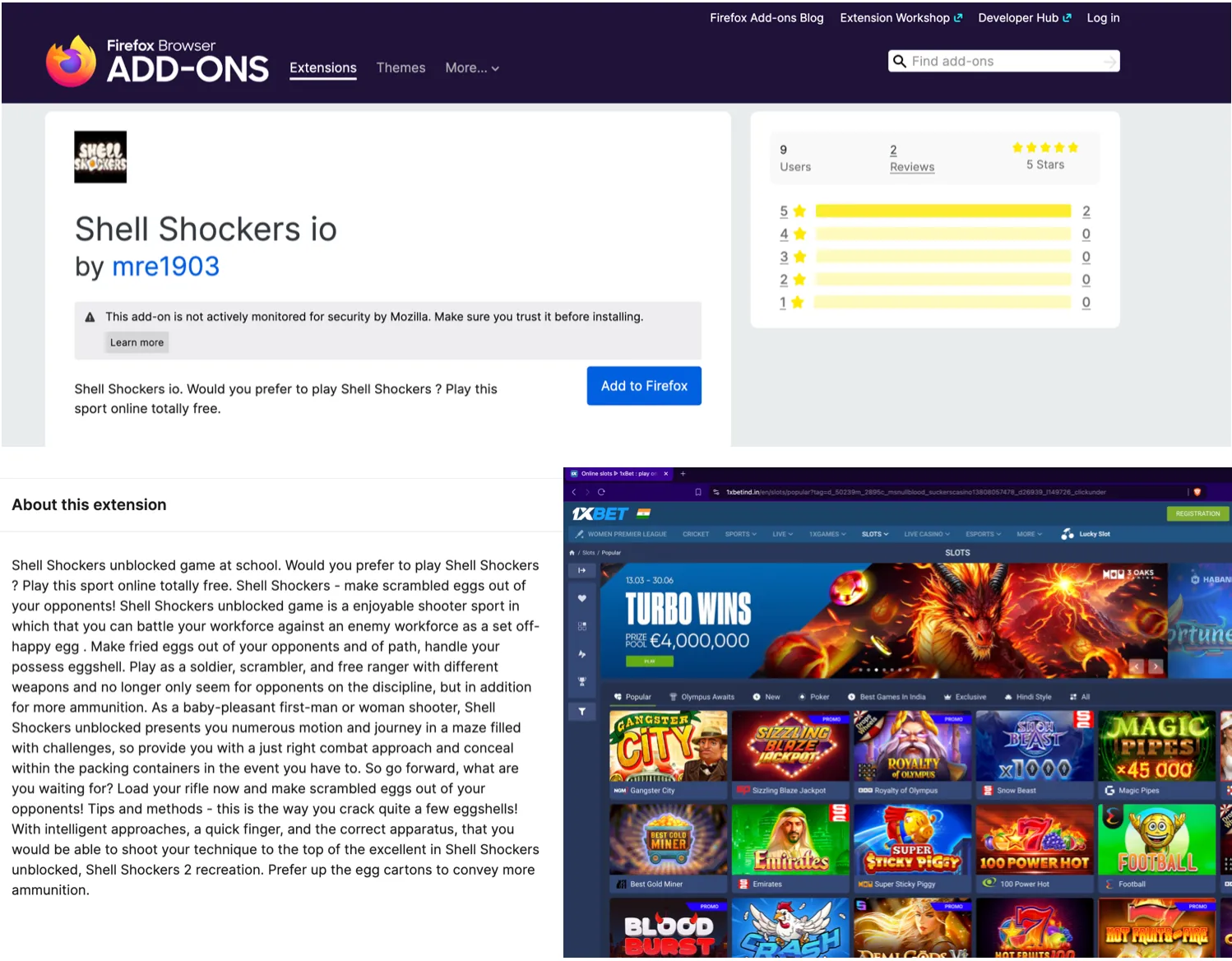
Malicious browser extensions from trusted stores are increasingly exploited to hijack user sessions, redirect traffic, and manipulate social media metrics, posing significant security risks. A notable example includes a malicious Chrome extension sold for $100,000 enabling comprehensive attacks such as credential theft and cryptocurrency draining. #ShellShockersIO #rivemks
Keypoints
- Browser extensions like Shell Shockers io exploit chrome.windows.create to launch deceptive popups redirecting users to tech support scams.
- The Wikipedia engelsiz giris extension redirects traffic through a vulnerable proxy to bypass censorship but exposes users to security risks.
- Some extensions manipulate social media engagement by auto-scrolling and clicking “like” buttons to skew analytics and damage platform authenticity.
- Operation Phantom Enigma infected over 700 users in Latin America, targeting banking customers and bypassing two-factor authentication through extensions.
- A malicious Chrome extension sold on the dark web for $100,000 includes features like cookie exfiltration, crypto theft, hidden remote access, and botnet control.
- Extensions operate with high privileges enabling data exfiltration, keylogging, screen capture, network interception, and persistent backdoors.
- Users are advised to audit extension permissions, verify developers, and remove unused extensions to mitigate risks.
MITRE Techniques
- [T1059] Command and Scripting Interpreter – Used in extensions to execute injected JavaScript for crypto draining and interaction automation (“API-based crypto drainer via JavaScript injections”).
- [T1176] Browser Extensions – Exploited by malicious extensions for session hijacking, redirects, and data exfiltration (“extensions infected 722 users across Latin America… bypassing two-factor authentication”).
- [T1071] Application Layer Protocol – Used for network interception and redirecting user traffic through proxies and malicious domains (“redirect Wikipedia traffic through a proxy domain”).
- [T1114] Email Collection – Via stealing authentication tokens and cookies for credential theft (“exfiltrates browser cookies in JSON format every 15 minutes”).
- [T1119] Automated Collection – Extensions manipulated social media metrics by automatically scrolling and clicking “like” buttons (“artificially inflating likes and views”).
- [T1219] Remote Access Tools – Hidden Virtual Network Computing (hVNC) functionality in malicious extensions for covert external control (“hidden virtual network computing functionality for covert remote interaction”).
- [T1565] Data Manipulation – Manipulating user engagement metrics to skew analytics and harm business trust (“some extensions manipulated user engagement metrics on platforms like Facebook”).
Indicators of Compromise
- [Domain] Malicious redirect domain – funformathgame[.]com used by Shell Shockers io for tech support scams.
- [Extension Name] Malicious browser extensions – Shell Shockers io, Wikipedia engelsiz giris.
- [Author] Malicious extension authors – mre1903A (Shell Shockers io), Mehmet Tamac (Wikipedia engelsiz giris), rivemks (seller of a malicious Chrome extension).
- [Malicious Domain] Proxy domain with vulnerabilities – tr[.]0wikipedia[.]org used by Wikipedia engelsiz giris extension.
Read more: https://socket.dev/blog/the-growing-risk-of-malicious-browser-extensions