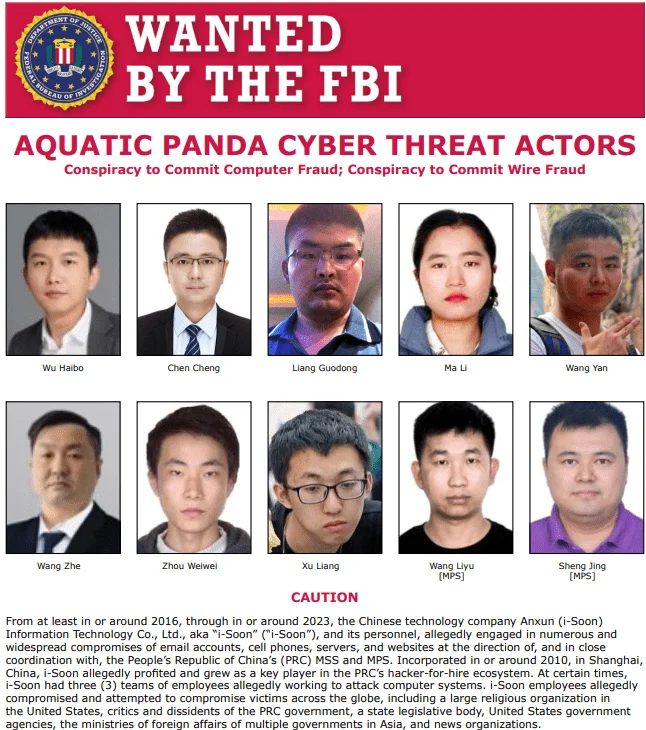
Aquatic Panda is a Chinese state-sponsored cyberespionage group linked to the contractor i-Soon, focused on long-term intelligence gathering and surveillance of government, NGOs, academic, and ideological targets worldwide. Utilizing advanced modular malware like ShadowPad and stealthy techniques, the group operates within China’s broader cyber network alongside entities such as Winnti, driven by objectives of state surveillance and influence. #AquaticPanda #ChineseAPT #Cyberespionage #ShadowPad #iSoon #Winnti #MSS
Keypoints
- Aquatic Panda is a suspected Chinese state-sponsored threat group linked to i-Soon, a Chinese contractor working for the Ministry of State Security (MSS) and Ministry of Public Security (MPS).
- The group focuses on cyberespionage targeting governments, NGOs, universities, religious organizations, and political think tanks across Asia, Europe, and North America.
- Aquatic Panda employs advanced modular malware tools such as ShadowPad and Winnti backdoors, enabling stealthy, persistent access with obfuscation and memory-only code execution.
- The group initially gains access via public-facing application vulnerabilities and watering hole attacks, redirecting victims to malicious infrastructure.
- Aquatic Panda’s tactics include encrypted command and control communications using domain generation algorithms (DGA) and DNS-based channels to evade detection.
- Despite i-Soon’s public exposure and operational decline by 2024, the broader Chinese cyber contractor ecosystem continues supporting state-driven cyber operations.
- Defensive strategies recommend patching, endpoint behavioral monitoring, multi-factor authentication, network segmentation, and integrating threat intelligence platforms like SOCRadar.
MITRE Techniques
- [T1087] Account Discovery – Aquatic Panda used Linux ‘last’ command to identify recently logged-in users (“used the last command in Linux to identify recently logged-in users”).
- [T1595.002] Active Scanning: Vulnerability Scanning – The group used public DNS logging services to detect Log4j vulnerable servers (CVE-2021-44228) (“Used public DNS logging services to find servers vulnerable to Log4j”).
- [T1560.001] Archive Collected Data: Archive via Utility – Data compression before exfiltration was done with WinRAR and 7-Zip (“Compressed files and dumps with WinRAR and 7-Zip before exfiltration”).
- [T1059.001] Command and Scripting Interpreter: PowerShell – PowerShell was used to download and execute Base64-encoded scripts (“Downloaded scripts and executed Base64 encoded commands in PowerShell”).
- [T1059.003] Command and Scripting Interpreter: Windows Command Shell – Executed Bash commands on Windows via cmd /C (“Attempted to run Bash commands via cmd /C on Windows”).
- [T1059.004] Command and Scripting Interpreter: Unix Shell – Malicious shell scripts installed Linux Winnti backdoors post SSH access (“Used malicious shell scripts post-SSH access to install Linux versions of Winnti”).
- [T1543.003] Create or Modify System Process: Windows Service – Created fake Windows services for persistence (“Created Windows services mimicking legitimate ones for persistence”).
- [T1005] Data from Local System – Captured Windows security logs using wevtutil (“Captured Windows security logs using wevtutil”).
- [T1574.001] Hijack Execution Flow: DLL Search Order Hijacking – Loaded malicious DLLs via hijacking search order (“Used search-order hijacking to load malicious files and DLLs into trusted processes”).
- [T1574.006] Hijack Execution Flow: Dynamic Linker Hijacking – Modified Linux ld.so preload for persistence (“Modified ld.so preload in Linux for Winnti persistence”).
- [T1562.001] Impair Defenses: Disable or Modify Tools – Attempted to disable endpoint detection and response tools (“Attempted to disable EDR tools”).
- [T1070.001] Indicator Removal: Clear Windows Event Logs – Removed logs to evade detection (“Cleared Windows Event Logs to evade detection”).
- [T1070.003] Indicator Removal: Clear Command History – Cleared Linux shell command histories (“Cleared shell command history in Linux”).
- [T1070.004] Indicator Removal: File Deletion – Deleted malware artifacts from hosts (“Deleted malware from compromised hosts”).
- [T1105] Ingress Tool Transfer – Downloaded malware onto compromised environments (“Downloaded malware onto compromised systems”).
- [T1654] Log Enumeration – Enumerated authentication logs before selective deletion (“Enumerated authentication logs before selective deletion for evasion”).
- [T1036.004] Masquerading: Masquerade Task or Service – Used service names like “Windows User Service” to blend in (“Created services like “Windows User Service” to blend in”).
- [T1036.005] Masquerading: Match Legitimate Name or Location – Renamed or relocated binaries to avoid detection (“Renamed or relocated binaries to evade detection”).
- [T1112] Modify Registry – Enabled RestrictedAdmin mode for pass-the-hash via RDP (“Enabled RestrictedAdmin mode for pass-the-hash via RDP”).
- [T1027.010] Obfuscated Files or Information: Command Obfuscation – Encoded PowerShell commands in Base64 (“Encoded PowerShell commands in Base64”).
- [T1588.001] Obtain Capabilities: Malware – Used njRAT to gain capabilities (“Acquired and used njRAT”).
- [T1588.002] Obtain Capabilities: Tool – Used Cobalt Strike tool (“Acquired and used Cobalt Strike”).
- [T1003.001] OS Credential Dumping: LSASS Memory – Attempted credential theft from LSASS memory (“Attempted credential theft from LSASS memory”).
- [T1021] Remote Services – Used remote scheduled tasks for malware deployment (“Used remote scheduled tasks to deploy malware”).
- [T1021.001] Remote Services: Remote Desktop Protocol – Lateral movement via RDP with stolen credentials (“Moved laterally via RDP using stolen credentials”).
- [T1021.002] Remote Services: SMB/Windows Admin Shares – Enabled lateral movement via SMB/admin shares (“Enabled lateral movement using admin shares”).
- [T1021.004] Remote Services: SSH – Used SSH to move laterally after credential theft (“Used SSH with stolen credentials for lateral movement”).
- [T1518.001] Software Discovery: Security Software Discovery – Searched for third-party endpoint detection and response (EDR) products (“Searched for third-party EDR software”).
- [T1218.011] System Binary Proxy Execution: Rundll32 – Used rundll32.exe to run a malicious DLL keylogger (“Used rundll32.exe to execute a malicious keylogger DLL”).
- [T1082] System Information Discovery – Ran OS commands to gather system information and privileges (“Ran native OS commands to assess privileges and system info”).
- [T1033] System Owner/User Discovery – Collected data on logged-in users (“Collected info on logged-in users”).
- [T1007] System Service Discovery – Searched for services related to security software (“Searched for services related to EDR”).
- [T1550.002] Use Alternate Authentication Material: Pass the Hash – Leveraged pass-the-hash via RestrictedAdmin mode (“Modified registry for RestrictedAdmin, enabling hash-based RDP login”).
- [T1078.002] Valid Accounts: Domain Accounts – Gathered domain credentials for lateral movement (“Gathered valid domain credentials for lateral movement”).
- [T1047] Windows Management Instrumentation – Used WMI for lateral movement (“Used WMI for lateral movement”).
Indicators of Compromise
- [Malware] ShadowPad – Utilized as the main modular backdoor with DNS-based C2 and memory-only decryption, indicating sophisticated stealth operations.
- [Malware] Winnti variants (Windows/Linux) – Employed for persistence, encrypted communication, and rootkit functionality, including fileless techniques on Linux.
- [File Hashes] Malware executables and archives – Examples include WinRAR and 7-Zip compressed files used for archiving exfiltrated data (plus additional unknown hashes).
- [Domains] Custom Domains & DGAs – Used by ShadowPad for encrypted command and control infrastructure rotation.
- [Scripts] Malicious PowerShell and shell scripts – Base64 encoded scripts for payload execution and Linux shell scripts for deploying backdoors post-SSH.
- [Tools] Cobalt Strike and njRAT – Widely used frameworks for command execution, credential theft, and lateral movement.
Read more: https://socradar.io/dark-web-profile-aquatic-panda/