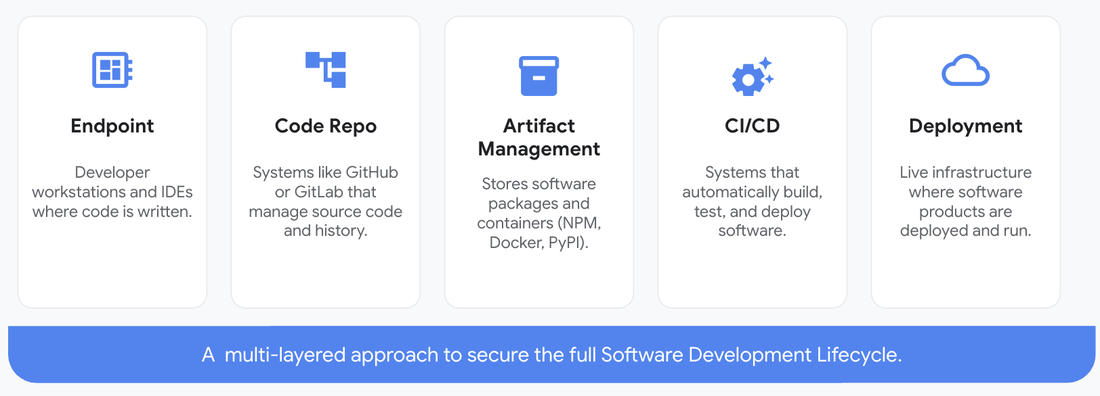
The article explains how software supply chain attacks are increasingly targeting developer endpoints, IDEs, build pipelines, package registries, and CI/CD systems to steal secrets, manipulate artifacts, and poison trusted workflows. It recommends a defense-in-depth strategy across the full SDLC, including secret scanning, hardened identities, immutable provenance, isolated runners, and runtime protections. #GitHubActions #OIDC #MCP #YubiKey #FIDO2 #SLSA #SBOM #GoogleArtifactRegistry #CSPM #CNAPP
Keypoints
- Threat actors are targeting the full software development lifecycle, not just production systems.
- Developer workstations, IDEs, and local dependencies are used to steal PATs, SSH keys, API tokens, and session credentials.
- Attackers are abusing pipeline mechanisms such as GitHub Actions cache poisoning, OIDC token extraction, and mutable action tags.
- The article recommends local secret scanning, strict endpoint security, and IDE/extension allowlisting to reduce compromise risk.
- Repository protections should include strong identity controls, branch protection, credential rotation, and immutable history verification.
- Build and artifact security should rely on exact version pinning, digest-based references, SBOMs, provenance checks, and quarantine of new packages.
- CI/CD and runtime defenses should use ephemeral runners, least privilege, scanning gates, deployment guardrails, and continuous monitoring.
MITRE Techniques
- [T1552 ] Unsecured Credentials – Threat actors seek secrets from developer environments and local files, including tokens and keys (‘collect personal access tokens (PATs), SSH keys’; ‘exclude local environment (.env) files from the workspace’).
- [T1036 ] Masquerading – Attackers use typosquatted local dependencies and mutable trusted names to disguise malicious content (‘typosquatted local dependencies’; ‘subvert mutable action tags’).
- [T1195 ] Supply Chain Compromise – The article describes compromise of trusted tools, packages, actions, and pipelines to inject malicious code (‘targeting trusted security scanners, utility libraries, and AI developer tools’; ‘publish compromised packages’).
- [T1056 ] Input Capture – Social engineering, malicious extensions, and IDE abuse are used to capture sensitive information from developers (‘highly tailored social engineering, malicious extensions’).
- [T1057 ] Process Discovery – EDR is configured to watch trusted IDE process trees for suspicious behavior (‘monitor trusted IDE process trees for anomalous file access, unexpected process spawning’).
- [T1105 ] Ingress Tool Transfer – Malicious packages, dependencies, and scripts are introduced into build environments and developer workspaces (‘malicious post-install scripts’; ‘dependency-poisoning attacks’).
- [T1027 ] Obfuscated Files or Information – The guidance emphasizes cryptographic provenance and digest pinning to defeat hidden replacement of trusted artifacts (‘pinning to an immutable cryptographic digest’; ‘cryptographically signing every internally produced container image’).
- [T1557 ] Adversary-in-the-Middle – Mutable tags and poisoned registries can cause pipelines to retrieve attacker-controlled content under trusted references (‘an upstream actor can silently replace the content behind a trusted name’).
- [T1528 ] Steal Application Access Token – Attackers extract OIDC and session credentials from developer and pipeline environments (‘OIDC token extraction’; ‘monitor user API activity to quickly detect compromised sessions’).
- [T1078 ] Valid Accounts – The article highlights abuse of legitimate developer and automation identities, including PATs and service account tokens (‘compromised sessions’; ‘service account PATs’).
- [T1098 ] Account Manipulation – Recommended controls include enforcing MFA, conditional access, and revocation when devices fall out of compliance (‘restrict or revoke a user’s ability to access SCM systems’).
- [T1611 ] Escape to Host – Sandboxing and restricted host mounts are recommended to prevent compromised dependencies from executing with host privileges (‘prevent compromised dependencies from executing with host privileges’).
- [T1190 ] Exploit Public-Facing Application – Runtime protections such as WAF and RASP are recommended to block web exploit attempts like SQL injection and XSS (‘block execution-level exploitation attempts like SQL injection’; ‘blocking common web exploits, such as cross-site scripting’).
- [T1610 ] Deploy Container – The article discusses containerized development environments and container image controls as part of securing the pipeline (‘require the use of containerized development environments’).
Indicators of Compromise
- [File names ] Local secret and build configuration files referenced for protection – .env, .gitignore, package-lock.json, requirements.txt
- [Hashes / digests ] Artifact integrity and pinning examples – SHA-256 digests, full commit hashes
- [Package / registry names ] Dependency and registry controls mentioned in the article – Google OSV, Google Artifact Registry, npm, pip
- [Artifact / attestation formats ] Software bill of materials and provenance formats – CycloneDX, SPDX, SLSA
- [Protocols / token types ] Authentication and identity mechanisms referenced – OIDC tokens, PATs, SSH keys
- [Platform / tool names ] CI/CD and endpoint systems discussed as control points – GitHub Actions, EDR, UEM, SCM, SCA, DAST, CSPM, CNAPP