Kaspersky GERT reported that NightEagle (APT-Q-95) expanded its operations from Asia to Russian businesses, using stolen VPN credentials, GhostContainer on Microsoft Exchange, and multiple tunneling and lateral-movement techniques. The campaign also involved BlueKeep exploitation, DCSync-related activity, and tooling hosted under disguised GitHub repositories to maintain access and move across internal networks. #NightEagle #APTQ95 #GhostContainer #MicrosoftExchange #BlueKeep #DCSync
Keypoints
- NightEagle (APT-Q-95) has been active since at least 2023 and is now targeting businesses in Russia in addition to earlier targets in Asia.
- Initial access was commonly achieved with compromised valid credentials used to access corporate VPNs from IPs linked to Cloudflare WARP tunnels and European virtual infrastructure providers.
- The group deployed the GhostContainer backdoor on Microsoft Exchange servers, likely via ASP.NET/VIEWSTATE abuse and in-memory payload injection.
- GhostContainer uses multiple components to process C2 commands, evade AMSI and Windows Event Log monitoring, and proxy or forward network traffic.
- For lateral movement and access persistence, the attackers combined Microsoft dev tunnels, rdp2tcp, Impacket atexec, and Windows portproxy functionality.
- NightEagle also exploited CVE-2019-0708 (BlueKeep) and performed Kerberos ticket abuse and DCSync-style actions to obtain domain credentials and compromise Active Directory.
- Kaspersky detection coverage includes GhostContainer, tunneling activity, BlueKeep exploitation, and NightEagle-related behaviors in both endpoint and network telemetry.
MITRE Techniques
- [T1078 ] Valid Accounts – Attackers used compromised valid credentials to access corporate VPNs (‘compromised valid credentials to gain access to corporate VPNs’).
- [T1133 ] External Remote Services – VPN access was used as the initial entry point into victim environments (‘gain access to corporate VPNs’).
- [T1059 ] Command and Scripting Interpreter – The backdoor delivered C2 commands and the attackers used administrative commands like netsh (‘processes C2 commands’ … ‘netsh interface portproxy add’).
- [T1014 ] Rootkit – The backdoor evaded AMSI and Windows Event Log monitoring by overwriting memory addresses in system DLLs (‘evades detection … by overwriting addresses in amsi.dll and ntdll.dll’).
- [T1190 ] Exploit Public-Facing Application – GhostContainer was associated with exploitation of Microsoft Exchange and CVE-2020-0688-related components (‘an exploit for the CVE-2020-0688 vulnerability’).
- [T1110 ] Brute Force – Not mentioned in the article.
- [T1055 ] Process Injection – The payload was injected into VIEWSTATE and launched the backdoor in memory (‘injecting a payload into it, which then launched the GhostContainer backdoor in memory’).
- [T1027 ] Obfuscated Files or Information – The attackers disguised archive and file names to resemble legitimate software (‘names … were disguised to look legitimate’ and ‘mimicking known legitimate software’).
- [T1090 ] Proxy – GhostContainer implemented proxying and socket forwarding, and rdp2tcp was used for traffic tunneling (‘implements network traffic redirection (proxying) and socket forwarding functionality’).
- [T1219 ] Remote Access Software – Microsoft dev tunnels and RDP were used to maintain remote access without exposing suspicious ports (‘expose port 3389 (RDP)’ and ‘maintain network access’).
- [T1021.001 ] Remote Desktop Protocol – The attackers leveraged RDP for lateral movement and tunnel setup (‘Once the attackers gain sufficient privileges … they leverage RDP to move laterally’).
- [T1048 ] Exfiltration Over Alternative Protocol – TCP traffic was tunneled over RDP connections using rdp2tcp (‘tunneling TCP traffic over an established RDP connection’).
- [T1021.002 ] SMB/Windows Admin Shares – Port forwarding to 445 suggests access to SMB services through redirected traffic (‘connectport=445’).
- [T1053.002 ] Scheduled Task/Job: Scheduled Task – Impacket atexec was used to create scheduled tasks (‘use the atexec utility … to create scheduled tasks’).
- [T1098 ] Account Manipulation – A local account was created and added to privileged groups (‘create a local account … and add it to the Administrators and Remote Desktop Users groups’).
- [T1003.006 ] OS Credential Dumping: DCSync – The attackers attempted to replicate AD password data to impersonate the domain controller (‘attempted to replicate the Domain-Password object … (a technique known as DCSync)’).
- [T1550.003 ] Use Alternate Authentication Material: Pass the Ticket – They requested Kerberos tickets with special flags and used long-lived tickets for legitimate access (‘use long-lived Kerberos tickets to gain legitimate access’).
- [T1484.001 ] Domain Policy Modification: Group Policy Modification – Not mentioned in the article.
- [T1210 ] Exploitation of Remote Services – CVE-2019-0708 was exploited to create accounts and move laterally (‘they exploited … CVE-2019-0708 (BlueKeep)’).
- [T1069.002 ] Permission Groups Discovery: Domain Groups – The attackers added accounts to the Administrators and Remote Desktop Users groups (‘add it to the Administrators and Remote Desktop Users groups’).
- [T1090.001 ] Proxy: Internal Proxy – The attackers used portproxy to relay traffic internally (‘netsh interface portproxy add v4tov4’).
Indicators of Compromise
- [IP addresses / network origins ] VPN and tunneling source origins used by attackers – Russian-segment IPs linked to Cloudflare WARP tunnels, European virtual infrastructure provider IPs
- [URLs ] GitHub-hosted archives used to store tools – https://github[.]com/mirror-js/mirror-js/refs/heads/main/js/js-webpack.zip, https://github[.]com/browserthemes/resourcepack/releases/download/main/resource-pack.zip
- [Domain patterns ] Dev tunnel domains used to expose RDP – *.*.devtunnels.ms
- [File names ] Disguised tool archives and executables – adobe_32.exe, AdobeSync.exe, trueconf.exe, 1cbroker.exe, and 2 more items
- [Windows event log / channel names ] RDP virtual channel artifacts seen during tunneling – rdp2tcp, XPSRD
- [Vulnerability identifiers ] Exploited and detected vulnerabilities – CVE-2019-0708, CVE-2020-0688
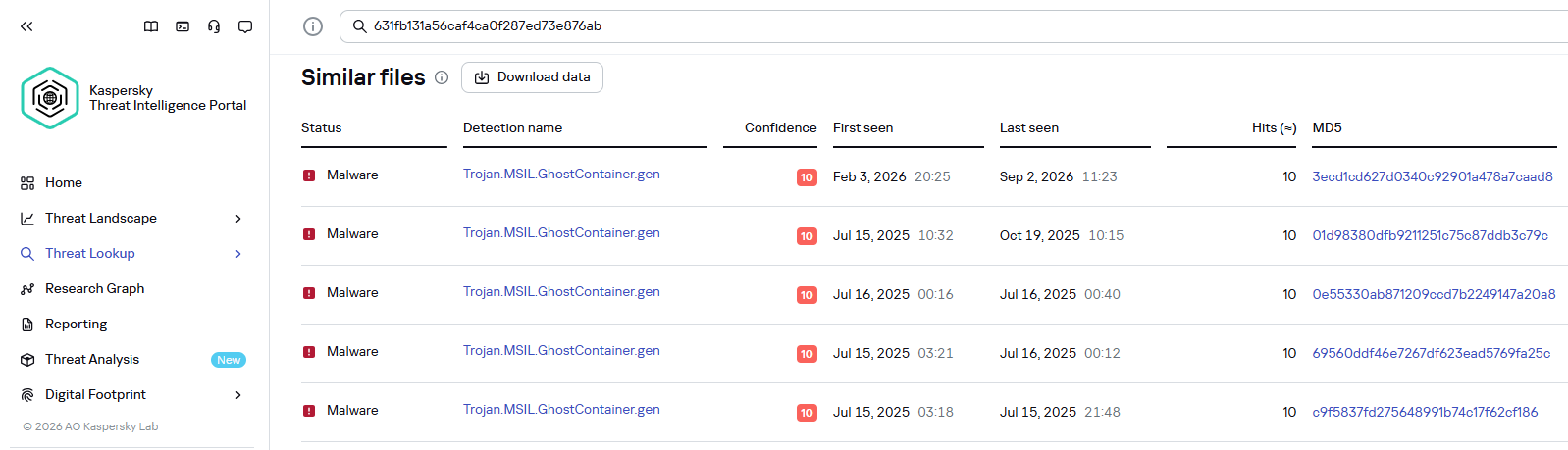
- [Detection signatures / malware names ] Kaspersky detections referenced in the article – Trojan.MSIL.GhostContainer.gen, Exploit.CVE-2019-0708.TCP C&C
Read more: https://securelist.com/tr/nighteagle-apt-ghostcontainer-and-tunneling/121323/