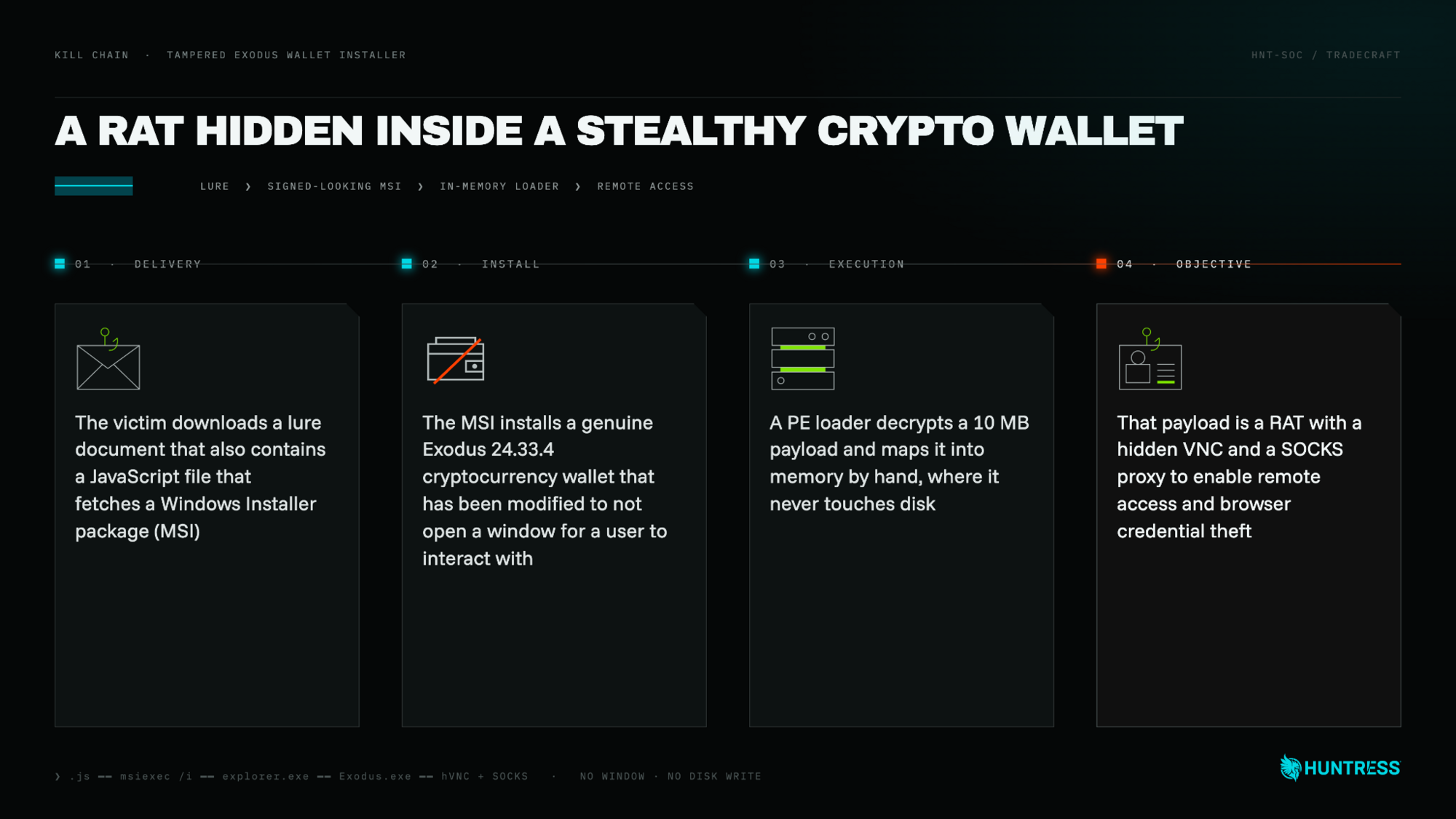
Attackers distributed a trojanized Exodus Wallet installer that silently installed a hidden, modified wallet and a modular RAT with browser theft, VNC, SOCKS proxy, and command execution capabilities. The campaign used fake documents, ZIP-delivered JavaScript, WebDAV search-ms redirection, and Azure Table Storage C2, while artifacts such as jn0101.msi, jg0384.msi, ExodusHelper, and ExdBackupTool helped reveal the operation. #Exodus #ExodusHelper #ExdBackupTool #AzureTableStorage #us05org #jn0101msi #jg0384msi
Keypoints
- The installer masqueraded as a cryptocurrency wallet but actually deployed a trojanized Exodus Wallet 24.33.4 bundle.
- Four unrelated organizations were compromised between late July and mid-August 2026, with three infections occurring within 85 minutes on August 18.
- Delivery methods included a fake PDF with a .pdf.js double extension, a ZIP file containing JavaScript, and a WebDAV-based search-ms redirection path.
- The modified Exodus package suppressed the wallet UI, enforced single-instance execution with ExodusHelper, and launched hidden wallet execution through explorer.exe.
- The embedded RAT supported browser credential theft, hidden VNC, SOCKS proxying, remote command execution, file management, and script execution.
- Command and control used Azure Table Storage as a dead drop, with tasking and results stored in tables such as ftable434 under bot-specific PartitionKeys.
- Additional persistence included a scheduled task that relaunched Exodus.exe hourly and another task, INetHealth, that repeatedly cleared proxy settings to preserve direct C2 access.
MITRE Techniques
- [T1059.007] JavaScript – The initial droppers and obfuscated components were JavaScript-based, including fake PDF.js delivery and heavily obfuscated wallet modifications (‘the malicious Javascript… downloads a Microsoft Installer’).
- [T1204.002] User Execution: Malicious File – Victims opened disguised files such as a fake PDF or ZIP update, triggering execution (‘what the user saw appeared to be a legitimate document’ and ‘the user opened it straight out of Explorer’).
- [T1036.007] Masquerading: Double File Extension – A file named like a PDF actually ended in .pdf.js to hide its true type (‘file name ending in .pdf.js’).
- [T1218.007] System Binary Proxy Execution: Msiexec – The payload was installed silently using msiexec (‘msiexec /i “%TEMP%jn0101.msi” /quiet /norestart’).
- [T1105] Ingress Tool Transfer – The JavaScript dropper downloaded and staged an MSI payload (‘it downloads… a Microsoft Installer (MSI), writes it to %TEMP%’).
- [T1053.005] Scheduled Task – The malware used scheduled tasks for persistence and proxy clearing (‘a scheduled task named INetHealth’ and ‘ExdBackupTool’).
- [T1102.002] Web Service: Bidirectional Communication – The payload used Azure Table Storage as a dead drop for tasking and results (‘POST https://lgapistorage123.table.core.windows.net/Tables’ and rows prefixed T_ / R_).
- [T1021.002] Remote Services: SMB/Windows Admin Shares is not directly shown; not listed.
- [T1021.001] Remote Services: Remote Desktop Protocol – The RAT included hidden VNC for interactive remote desktop access (‘Hidden VNC, interactive remote desktop’).
- [T1090.001] Proxy: Internal Proxy – The RAT included a SOCKS module that turned the host into a relay (‘SOCKS proxy, turning the host into a relay’).
- [T1055] Process Injection is implied but not explicitly described; not listed.
- [T1106] Native API – The payload used low-level Windows APIs such as VirtualAlloc, WriteProcessMemory, and RtlAddFunctionTable to manually map and run code (‘That is a manual Portable Executable (PE) loader’).
- [T1041] Exfiltration Over C2 Channel – Stolen browser data and command output were sent through the C2 framework (‘browser credential theft’ and result rows in Azure Table Storage).
- [T1112] Modify Registry – The INetHealth task modified Internet Settings registry values to disable proxy settings (‘Set-ItemProperty… ProxyEnable 0’).
- [T1219] Remote Access Software – The modular RAT bundled capabilities for persistent remote access and control (‘hidden VNC’, ‘remote command execution’, ‘file browse’).
Indicators of Compromise
- [File names / installers] Disguised installer and related payloads – jn0101.msi, jg0384.msi, and ton435.msi
- [File hashes] MSI and payload hashes – c513a7346484ee69a2931c4a89956ee50aa63e4366ef989315e669d8f10d7485, 8c3b41ea5a85778145a6e5772bfee2eb0f8b027d0af199fb71a76dfb8bb29e5a
- [File paths] Per-user install and runtime locations – %APPDATA%ExdBackupTool, %TEMP%.tmp.node, C:WindowsInstallerSourceHash{4046AD2B-3831-4011-AEAD-D98C5C9FD1EF}
- [Domain names] Delivery and C2 infrastructure – us05[.]org, lgapistorage123.table.core.windows.net, winapi.table.core.windows.net
- [IP addresses] Hosting and delivery server – 35.212.159.20
- [Executable / task names] Persistence and single-instance markers – Exodus.exe, ExodusHelper, INetHealth, ExdBackupTool
- [URLs / paths] Delivery and dead-drop endpoints – 35.212.159.20/jn0101.msi, https://lgapistorage123.table.core.windows.net/Tables, …/ftable434(PartitionKey=”,RowKey=’B’)
Read more: https://www.huntress.com/blog/exodus-crypto-wallet-installer-rat