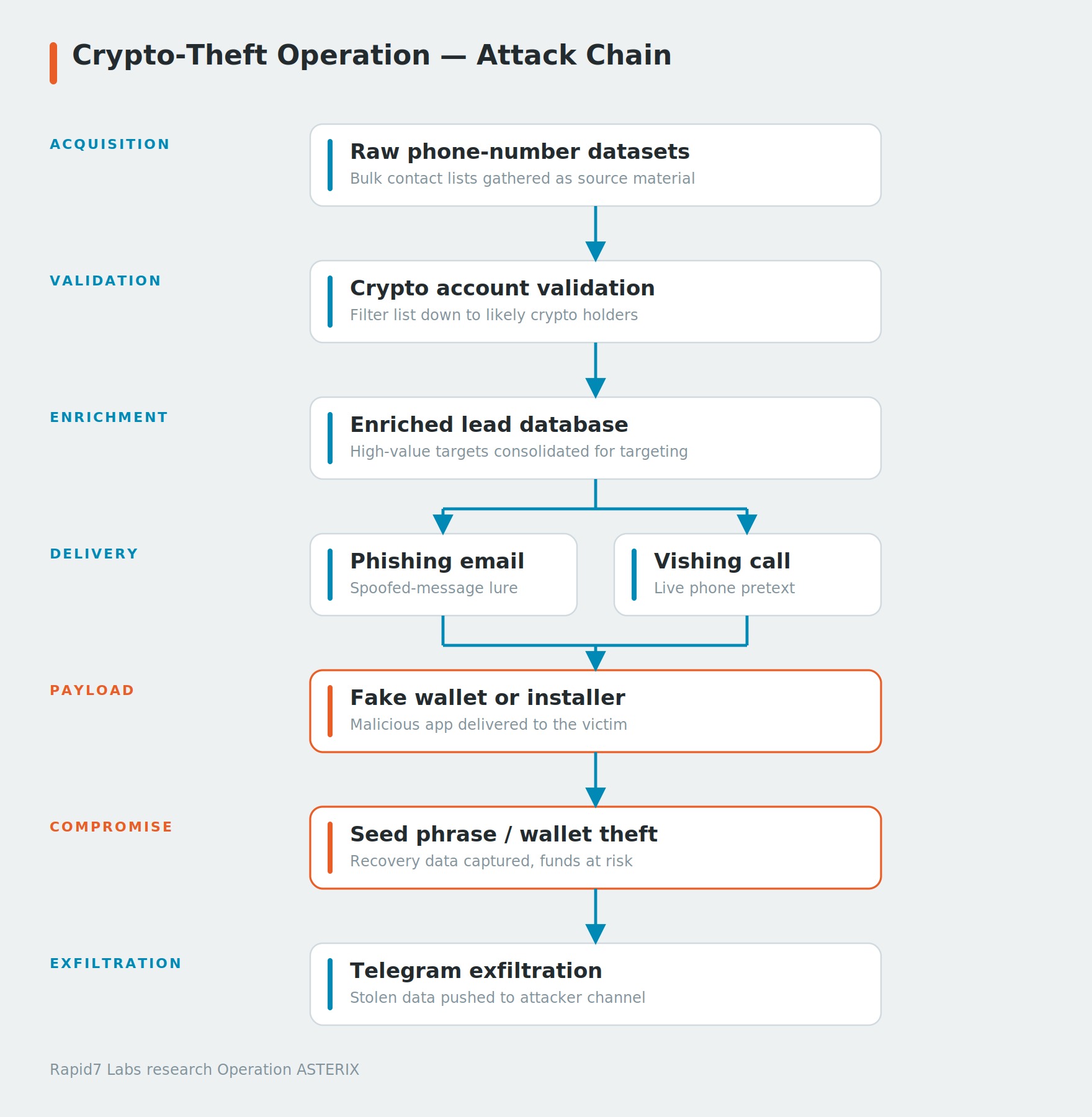
Rapid7 uncovered Operation ASTERIX, a cryptocurrency fraud campaign that used exposed infrastructure to stage phishing panels, vishing tools, fake wallet apps, and Telegram exfiltration while heavily relying on AI coding assistants during development. The operator also tried to bypass model safety controls with a custom jailbreak prompt after one AI model resisted parts of the workflow. #OperationASTERIX #TrezorSuite #LedgerLive #Exodus #Asterisk #Crypto.com #Kraken
Keypoints
- Rapid7 found a misconfigured web directory exposing the working environment for Operation ASTERIX.
- The campaign used Asterisk-based vishing, phishing panels, fake support emails, and counterfeit wallet applications to steal recovery phrases.
- The operator validated large phone-number datasets against cryptocurrency services such as Crypto.com and Kraken to find likely wallet holders.
- Recovered tooling included fake Trezor Suite, Ledger Live, Exodus, and a trojanized Claude Code installer used as a delivery path.
- Seed phrases and passphrases were exfiltrated to Telegram bots, along with victim IP information.
- Evidence showed extensive AI-assisted development with GitHub Copilot, Claude Code, and Kimi, including code packaging, obfuscation, and troubleshooting.
- The operator attempted a custom jailbreak prompt when one model refused to assist with harmful tasks.
MITRE Techniques
- [T1589.002 ] Gather Victim Identity Information: Phone Numbers – Bulk phone-number datasets were used to identify likely crypto users, narrowing targets through validation. (‘bulk-validates phone numbers’ / ‘The server had approximately 885,000 phone numbers’)
- [T1583.003 ] Acquire Infrastructure: Virtual Private Server – The operation used hosted infrastructure for panels, payloads, and control services. (‘infrastructure used to support’ / ‘centred on a single host’)
- [T1587.001 ] Develop Capabilities: Malware – Fake wallet applications were built on the server for theft and delivery. (‘Fake Trezor Suite, Ledger Live, and Exodus applications were built on the server’)
- [T1588.002 ] Obtain Capabilities: Tool – The operator relied on reusable tooling and builders to support the campaign. (‘rebrandable Malware-as-a-Service builder’)
- [T1608.001 ] Stage Capabilities: Upload Malware – Malware and build artifacts were staged on exposed infrastructure. (‘malware was built and staged on an open-directory server’)
- [T1566.002 ] Phishing: Spearphishing Link – Fake documentation and support pages delivered malicious install flows. (‘fake Trezor Suite documentation page and fake Claude Code installation page’)
- [T1189 ] Drive-by Compromise – A legitimate-looking install command was replaced with attacker-controlled code on a cloned page. (‘replaced the legitimate installation command with an attacker-controlled script’)
- [T1204.002 ] User Execution: Malicious File – Victims were induced to install fake wallet applications manually. (‘User manually installed the fake wallet application’)
- [T1059.004 ] Command and Scripting Interpreter: Unix Shell – The fake Claude page used shell commands to launch the payload. (‘curl -fsSL | bash’)
- [T1059.001 ] Command and Scripting Interpreter: PowerShell – A Windows delivery path used PowerShell to execute remote content. (‘irm | iex’)
- [T1059.007 ] Command and Scripting Interpreter: JavaScript – Electron app logic executed phishing and exfiltration behavior in JavaScript. (‘Electron main-process files, including index.js and trezor-monitor.js’)
- [T1543.001 ] Create or Modify System Process: Launch Agent – macOS persistence was established with LaunchAgents. (‘com.trezormovement.agent was written at runtime’)
- [T1547.001 ] Boot or Logon Autostart: Registry Run Keys – Windows persistence logic referenced Run keys, though it was inert in the sample. (‘HKCUSoftwareMicrosoftWindowsCurrentVersionRun’)
- [T1036 ] Masquerading – The malware impersonated legitimate wallet software and related services. (‘Malware impersonated Trezor Suite, Ledger Live, and Exodus’)
- [T1036.005 ] Masquerading: Match Legitimate Name or Location – Names, icons, and bundle identifiers were made to resemble real products. (‘Application names, icons, and bundle identifiers matched legitimate software’)
- [T1027 ] Obfuscated Files or Information – Obfuscation was used to hide or complicate analysis. (‘javascript-obfuscator was used’ / ‘control-flow flattening’)
- [T1553.001 ] Subvert Trust Controls: Gatekeeper Bypass – Victims were instructed to bypass macOS security prompts. (‘right-click and select Open’)
- [T1564.003 ] Hide Artifacts: Hidden Window – The fake app ran in a nearly invisible Electron window. (‘1×1 pixel BrowserWindow with opacity: 0’)
- [T1601 ] Modify System Image – The app.asar payload was swapped after packaging. (‘app.asar was replaced after packaging’)
- [T1057 ] Process Discovery – The malware repeatedly scanned for the legitimate wallet process. (‘scanned the process list for Trezor Suite’)
- [T1082 ] System Information Discovery – The code checked the platform to choose macOS or Windows behavior. (‘process.platform was used to select the darwin or win32 configuration’)
- [T1056.003 ] Input Capture: Web Portal Capture – Fake forms collected recovery phrases and passphrases. (‘a fake seed-entry form collected 12-, 18-, 20-, or 24-word BIP39 recovery phrases’)
- [T1115 ] Clipboard Data – The Ledger Live Windows build replaced copied crypto addresses. (‘clipboard hijacker that replaced cryptocurrency addresses’)
- [T1185 ] Man-in-the-Browser – The genuine wallet was terminated and replaced by a counterfeit interface. (‘The genuine wallet application was terminated and replaced with a fake application’)
- [T1102.001 ] Web Service: Dead Drop Resolver – Telegram Bot API served as the exfiltration endpoint. (‘api.telegram.org’ / ‘used as an exfiltration dead drop’)
- [T1571 ] Non-Standard Port – A checker communicated with a service on port 1337. (‘136.0.213.184:1337’)
- [T1071.001 ] Application Layer Protocol: Web Protocols – The campaign used HTTPS web requests for exfiltration and lookup. (‘HTTPS communications were made to api.telegram.org and api.ipify.org’)
- [T1567 ] Exfiltration Over Web Service – Stolen phrases and metadata were sent out via Telegram. (‘sent to a Telegram bot’)
- [T1489 ] Service Stop – The malware killed the legitimate wallet process to force replacement. (‘kill -9 terminated the genuine Trezor Suite’)
- [T1657 ] Financial Theft – Stolen recovery seeds gave full access to victim wallets. (‘provides full access to the victim’s cryptocurrency wallet’)
Indicators of Compromise
- [SHA-256 ] Fake wallet payloads and builds – ba9d459169a303067a4fe36c8b8582a5ea023b9c270dafe89613bab840501b19, 961a398a5c71e837626b5fce68e44b14a5d220e3bd74a3d0ecd61a2762c38176, and other 3 items
- [IP address ] Infrastructure and C2 – 82.25.35.77, 82.25.35.200, and other 2 items
- [Domain ] Phishing, branding, and delivery sites – macos-claude[.]com, ledgerhelp[.]com, and other 3 items
- [URL ] Exfiltration and account-check endpoints – https://app.mona.co/api/passkeys/verify_option/, https://api.telegram.org/bot/sendMessage, and other 2 items
- [File name ] Malware, installers, and scripts – LedgerLiveSetup.exe, extract_sg_numbers.py, and other 6 items
- [LaunchAgent label ] Persistence artifacts – com.trezormovement.agent.plist, io.trezor.agent.plist, and other 2 items
- [Telegram bot token / chat ID ] Operator control and exfiltration routing – 8017226744, 8682890653:AAG9…, and other 2 items
- [Network port / listener ] Delivery, telemetry, and local testing – 8080, 9000, and other 3 items
Read more: https://www.rapid7.com/blog/post/tr-operation-asterix-crypto-fraud-vishing-phishing