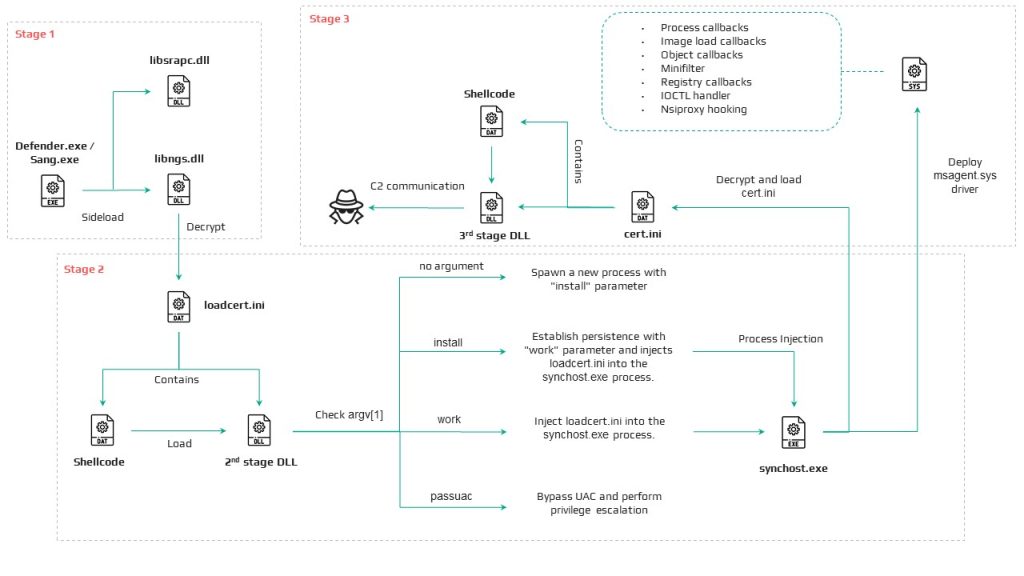
CoolClient is a HoneyMyte (Mustang Panda) backdoor that has evolved into a kernel-assisted implant with new rootkit-style stealth, process hiding, and protection capabilities. It was observed in intrusions across Asia, including Myanmar, Mongolia, Pakistan, and Russia, and continues to follow a PlugX-to-CoolClient deployment chain. #CoolClient #HoneyMyte #MustangPanda #PlugX #synchost.exe #msagent.sys
Keypoints
- CoolClient is attributed to HoneyMyte, also known as Mustang Panda, and has been used in cyber-espionage against organizations in Asia and Russia.
- The newest variant adds a signed kernel-mode driver that communicates with the user-mode backdoor through IOCTL requests.
- The driver provides stealth by hiding the CoolClient process and protecting related files and registry entries from inspection or modification.
- In the Myanmar intrusion, HoneyMyte used PlugX as the initial post-compromise implant to deploy CoolClient components.
- Persistence and execution rely on DLL sideloading through a renamed Sangfor executable, scheduled tasks, and an HKCU Run key entry.
- The malware injects into synchost.exe, deploys msagent.sys, and then launches the final-stage implant cert.ini for C2 communication.
- The driver also hides processes, modules, files, registry objects, and selected network indicators, making detection significantly harder.
MITRE Techniques
- [T1574.002 ] DLL Side-Loading – CoolClient executes by abusing a legitimate Sangfor binary that loads malicious libngs.dll [‘the legitimate Sangfor application (defender.exe or Sang.exe) loads the malicious libngs.dll through DLL sideloading’]
- [T1055 ] Process Injection – The malware injects decrypted payloads into synchost.exe and later into a suspended synchost.exe instance for execution [‘the decrypted DLL is then injected into a newly created suspended instance of synchost.exe’ and ‘allocation, thread context modification, and ResumeThread’]
- [T1543.003 ] Create or Modify System Process: Windows Service – CoolClient installs itself as a service and also deploys msagent.sys as a driver service [‘establishes an additional persistence mechanism by installing itself as a Windows service’ and ‘a new driver service is created and started’]
- [T1547.001 ] Registry Run Keys / Startup Folder – Persistence is maintained via an AutoRun entry under HKCU Run [‘creates an AutoRun entry under: HKCUSoftwareMicrosoftWindowsCurrentVersionRun’]
- [T1112 ] Modify Registry – The malware adds Microsoft Defender exclusions and writes configuration values used by the driver [‘added both a folder exclusion and a file exclusion’ and ‘updates the HKLMSYSTEMRNGWid_H1deF5Dirs registry value’]
- [T1562.001 ] Impair Defenses: Disable or Modify Tools – CoolClient excludes its fake Defender path from Microsoft Defender scanning to avoid detection [‘added both a folder exclusion and a file exclusion to Microsoft Defender’]
- [T1068 ] Exploitation for Privilege Escalation – The sample uses an RPC-based UAC bypass and privilege elevation flow to relaunch itself with elevated rights [‘implements an RPC-based process creation technique’ and ‘launch winver.exe through the RPC interface’]
- [T1134.002 ] Access Token Manipulation: Create Process with Token – The malware duplicates and reuses access tokens to create an elevated process under another session [‘duplicates its access token, updates the session identifier, and creates a new synchost.exe process using CreateProcessAsUserA’]
- [T1027 ] Obfuscated Files or Information – CoolClient decrypts components with XOR and uses obfuscated control flow in its loader [‘decrypted using a 0x32-byte repeating XOR keystream’ and ‘heavily obfuscated through control flow flattening’]
- [T1562.006 ] Impair Defenses: Indicator Blocking – The driver hides files, registry entries, processes, modules, and network indicators from visibility [‘hiding and protection mechanisms’ and ‘matching IP addresses are removed before the data is returned to user mode’]
- [T1014 ] Rootkit – The newly introduced signed kernel-mode driver provides rootkit-style hiding and protection features [‘enables the driver’s rootkit functionality’ and ‘hiding and protecting processes, files, and registry objects’]
Indicators of Compromise
- [File names / hashes ] malware components and related binaries – msagent.sys, libngs.dll, ctxmui.dll, and 2 more hashes
- [Directories ] installation and decoy paths used for deployment and hiding – C:Program Filesmicrosoftwindows defender, C:Program Fileswindows media playermediares, and other 6 paths
- [Domains ] C2 or infrastructure domains observed in the campaign – cloudtroe.giize[.]com, employers.theworkpc[.]com, and other 8 domains
- [Registry keys and values ] persistence and driver configuration – HKCUSoftwareMicrosoftWindowsCurrentVersionRun, HKLMSYSTEMRNGWid_H1deF5Dirs, and REGISTRYMACHINESYSTEMRNG
- [Device / driver objects ] driver communication endpoints – .msagent, DeviceToolTool, and DosDevicesToolTool
- [IOCTL codes ] driver control operations used by CoolClient – 0x222120, 0x2221E0, and other 31 codes
- [Service names ] persistence and driver service names – media_updaten, msagent, and synchost.exe
- [RPC endpoint / GUID ] UAC-bypass communication endpoint – ncalrpc endpoint 201ef99a-7fa0-444c-9399-19ba84f12a1a
Read more: https://securelist.com/honeymyte-coolclient-driver-rootkit/121028/