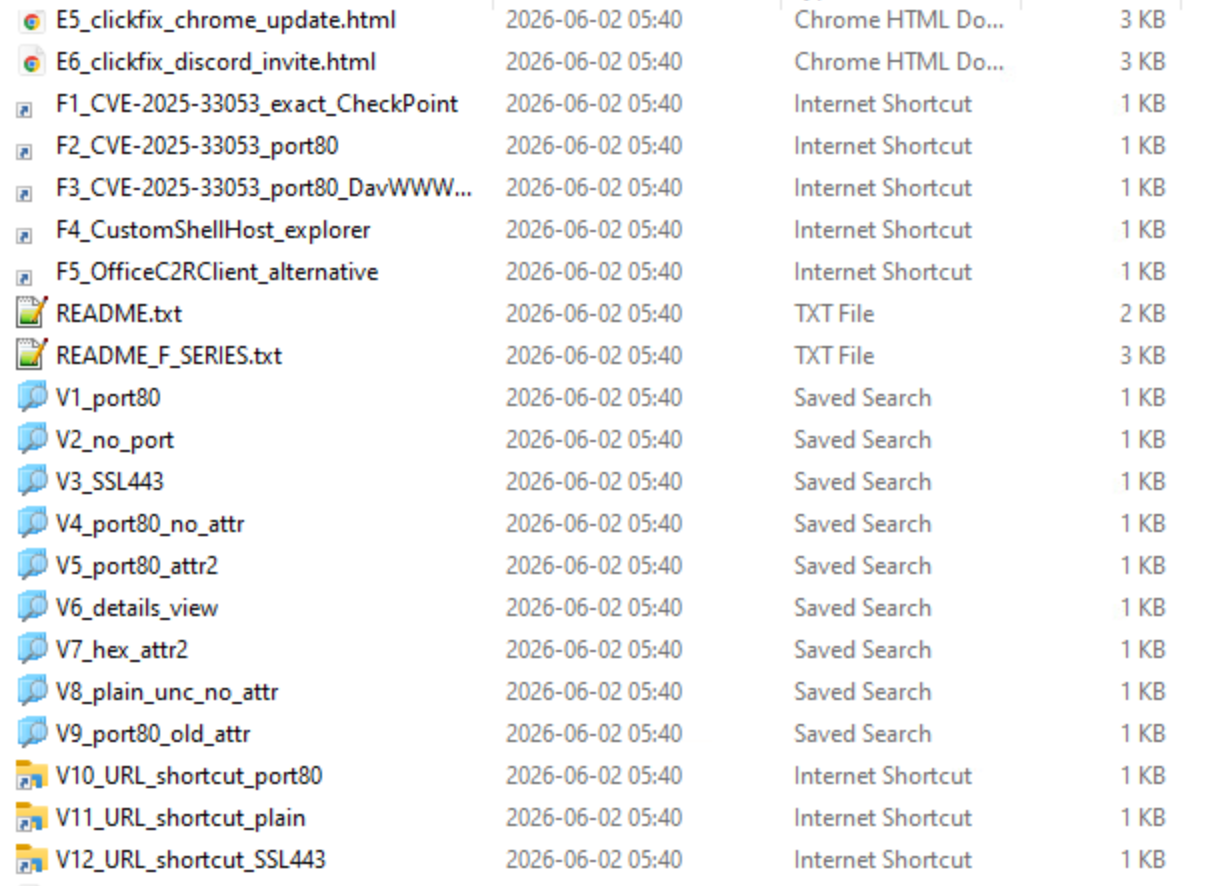
An exposed server used by attackers functioned as a malware delivery lab, revealing more than 1,000 artifacts for testing WebDAV execution paths, lure generation, and payload staging. The operation appeared to leverage generative AI to rapidly create READMEs, social-engineering lures, and delivery tests, while active campaigns included a CURP-themed phishing flow and the DlrtyGames chain. #WebDAV #CURP #DlrtyGames #PureRAT #StealthFalcon
Keypoints
- The exposed server was not just hosting payloads; it operated as an attacker QA and delivery workspace with over 1,000 artifacts.
- The workspace contained bulk-generated lures, filename-spoofing tests, ClickFix pages, WebDAV scripts, droppers, and operator notes.
- Investigators observed testing around multiple Windows delivery methods, including WebDAV, UNC paths, search-ms, library-ms, and LOLBins.
- The attacker appeared to be using generative AI to produce structured READMEs, lure templates, test plans, and other documentation.
- A CURP-themed phishing campaign used a typosquatted government site and WebDAV delivery to push a disguised executable.
- The final payload in one chain was a fileless .NET information stealer, while another chain delivered a modular RAT through DLL sideloading and process hollowing.
- The server also exposed operational details of a WebDAV admin panel, including delivery tracking, visitor analysis, and blocking controls.
MITRE Techniques
- [T1204.002 ] User Execution: Malicious File – The victim was induced to open a file from a WebDAV share, triggering the initial execution chain (‘a user executed a file pulled from a WebDAV server’).
- [T1027.013 ] Obfuscated Files or Information: Encrypted/Encoded File – The payloads were staged as encrypted droppers and packed content that had to be decrypted before use (‘Encrypted droppers’, ‘decrypted the embedded payload using AES and GZip’).
- [T1140 ] Deobfuscate/Decode Files or Information – The loader decrypted and unpacked the hidden payload before execution (‘decrypted the embedded payload using AES and GZip’).
- [T1027.007 ] Obfuscated Files or Information: Dynamic API Resolution – The DlrtyGames chain resolved APIs by hash to hinder analysis (‘resolved APIs by hash’).
- [T1620 ] Reflective Code Loading – The stealer was mapped directly into memory using Assembly.Load(byte[]) (‘mapped the payload directly into memory’).
- [T1055.012 ] Process Hollowing – Malicious code ran inside legitimate signed processes to evade detection (‘executed inside a legitimate, EV-signed Qihoo 360 process via process hollowing’).
- [T1036.002 ] Masquerading: Right-to-Left Override – The lure disguised an executable as a PDF using RTLO (‘a right-to-left override (RTLO) masqueraded .scr executable’).
- [T1036.007 ] Masquerading: Double File Extension – The directory included tests for double-extension tricks to make executables appear as documents (‘double extensions’).
- [T1574.001 ] Hijack Execution Flow: DLL – The DlrtyGames chain used DLL sideloading through a legitimate signed binary (‘used DLL sideloading to load discord-rpc.x64.dll’).
- [T1106 ] Native API – The final injection stage used low-level Windows process manipulation APIs and related calls (‘updated thread context, and resumed execution’).
- [T1497.003 ] Time Based Evasion – The payload delayed execution to complicate analysis (‘After a 45-second sleep delay’).
- [T1622 ] Debugger Evasion – The stealer checked for analysis tooling and terminated if monitored (‘called IsDebuggerPresent’, ‘called FailFast’).
- [T1548.002 ] Bypass User Account Control – The DlrtyGames chain performed COM auto-elevation (‘performed COM auto-elevation through dllhost.exe’).
- [T1113 ] Screen Capture – The RAT included screenshot capability (‘plugins for … screenshots’).
- [T1056.001 ] Keylogging – The RAT included a keylogger module with keyword triggers (‘Its keylogger module used plaintext keyword triggers’).
- [T1005 ] Data from Local System – The stealer collected local application data, Telegram data, and desktop screenshots (‘browser data, messaging sessions, and local application data’).
- [T1555.003 ] Credentials from Web Browsers – The stealer targeted browser usernames, passwords, cookies, and session tokens (‘saved browser usernames, passwords, cookies, session tokens’).
- [T1539 ] Steal Web Session Cookie – The collection logic included browser cookies and session tokens (‘cookies, session tokens’).
- [T1041 ] Exfiltration Over C2 Channel – Stolen data was sent to attacker infrastructure over HTTP/TLS (‘exfiltrated to 77[.]110.127.205’).
- [T1573 ] Encrypted Channel – The exfiltration used TLS via SslStream (‘over SslStream (TLS without SNI)’).
- [T1053.005 ] Scheduled Task – The IOC section references task-based persistence artifacts (‘Schedule tasks: brokerhost, net_queue_32’).
- [T1547.001 ] Registry Run Keys / Startup Folder – Persistence was established via a Run key (‘HKCUSoftwareMicrosoftWindowsCurrentVersionRunXNNNMHJAZNCNHGIKJDW’).
- [T1546.003 ] WMI Event Subscription – The article’s MITRE table lists possible persistence using WMI event subscription (‘Possible persistence WMI Event Subscription’).
- [T1055 ] Process Injection – The report describes code being executed inside another process and the RAT being injected into signed hosts (‘process hollowing’, ‘created signed host processes’).
Indicators of Compromise
- [Domains/URLs ] CURP phishing and delivery infrastructure – hxxps://gobf[.]mx, www[.]gobf[.]mx
- [WebDAV hostnames/paths ] remote delivery shares used for payload launch – onedrive[.]cv, summerartcamp.net@ssl@443DavWWWRootOSYxaOjr
- [IP addresses ] C2 and delivery endpoints – 77[.]110[.]127[.]205, 23[.]94[.]252[.]228
- [Ports ] observed C2/service ports – 56003, 57666, and other ports such as 56001-56003, 57777, 57888
- [File names ] lure, loader, and campaign artifacts – ReportFinal.rcs.pdf, DlrtyGames.exe, discord-rpc.x64.dll
- [File hashes ] recovered binaries and modules – SHA256 04A8018191F2E9E76072D072A933371D9D669A42DE2B2A087541CD3A653B0BA7, SHA256 e8be17a7fbef48b45f1e958b3ae5ebdfcad58808969982c431a905eefcae5268
- [Certificates/identifiers ] payload and infrastructure identifiers – CN=Eglgyqnoa, 06x12x2026SantaEbash2, fc54e0d16d9764783542f0146a98b300
- [Registry keys ] persistence artifact – HKCUSoftwareMicrosoftWindowsCurrentVersionRunXNNNMHJAZNCNHGIKJDW
- [Paths ] staging and extraction locations – %TEMP%is-XXXXX.tmpFo-Binary.exe, C:ProgramDatabasenet
Read more: https://www.rapid7.com/blog/post/tr-exposed-webdav-malware-delivery-lab-analysis