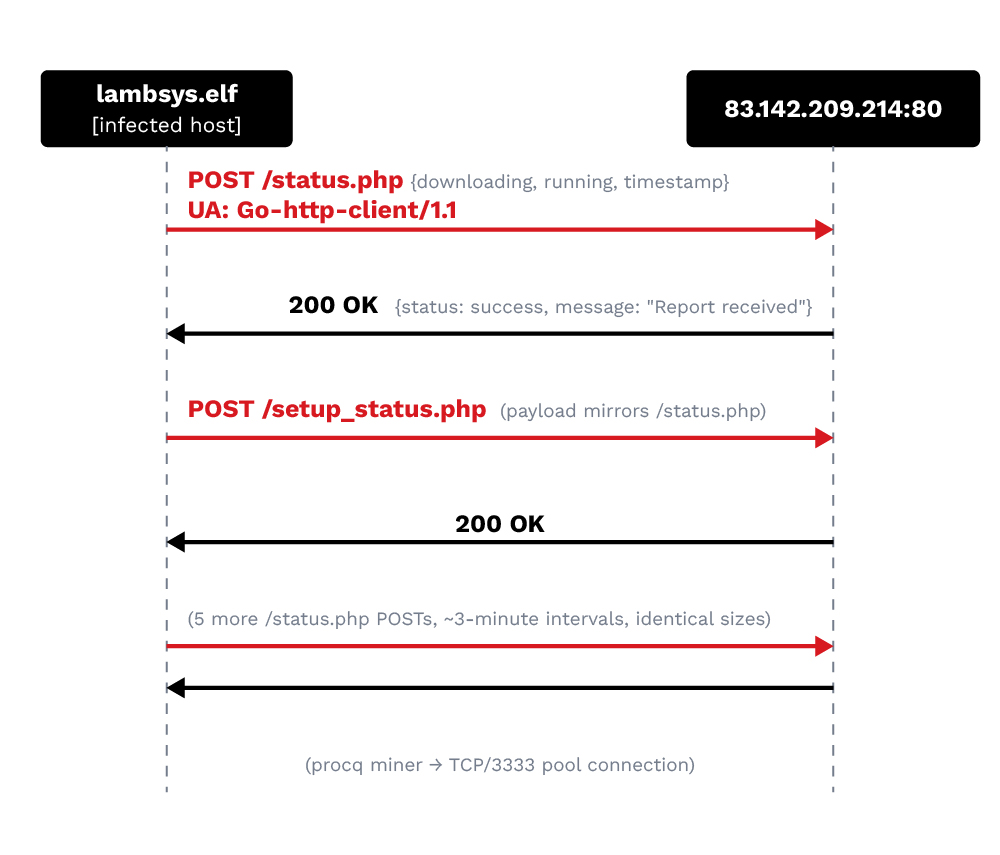
This campaign exploited CVE-2026-33017 in Langflow to deliver a cryptocurrency-mining toolchain that disables defenses, establishes persistence, and spreads via reused SSH keys. The operators used the infrastructure 83.142.209.214 and a customized XMRig miner named procq, while also reusing tactics linked to the KORKERDS and MALXMR.UWEKB lineage. #Langflow #CVE-2026-33017 #procq #KORKERDS #MALXMR.UWEKB
Keypoints
- Exploit activity targeted Langflow’s unauthenticated /api/v1/build_public_tmp/{flow_id}/flow endpoint through CVE-2026-33017.
- The initial payload used Python code execution to download and run isp.sh from 83.142.209.214.
- isp.sh deployed lambsys, created persistence in /var/tmp/.xlamb/, and attempted lateral movement through SSH key reuse.
- lambsys disabled security controls including AppArmor, UFW, iptables, SELinux, the NMI watchdog, and Aliyun security tooling.
- The malware killed rival miners, removed competing accounts such as akay and vfinder, and cleared logs to reduce visibility.
- It downloaded ks.tar, verified it with a hardcoded MD5, and extracted a customized XMRig miner called procq.
- The campaign showed overlaps with prior miner families and techniques associated with KORKERDS and MALXMR.UWEKB.
MITRE Techniques
- [T1595.002 ] Active Scanning – Threat actors performed recon against exposed Langflow endpoints with varied user agents before exploitation (’10 requests in five seconds’, ‘mass-scanning unauthenticated AI application endpoints’).
- [T1190 ] Exploit Public-Facing Application – CVE-2026-33017 was used against Langflow’s unauthenticated API endpoint to gain code execution (‘an unauthenticated POST to Langflow’s /api/v1/build_public_tmp/{flow_id}/flow endpoint’).
- [T1059.006 ] Command and Scripting Interpreter: Python – Attacker-controlled Python was evaluated inside the Langflow process (‘__import__(‘os’).system(…)’).
- [T1059.004 ] Command and Scripting Interpreter: Unix Shell – The attack chain used shell execution via curl | sh and wget | sh (‘curl … | sh’, ‘wget -O – … | sh’).
- [T1105 ] Ingress Tool Transfer – Payloads including isp.sh, lambsys, and ks.tar were downloaded from the attacker server (‘downloads lambsys binary via curl or wget’, ‘Downloads ks.tar’).
- [T1053.003 ] Scheduled Task/Job: Cron – lambsys created cron-based persistence that checked and relaunched the miner (‘plant two persistence watchdogs: a cron job every five minutes’).
- [T1543.004 ] Create or Modify System Process – The malware disabled startup/security services and manipulated boot-time behavior (‘service apparmor stop’, ‘systemctl disable aliyun.service’).
- [T1562.001 ] Impair Defenses: Disable or Modify Tools – Security products and system protections were disabled (‘Disable AppArmor, UFW, iptables, SELinux, the kernel NMI watchdog’).
- [T1562.004 ] Impair Defenses: Disable Firewall – Network filtering was removed to allow miner and beacon traffic (‘ufw disable’, ‘iptables -F’).
- [T1222 ] File and Directory Permissions Modification – chattr was used to strip or set immutable/append-only flags on persistence and SSH paths (‘chattr -iua /tmp/’, ‘chattr +iua /var/tmp and /tmp’).
- [T1070.002 ] Indicator Removal on Host: Clear Linux or Mac System Logs – The malware deleted syslog to erase evidence (‘rm -rf /var/log/syslog’).
- [T1070.004 ] Indicator Removal on Host: File Deletion – The operator removed logs and cleanup artifacts from the host (‘rm -rf /var/log/syslog’, ‘rm -rf ks.tar’).
- [T1021.004 ] Remote Services: SSH – isp.sh used SSH to move laterally to reachable hosts with BatchMode and known_hosts enumeration (‘spread itself to every SSH-reachable host’).
- [T1552.004 ] Unsecured Credentials: Private Keys – The worm enumerated SSH private keys and agent sockets for lateral movement (‘id_rsa, id_ed25519, or id_dsa’).
- [T1016 ] System Network Configuration Discovery – The malware enumerated connectivity and reachable hosts through SSH-related files and sockets (‘known_hosts parsing to enumerate reachable hosts’).
- [T1082 ] System Information Discovery – The campaign queried system identity and environment details (‘id’, ‘uname’, ‘/etc/os-release’).
- [T1083 ] File and Directory Discovery – The dropper checked for existing binaries and searched for miner artifacts (‘checks whether a binary called lambsys is already running’).
- [T1614 ] System Location Discovery – The malware queried ipinfo.io to learn the victim’s public location and ASN (‘DNS lookup for ipinfo.io’).
- [T1496 ] Resource Hijacking – The customized XMRig miner used victim CPU resources for Monero mining (‘begun beaconing to its C&C’, ‘connects to a pool on TCP/3333’).
- [T1531 ] Account Access Removal – The malware deleted competing miner-related accounts (‘userdel akay’, ‘userdel vfinder’).
- [T1574.006 ] Hijack Execution Flow: Dynamic Linker Hijacking – The analysis notes cleanup of /etc/ld.so.preload used by LD_PRELOAD-based rootkits (‘rm -f /etc/ld.so.preload’).
- [T1036.005 ] Masquerading: Match Legitimate Resource Name or Location – The miner used misleading names and paths to blend in (‘SystemMonitor/6.25.0’, hidden directory names, innocent-looking component labels).
- [T1027 ] Obfuscated Files or Information – The malware hid payloads in obfuscated directories and packed binaries with UPX (‘triple-dot-space hidden directory’, ‘UPX-packed Go binary’).
Indicators of Compromise
- [IP addresses ] attacker infrastructure and C&C – 83.142.209.214, 94.156.64.241
- [URIs / endpoints ] Langflow exploitation and beaconing – /api/v1/build_public_tmp/{flow_id}/flow, /status.php, /setup_status.php
- [File names ] dropper, miner, and persistence artifacts – isp.sh, lambsys.elf, ks.tar, procq, init_rmount
- [File paths ] hidden persistence and staging locations – /var/tmp/.xlamb/, /var/tmp/init_rmount, /var/log/syslog, /tmp/.X11-unix/01
- [User/host artifacts ] competing account names and SSH artifacts – akay, vfinder, ~/.ssh/known_hosts, ~/.ssh/authorized_keys
- [Hashes ] payload integrity checks and sample identifiers – MD5 46096a72d84db5f1dafd944fcf6571c8, and 2 more hashes
- [Network ports ] mining, staging, and beaconing ports – TCP/8080, TCP/80, TCP/3333
- [Wallets ] mining payout address – 47VVuaLN…JkjbZT31