Threat hunters uncovered EtherRAT being distributed through a suspicious website that led to a broader malicious infrastructure hosting malware, phishing pages, and remote desktop software. EtherRAT is a Node.js-based RAT that uses the Ethereum blockchain to resolve its C2 server and employs layered loaders, obfuscation, and persistence to execute attacker-supplied code. #EtherRAT #Ethereum #Nodejs
Keypoints
- Threat hunting revealed a malicious website distributing EtherRAT through MSI installers and PowerShell scripts.
- The delivery infrastructure also hosted phishing pages, malicious documents, and remote control software.
- EtherRAT is a Node.js RAT that can run arbitrary JavaScript from its C2 server and gain full machine control.
- The malware uses Ethereum blockchain queries to retrieve its active C2 URL, making takedowns harder.
- The MSI chain used multiple stages, including BAT, JScript, and encrypted payload loaders, plus persistence via registry modification.
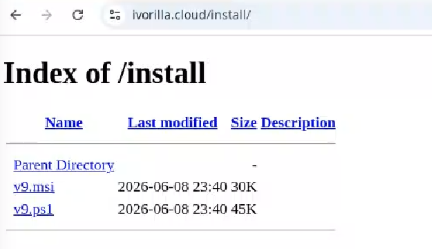
- The analyzed infrastructure used open directories, versioned installers, and randomized paths to increase stealth and hinder detection.
- Phishing campaigns within the same infrastructure used email attachments, fake document prompts, and URL cloaker pages.
MITRE Techniques
- [T1105] Ingress Tool Transfer – The malware downloaded Node.js from the official website when it was not present (‘Downloads Node.js if it’s not found’ / ‘Uses curl -sLo to download Node.js from the official website’).
- [T1027] Obfuscated Files or Information – The BAT, JScript, and EtherRAT payloads were heavily obfuscated and decrypted before execution (‘The executed “cDQMlQAru0.xml” is a loader that decrypts the embedded code’ / ‘newly obfuscated version of the script’).
- [T1059.007] Command and Scripting Interpreter: JavaScript – EtherRAT executed attacker-controlled JavaScript received from the C2 server (‘Execute arbitrary JavaScript code received by the C2 server’).
- [T1059.003] Command and Scripting Interpreter: Windows Command Shell – The MSI chain invoked cmd.exe and BAT scripts to run the infection stages (‘conhost –headless cmd /c “KmPuGimn.cmd”‘).
- [T1059.001] Command and Scripting Interpreter: PowerShell – PowerShell was used both as a delivery method and for host checks (‘PowerShell scripts’ / ‘powershell -NoProfile -NonInteractive -WindowStyle Hidden’).
- [T1106] Native API – The malware used Windows native process execution via conhost.exe in headless mode to run commands and scripts (‘conhost.exe –headless’).
- [T1547.001] Boot or Logon Autostart Execution: Registry Run Keys / Startup Folder – Persistence was added through a registry key (‘Adds a registry key for persistence with “conhost.exe –headless”’).
- [T1082] System Information Discovery – The post-compromise activity queried GPU, domain, and machine information (‘Get-WmiObject Win32_VideoController’, ‘Win32_ComputerSystem’, ‘MachineGuid’).
- [T1016] System Network Configuration Discovery – The malware checked whether the host was in a domain and queried network-related context (‘(Get-WmiObject Win32_ComputerSystem).Domain’ / ‘PartOfDomain’).
- [T1041] Exfiltration Over C2 Channel – The RAT sent its source code to the C2 server and received a re-obfuscated script back (‘sends its own source code to the C2 server’ / ‘Body: { “code”: “” }’).
- [T1140] Deobfuscate/Decode Files or Information – Multiple custom decoders were used to decrypt payloads and embedded code (‘decrypts the embedded code with a XOR function’ / ‘custom stream-like decoding routing’).
- [T1608.001] Stage Capabilities: Download New Code at Runtime – The C2 returned a newly obfuscated version of the script that was written back to disk (‘The C2 responds with a newly obfuscated version of the script’).
Indicators of Compromise
- [IP addresses] Malicious infrastructure and EtherRAT-related hosting – 82.165.65.244, 185.221.216.121, and other 4 IPs
- [Domains] EtherRAT distribution and C2 endpoints – ivorilla.cloud, mx.nrlwz.com, and other 4 domains
- [Domains] EtherRAT C2 infrastructure – cambioefectivo.com, vabelles.com, tranzed.org, kibrisarazi.com, aravisblog.com, publicspeakingtip.org
- [File names] MSI loader and payload components – v9.msi, KmPuGimn.cmd, cDQMlQAru0.xml, MRaQCipBIZeiZNx.log
- [File names] Post-execution artifacts and copied payload – _MJlLlt5.exe, svchost.log, cl.zip
- [Paths] Infection chain and phishing kit locations – /install, /zht/sharep-redirect.html, /bl/me.php, /t/teams, /teams/Windows/invite.php
- [Registry / host artifacts] Persistence and host checks – HKLMSOFTWAREMicrosoftCryptographyMachineGuid, conhost.exe –headless
- [Ethereum blockchain identifiers] C2 resolution data – 0x88ea8d0bc4146f0a018e989df3fd089ac48f9a58, 0x7d434425, 0xf6a772e163e64b07f658946f863b5d457d88f9f0