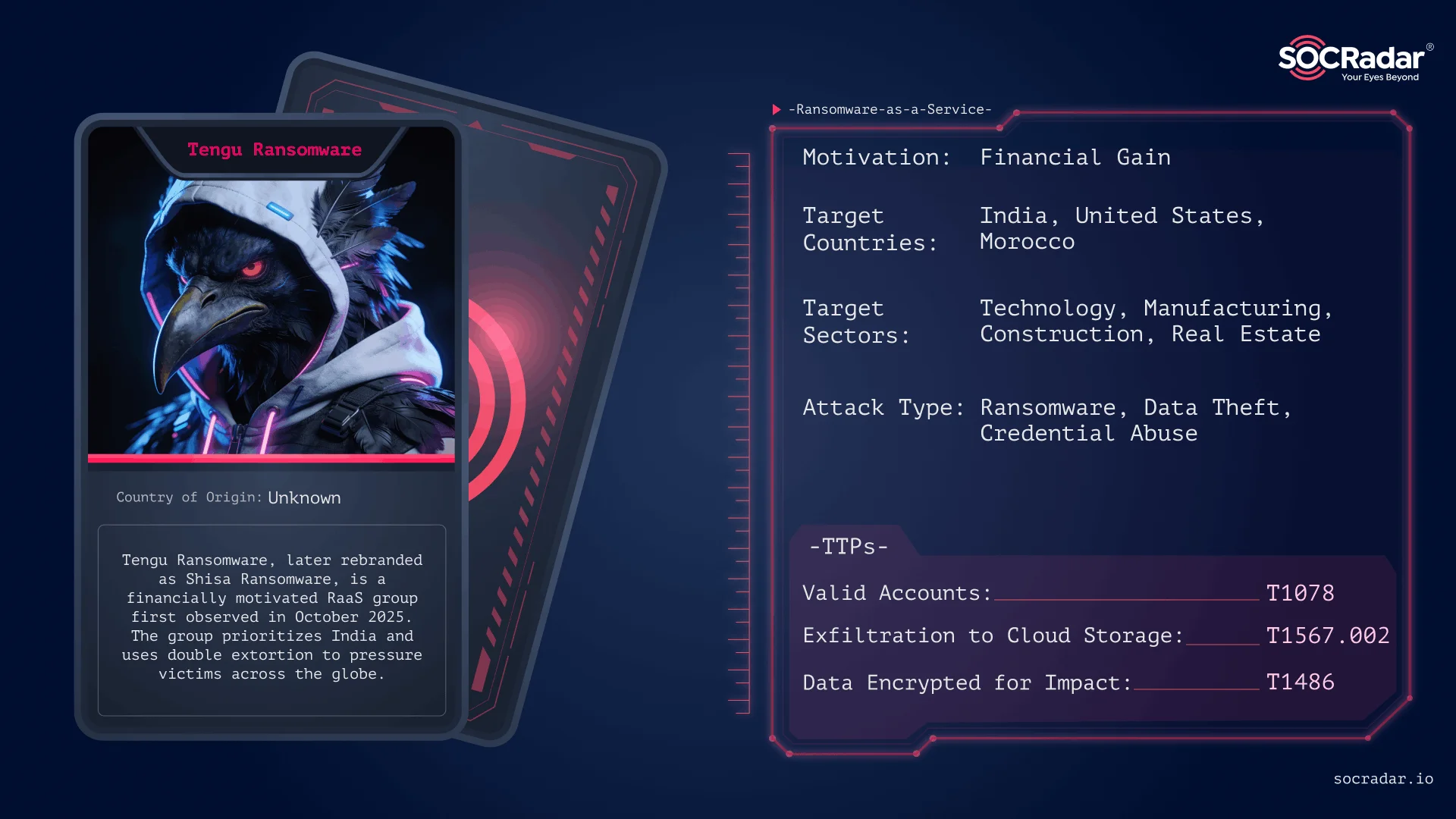
Tengu Ransomware emerged as a disciplined RaaS operation that used double extortion, custom tooling, and affiliate management to claim about 50 victims before rebranding as Shisa Ransomware in March 2026. Its activity spanned multiple regions and relied on Tor-based leak infrastructure, intermittent encryption, and tools such as StealTENGU, StealTG, and NetExec to steal data, disable defenses, and pressure victims to pay. #TenguRansomware #ShisaRansomware #StealTENGU #StealTG
Keypoints
- Tengu Ransomware first appeared on October 9, 2025, as a Ransomware-as-a-Service operation.
- The group used a double-extortion model, stealing data before encrypting systems and threatening public release through a Data Leak Site.
- In under six months, Tengu claimed about 50 victims across multiple continents before rebranding as Shisa Ransomware in March 2026.
- The operation offered Windows, Linux, and ESXi builds, and used custom tools such as StealTENGU and StealTG for exfiltration.
- Tengu relied on brute-force access, credential abuse, LOLBins, LSASS dumping, and exploitation of CVE-2020-1472 to move through networks.
- The group’s infrastructure included Tor-based leak sites, backup onion domains, a separate file server, and operational security mistakes that exposed attacker IPs.
- Observed victims spanned many regions and sectors, with Technology and Manufacturing among the most affected industries.
MITRE Techniques
- [T1595.002] Active Scanning: Vulnerability Scanning – Affiliates appear to probe exposed services and weak targets before intrusion, using reconnaissance to find viable entry points (‘conduct brute-force attacks against exposed RDP and SMB interfaces’).
- [T1566.002] Phishing: Spearphishing Link – Initial access could be obtained through phishing links sent to targets (‘initial access is achieved through spearphishing links’).
- [T1190] Exploit Public-Facing Application – The group used exposed internet-facing applications as an entry path (‘exploitation of public-facing applications’).
- [T1078] Valid Accounts – Stolen or reused credentials were used to gain access (‘the reuse of valid credentials from prior data breaches’).
- [T1059.001] Command and Scripting Interpreter: PowerShell – PowerShell was used for script execution and payload delivery (‘powershell.exe’).
- [T1059.003] Command and Scripting Interpreter: Windows Command Shell – Command shell activity supported execution and system enumeration (‘cmd.exe’).
- [T1218.011] System Binary Proxy Execution: Rundll32 – Rundll32 was used to execute payloads while blending in with trusted binaries (‘rundll32.exe’).
- [T1219] Remote Access Software – The group mimicked or used remote management tooling to maintain access (‘FortiRDP subsequently installed on the victim machine’).
- [T1068] Exploitation for Privilege Escalation – ZeroLogon was used to escalate privileges on an unpatched domain controller (‘exploited ZeroLogon (CVE-2020-1472) against an unpatched domain controller’).
- [T1078.002] Valid Accounts: Domain Accounts – Domain administrator access was obtained and then used to expand control (‘obtain domain administrator privileges’).
- [T1562.001] Impair Defenses: Disable or Modify Tools – Defender and security tools were disabled to reduce detection (‘Windows Defender is disabled early in the intrusion’).
- [T1070.001] Indicator Removal: Clear Windows Event Logs – Event logs were cleared to erase forensic evidence (‘Event logs are cleared using wevtutil’).
- [T1003.001] OS Credential Dumping: LSASS Memory – LSASS memory was dumped to extract credentials (‘LSASS memory is dumped to extract credentials in cleartext’).
- [T1110.001] Brute Force: Password Guessing – Repeated login attempts were used against exposed services (‘conduct brute-force attacks against exposed RDP and SMB interfaces’).
- [T1110.003] Brute Force: Password Spraying – The access pattern also included broad credential attempts across services (‘Alert on repeated authentication failures across SMB and RDP services’).
- [T1087.002] Account Discovery: Domain Account – Active Directory was enumerated to identify privileged accounts (‘AD is then enumerated to map privileged accounts’).
- [T1046] Network Service Discovery – The group mapped network services and shares to identify targets for movement (‘map privileged accounts, high-value systems, and network shares’).
- [T1021.001] Remote Services: Remote Desktop Protocol – RDP was used for interactive access and lateral movement (‘RDP is also used for interactive access to high-value targets’).
- [T1021.002] Remote Services: SMB/Windows Admin Shares – SMB was used for lateral movement and administration (‘NetExec (nxc) over SMB’).
- [T1039] Data from Network Shared Drive – Data was collected from network shares before exfiltration (‘Data is collected from network shares and local systems’).
- [T1074.001] Data Staged: Local Data Staging – Stolen data was staged prior to exfiltration (‘Data is collected … and staged before exfiltration’).
- [T1567.002] Exfiltration Over Web Service: Exfiltration to Cloud Storage – Exfiltration used cloud services such as MEGA, PixelDrain, and StorJ (‘MEGA as the primary destination’).
- [T1071.001] Application Layer Protocol: Web Protocols – Communication and storage relied on web-based services and Tor-hosted infrastructure (‘dedicated DLS on the Tor network’).
- [T1090.003] Proxy: Multi-hop Proxy – Affiliates used residential proxies and VPS infrastructure to hide origin (‘leveraging residential proxies and commercial VPS infrastructure’).
- [T1490] Inhibit System Recovery – Shadow copies were deleted before encryption to prevent recovery (‘Shadow copies are deleted immediately before execution’).
- [T1486] Data Encrypted for Impact – Files were encrypted and renamed with the .tengu extension (‘Encrypted files receive the .tengu extension’).
Indicators of Compromise
- [SHA-256 hash] unsigned .NET executable / Defender disabler linked to Tengu activity – fafb6c5e12dfeefaba5ac8982d5bb13dd206cfcd328b9d36aa87257f762ee24a
- [Dropped files] tools found in C:WindowsSystem32 – wraithnet_bot[.]exe, controller_gui[.]exe, and 2 more files
- [File extension] encrypted victim files – .tengu
- [Ransom note filenames] notes dropped in affected directories – TENGU_README.txt, [VictimID]-README.txt, and 2 more filenames
- [Email addresses] victim contact addresses used by the group – tengulocker@cyberfear[.]com, tengunlocker@onionmail[.]com
- [IP addresses] high-confidence attack infrastructure and proxies – 110.227.205[.]232, 94.26.88[.]100 / .101 / .102 / .103, and other 6 items
- [Command lines] behavioral indicators of compromise seen during attacks – nxc smb [target], sc config wscsvc start= disabled, and other 3 items
Read more: https://socradar.io/blog/dark-web-profile-tengu-ransomware-shisa/