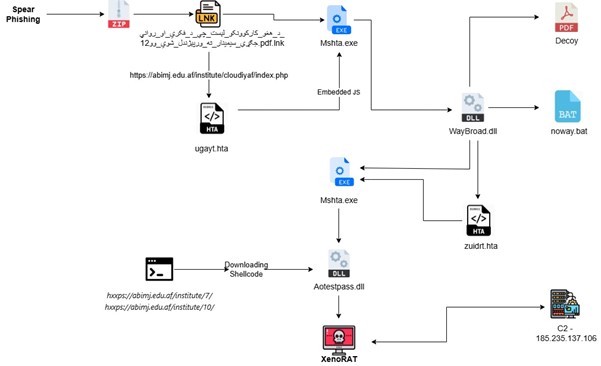
Seqrite Labs analyzed a SideCopy-linked spear phishing campaign targeting Afghanistan’s Ministry of Finance and provincial Mustoufiats, using a Pashto-named LNK file to deliver a multi-stage loader chain that ends in XenoRAT. The operation abused compromised Afghan infrastructure for delivery and bulletproof European hosting for C2, reinforcing attribution to SideCopy and the codename “Operation XENOFISCAL.” #SideCopy #TransparentTribe #APT36 #XenoRAT #MinistryofFinance #Afghanistan
Keypoints
- Seqrite Labs linked the campaign to the SideCopy cluster with medium-to-high confidence based on overlapping TTPs and infrastructure patterns.
- The attack targeted Afghanistan’s Ministry of Finance, provincial finance directorates, and Pashto-speaking government officials.
- Initial delivery used a ZIP archive containing a malicious LNK file with a Pashto filename crafted to resemble an internal government document.
- The infection chain used mshta.exe, obfuscated JavaScript/HTA stages, registry persistence, and staged DLL loading to deploy the final payload.
- The final payload was XenoRAT, which connected to hardcoded C2 infrastructure at 185.235.137.106 and used a mutex named clouda.
- The decoy document was a provincial finance staff directory for all 34 Afghan provinces, suggesting prior intelligence gathering by the operator.
- Infrastructure analysis showed the delivery domain was hosted on Afghan government-related IP space, while the RAT C2 was on HZ Hosting in Bulgaria/Frankfurt.
MITRE Techniques
- [T1566.001] Spearphishing Attachment – The campaign began with a ZIP archive delivered through phishing, containing the malicious LNK attachment (‘a ZIP archive containing a malicious LNK file’).
- [T1218.005] Trusted Developer Utilities Proxy Execution: mshta – The LNK launched mshta.exe to fetch and run remote content (‘it launches the Windows utility mshta.exe’).
- [T1059.003] Command and Scripting Interpreter: Windows Command Shell – The malware used cmd.exe to execute commands, start payloads, and register persistence (‘runs cmd.exe /c start … and executes the specified file or command’).
- [T1059.007] Command and Scripting Interpreter: JavaScript – The HTA stage contained heavily obfuscated JavaScript used to decode and execute malicious logic (‘heavily obfuscated JavaScript code designed to execute malicious logic’).
- [T1547.001] Registry Run Keys / Startup Folder – Persistence was created through HKCU Run keys, including an entry named Edgre (‘creates a new entry under the HKCU…Run registry key’).
- [T1053.005] Scheduled Task – The malware also created a scheduled task named XenoUpdateManager for admin-level startup persistence (‘creates a Windows Scheduled Task named “XenoUpdateManager”’).
- [T1027] Obfuscated Files or Information – Multiple stages used obfuscation, encoded strings, and hidden commands to hinder analysis (‘heavily obfuscated JavaScript’, ‘Base64-encoded registry commands’).
- [T1140] Deobfuscate/Decode Files or Information – The loader decoded Base64 content, decompressed payloads, and reconstructed executables in memory (‘custom Base64 decoding routine’, ‘GZip decompression’).
- [T1106] Native API – The shellcode loader used Windows APIs such as VirtualAlloc, CreateThread, and WaitForSingleObject (‘allocates executable memory’, ‘transfers execution’).
- [T1027.011] Embedded Payloads / Reflective Code Loading – The payload was reconstructed and executed from memory using .NET deserialization and in-memory loading (‘BinaryFormatter.Deserialize_2()’, ‘Assembly.Load(byte[])’).
- [T1129] Shared Modules – The infection chain loaded and invoked external DLL modules dynamically from memory (‘loads it dynamically using Assembly.Load’).
- [T1070.004] File Deletion – The uninstaller removed itself from disk after cleanup (‘Del’, ‘self-terminates the program’).
- [T1012] Query Registry – The malware queried registry paths to detect .NET versions and manage startup entries (‘querying the registry path HKLMSOFTWAREMicrosoft.NETFramework…’).
- [T1518] Software Discovery – The malware checked for installed antivirus products via WMI (‘GetAntivirus function retrieves antivirus information’).
- [T1095] Non-Application Layer Protocol – XenoRAT used TCP-based C2 communication (‘establishing a TCP-based command-and-control connection’).
- [T1071.001] Application Layer Protocol: Web Protocols – The loader fetched payloads over HTTPS from web resources (‘downloaded the encoded payload from hxxps://abimj.edu.af/…’).
- [T1090.002] Proxy: External Proxy – The RAT used SOCKS5 proxy-based tunneling (‘Supports SOCKS5 proxy-based network tunneling’).
- [T1095] Encrypted Channel – Communication was encrypted with AES and a shared key (‘data security is enforced using AES encryption’).
- [T1568] Dynamic Resolution – The malware selected different payload endpoints based on OS version (‘dynamically selects the download endpoint based on the victim operating system version’).
Indicators of Compromise
- [SHA256] Malicious archive and stage files – 194B912C242604D6F9A79369F22338C58A13CE0CC2ED280CE505075808BC2F14, 3B4194BDFE40D94031A94B30397FFD8A4B09D0A4057668E897B8BDCD1703DD01, and 7 more hashes
- [File names] Delivered and reconstructed payloads – ugayt.hta, zuidrt.hta, and other payload filenames such as noway.bat, WayBroad.dll, Aotestpass.dll
- [Domains / URLs] Delivery and staging infrastructure – abimj.edu.af, hxxp://abimj.edu.af/institute/cloudiyaf/document.pdf, and hxxps://abimj.edu.af/institute/10/
- [IP addresses] RAT C2 and delivery hosting – 185.235.137.106, 103.132.98.224, and 103.132.98.226
- [Network blocks / ASNs] Hosting infrastructure context – 103.132.98.0/23, AS58469, and AS59711
- [Registry keys] Persistence locations – HKCUSoftwareMicrosoftWindowsCurrentVersionRun, HKLMSOFTWAREMicrosoft.NETFrameworkv4.0.30319
- [Mutex] Single-instance control – clouda
- [Scheduled task name] Admin persistence – XenoUpdateManager