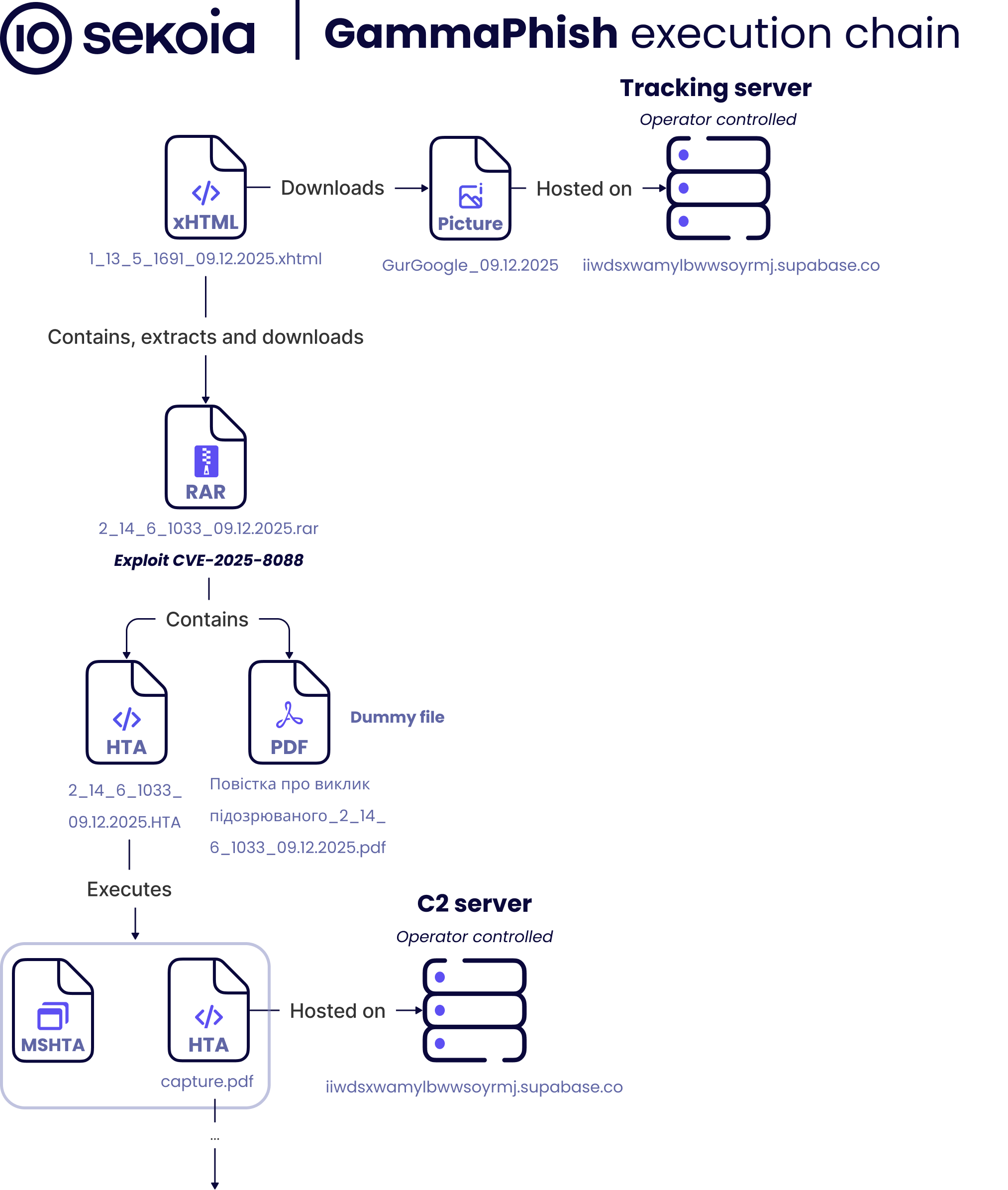
Sekoia.io’s TDR team reconstructed a January 2026 Gamaredon infection chain targeting Ukraine, showing how the group uses GammaPhish and GammaWorm to deliver modular payloads through hidden Windows features, malicious archives, and dead-drop resolvers. The report also unifies Gamaredon malware naming and details how the worm persists, propagates via USB and network drives, and exfiltrates data through GammaSteel-like stages while maintaining backdoor access. #Gamaredon #GammaPhish #GammaWorm #GammaLoad #GammaSteel
Keypoints
- Gamaredon is a Russian FSB-linked cyberespionage group that continues targeting Ukrainian government, military, and critical infrastructure networks.
- The report reconstructs a January 2026 infection chain using forensic artifacts, partner-provided samples, and live C2 interaction.
- Sekoia proposes a unified taxonomy for Gamaredon malware families, including GammaPhish, GammaLoad, GammaWorm, GammaSteel, and GammaWipe.
- GammaPhish uses weaponized xHTML, HTML smuggling, and CVE-2025-8088 abuse in a RAR archive to place an HTA file in the Windows Startup folder.
- GammaWorm relies heavily on NTFS Alternate Data Streams, scheduled tasks, registry changes, and malicious LNK files to persist and spread across USB and network drives.
- The worm uses dead-drop resolvers hosted on public services like Telegram, Telegraph, Teletype, Cloudflare, and Supabase to maintain dynamic C2 infrastructure.
- Gamaredon’s newer architecture is highly modular and fileless, with each stage capable of acting as a backdoor for remote code execution and configuration updates.
MITRE Techniques
- [T1566.001 ] Spearphishing Attachment – Initial delivery is likely via malicious email attachments containing the xHTML lure and archive (‘likely delivered as an attachment to a spearphishing email’)
- [T1189 ] Drive-by Compromise / Lure Document Execution – The xHTML page is opened to display a fake downloaded document and trigger the malicious chain (‘DOCUMENT DOWNLOADED’)
- [T1036 ] Masquerading – The archive uses fake authentication and legitimate-looking URLs to appear benign (‘adds www.bbc.com, to appear legitimate’)
- [T1027 ] Obfuscated Files or Information – The HTA, VBScript, and worm code are heavily junk-filled and obfuscated (‘approximately 90% of junk and obfuscated code’)
- [T1059.005 ] Visual Basic – Gamaredon uses VBScript loaders and worm logic for execution (‘executes mshta.exe… load a remote payload’)
- [T1059.001 ] PowerShell – GammaSteel is described as a modular PowerShell stealer (‘a modular PowerShell stealer’)
- [T1055 ] Process Injection – Not explicitly process injection, but remote execution is achieved by launching system utilities to run remote code (‘mshta.exe… execute the content of this file’)
- [T1204.002 ] Malicious File – Archive – The malicious RAR archive is manually opened by the victim to continue execution (‘user must manually open the downloaded RAR archive’)
- [T1074.001 ] Local Data Staging – GammaSteel stages modules entirely in the Windows registry before use (‘stages itself entirely within the Windows registry’)
- [T1112 ] Modify Registry – Multiple registry keys are written to store C2, persistence, and visibility changes (‘writes… registry entry’, ‘modify Explorer registry settings’)
- [T1053.005 ] Scheduled Task – GammaWorm creates scheduled tasks for persistence and module execution (‘creates scheduled tasks’)
- [T1091 ] Replication Through Removable Media – The worm spreads via USB drives and creates copies on them (‘specifically targets USB and network drives’)
- [T1021.002 ] SMB/Windows Admin Shares – Network drives and shares are targeted for propagation (‘targets network shares and USB drives’)
- [T1547.001 ] Registry Run Keys / Startup Folder – The HTA is dropped into Startup and RunOnce is used for persistence (‘Start MenuProgramsStartup’, ‘RunOnceExplorerGuard’)
- [T1218.005 ] Mshta – mshta.exe is used to execute remote content from a URL (‘mshta.exe… remote payload’)
- [T1105 ] Ingress Tool Transfer – The malware fetches payloads from C2 servers and public hosting services (‘fetch and execute arbitrary VBScript payloads’)
- [T1132.001 ] Data Encoding – Base64 – Payloads are embedded and decoded from Base64 (‘Base64-encoded RAR archive’, ‘decodes the content from Base64’)
- [T1568.003 ] Dynamic Resolution: Distributed Web Services – Dead drop resolvers use Telegram, Cloudflare, Supabase, and similar services (‘uses Dead Drop Resolvers… Telegram or Cloudflare’)
- [T1021 ] Remote Services – Gamaredon’s infrastructure enables remote execution and operator control over compromised systems (‘arbitrary remote code execution’)
- [T1070.004 ] File Deletion – The RunOnce persistence is removed by Windows after execution, but recreated by the malware (‘it will be deleted immediately after the command is launched’)
- [T1119 ] Automated Collection – GammaSteel monitors files, drives, and USB insertions for exfiltration (‘real-time surveillance of specific files’)
- [T1560 ] Archive Collected Data – Targeted files are exfiltrated to cloud storage after collection (‘exfiltrated to an S3-compatible cloud storage provider’)
- [T1140 ] Deobfuscate/Decode Files or Information – The worm removes markers and Base64-decodes fetched code before execution (‘removing carriage returns and operator-inserted && markers’)
Indicators of Compromise
- [File hash ] Sample identifiers for GammaPhish and GammaWorm – 1794369214b7f62e70a0485e61335c61, 8e1624d110c090ff57d4b493a9107c66
- [File name ] Weaponized lure and worm samples – 1_13_5_1691_09.12.2025.xhtml, ~.gif
- [File name ] Extracted or dropped components – 2_14_6_1033_09.12.2025.rar, 2_14_6_1033_09.12.2025.HTA
- [Domain/URL ] Dead-drop and C2 infrastructure used for fetching payloads and resolving configuration – iiwdsxwamylbwwsoyrmj.supabase.co, graph.org, telegra.ph, teletype.in, t.me, trycloudflare.com
- [IP address ] Operator or fallback C2 endpoint referenced in the report – 104.194.140.6
- [Registry keys ] Persistence and C2 configuration storage – HKEY_CURRENT_USERSoftwareMicrosoftWindowsCurrentVersionRunOnceExplorerGuard, HKCUConsoleWindowsUpdates, HKCUConsoleWindowsResponby, HKCUConsoleWindowsDetect
- [Registry keys ] Additional configuration keys used by dead-drop resolver modules – HKCUConsoleURLTeletype, HKCUConsoleWindowsTelegra, HKCUConsoleURLTelegra, HKCUConsoleIpURL
- [File paths ] ADS-based storage locations and persistence targets – %USERPROFILE%:GTR, %USERPROFILE%:save, %USERPROFILE%:URL, %USERPROFILE%:LNK, %USERPROFILE%:SERVER
- [Vulnerability ] Exploited archive path traversal flaw – CVE-2025-8088