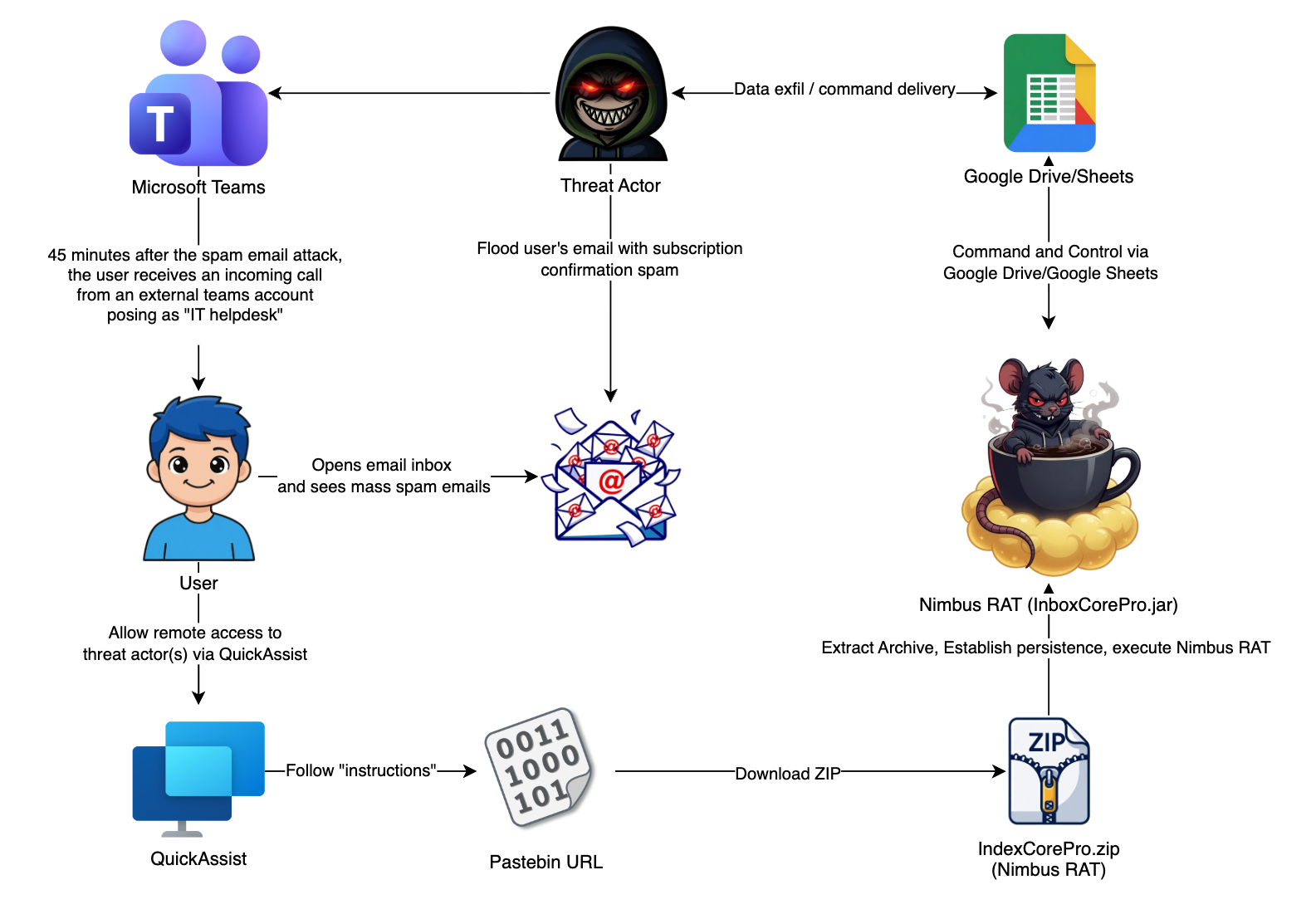
In early April 2026, eSentire TRU documented a legal-industry intrusion that used Microsoft Teams vishing, Quick Assist, and a Java-based implant tracked as Nimbus RAT to gain access in under 20 minutes. The campaign relied on throwaway Microsoft 365 tenants, compromised SharePoint staging, Pastebin instructions, and Google Drive/Google Sheets C2, with activity linked to BlackSuit, Black Basta-derived crews, Storm-1811, and 3AM. #NimbusRAT #BlackSuit #BlackBasta #Storm1811 #3AM #MicrosoftTeams #QuickAssist #SharePoint #GoogleDrive #GoogleSheets
Keypoints
- eSentire TRU identified a targeted intrusion against a legal-sector customer in early April 2026.
- The attack chain used mailbox bombing, Microsoft Teams vishing, and Quick Assist to obtain remote access.
- Nimbus RAT was deployed as the main payload and was previously associated with BlackSuit affiliate activity after the Black Basta split.
- The intrusion moved from initial contact to RAT execution in less than 20 minutes during the observed incident.
- TRU observed 1,540 suspicious external Microsoft Teams events across 172 customer environments over about a year.
- Throwaway Microsoft 365 tenants and freshly registered .top domains were heavily used as delivery infrastructure.
- Nimbus RAT used Google Drive and Google Sheets for command-and-control, bundled its own Java runtime, and supported credential theft, file operations, screenshots, and in-memory code execution.
MITRE Techniques
- [T1598.002 ] Phishing for Information: Spearphishing Voice – The actors used Microsoft Teams vishing to impersonate IT support and trick the victim into granting access (‘an actor-controlled Microsoft Teams account posing as IT helpdesk reached out to the user offering assistance’).
- [T1114.001 ] Inbox Rules – Email Bombing / Mailbox Flooding – The victim’s mailbox was flooded with subscription emails to create urgency and a believable pretext (‘the mailbox received 282 emails in 90 minutes’).
- [T1219 ] Remote Access Software – The victim was walked through launching Quick Assist to provide remote control to the attacker (‘the user was walked through launching Quick Assist’).
- [T1105 ] Ingress Tool Transfer – The payload was downloaded from a compromised Microsoft 365 tenant and extracted locally (‘the threat actor deployed a payload from a compromised Microsoft 365 tenant’).
- [T1059.003 ] Command and Scripting Interpreter: Windows Command Shell – The operator ran reconnaissance and other actions through cmd.exe (‘executed LOLBins for reconnaissance purposes via Command Prompt’).
- [T1059.006 ] Command and Scripting Interpreter: JavaScript / Java / JAR execution – Nimbus RAT was a Java-based implant executed via javaw.exe and a JAR file (‘javaw.exe executes InboxCorePro.jar – Nimbus RAT active’).
- [T1106 ] Native API – The implant invoked Windows APIs through JNA, including real credential prompts and system enumeration (‘invoke the real Windows CredUIPromptForCredentialsW API directly via JNA’).
- [T1056.002 ] GUI Input Capture – The malware displayed fake or real credential prompts to capture user credentials (‘a Java Swing imitation of the Windows Security credential prompt’).
- [T1021 ] Remote Services – The user granted interactive remote access through Quick Assist, enabling the operator to control the host (‘the user launched Quick Assist from Windows Explorer’).
- [T1112 ] Modify Registry – Persistence was staged through a registry import file and registry operations (‘pre-staged a registry import file’).
- [T1048.003 ] Exfiltration Over Unencrypted/Obfuscated Non-C2 Protocol? – Not applicable; removed due to article specifics.
- [T1053.005 ] Scheduled Task/Job: Startup Items – Persistence was established through a Startup folder launcher (‘they placed a launcher in the Startup folder’).
- [T1102.001 ] Web Service: Dead Drop Resolver – Nimbus RAT used Pastebin for operator instructions and Google Drive/Sheets for command delivery (‘Google Drive and Google Sheets for command-and-control’).
- [T1027 ] Obfuscated Files or Information – The malware used randomized package names and encrypted configuration/traffic to hinder analysis (‘randomized nonsense English words as a deliberate obfuscation layer’).
- [T1021.004 ] Remote Services: SSH/Remote Desktop? – Not applicable; removed due to article specifics.
- [T1105 ] Ingress Tool Transfer – The actor used Pastebin-linked instructions to direct payload download and staging (‘The Pastebin pointed to a ZIP archive named InboxCorePro.zip’).
- [T1071.001 ] Application Layer Protocol: Web Protocols – C2 traffic blended into normal Google API traffic over Google Drive and Google Sheets (‘all network traffic appear as legitimate Google API calls’).
- [T1573 ] Encrypted Channel – All C2 traffic was RSA-encrypted with a hardcoded public key (‘All C2 traffic is RSA-encrypted using a hardcoded 4096-bit public key’).
- [T1059.006 ] Command and Scripting Interpreter: Java – The implant compiled and ran attacker-supplied Java source in memory (‘in-memory Java compile and run’).
- [T1021.006 ] Remote Services: Windows Remote Management – Not applicable; removed due to article specifics.
- [T1105 ] Ingress Tool Transfer – The second-stage tool was recovered from a Drive folder and configured for exfiltration (‘a configuration file recovered from the threat actor’s Drive’).
Indicators of Compromise
- [Domains ] Malicious instruction/payload delivery and sender infrastructure – pastebin[.]com/G6jA0PLU, -my[.]sharepoint.com, and several .top domains such as system-clean[.]top and scanseq[.]top
- [File names ] Delivered archive, payload, and registry file – InboxCorePro.zip, InboxCorePro.jar, InboxCorePro.reg, and license.txt
- [SHA-256 hashes ] Recovered archive, JAR payload, and bundled Java runtime – 9E5B1E10AD6904D3F5B48D38470CD57263974640A27D13CF793EF026D3D6B886, 91E523A46F3BB860AC2E5800B7E1EC89D75A2408410B9CD25EEBC17C8D7A92BC, and 99813F3D0625E880158C68039C0E2FBF488DB0BE3DB77CD1CE6D382644193F0E
- [Campaign UUID / identifiers ] Nimbus RAT configuration and C2 naming – 1hc1his4gmto0q1, entry_{campaignUUID}, exit_{campaignUUID}, and newconfig_
- [Email / account artifacts ] Payload staging and compromise context – arturolopez@[.]com, BackupBOX, and a victim email-address-named 1.13 GB ZIP archive
- [Paths ] Host and persistence locations – C:ProgramDataInboxCorePro, %TEMP%java_app.lock, and the Startup folder path used for launcher persistence
- [IP addresses / source infrastructure ] Hosting-provider source infrastructure used for Teams delivery – multiple datacenter-hosted source IPs and repeated ASN-based infrastructure, including NKtelecom INC, GTHost, M247 Europe SRL, tzulo inc., and others