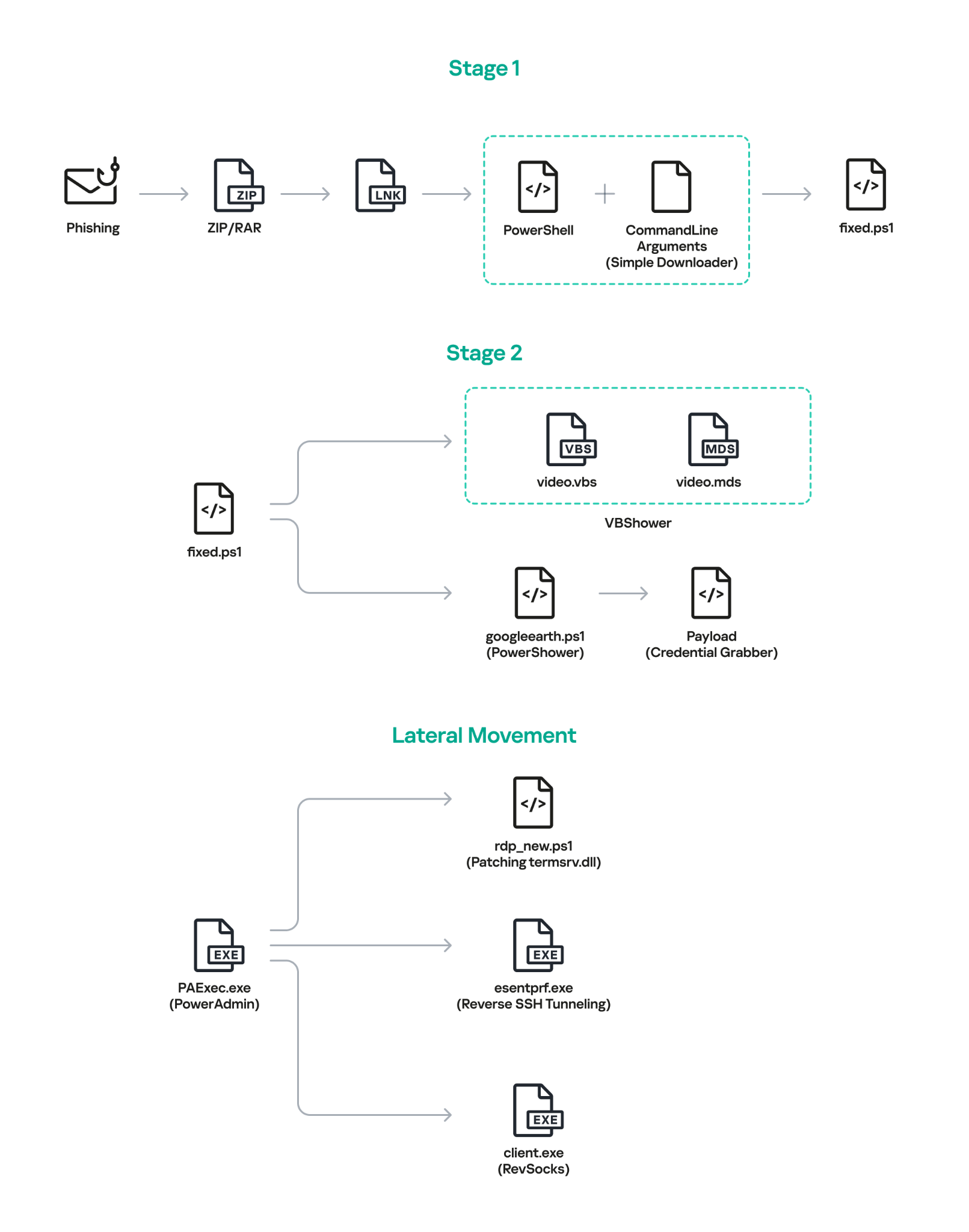
Cloud Atlas conducted widespread SSH tunnel activity through 2025 into 2026 against government and commercial targets in Russia and Belarus, using phishing archives, malicious LNK files, PowerShell loaders, and multiple backup access tools. The campaign added VBCloud, PowerShower, RevSocks, Tor, and PowerCloud to support theft, reconnaissance, persistence, and covert remote access. #CloudAtlas #VBCloud #PowerShower #RevSocks #PowerCloud
Keypoints
- Cloud Atlas activity remained active in 2025 and 2026, targeting organizations in Russia and Belarus.
- Initial access commonly used phishing ZIP archives containing malicious LNK files that launched PowerShell scripts.
- The group also used older malicious document infection chains leveraging CVE-2018-0802 in Microsoft Office Equation Editor.
- Fixed.ps1 delivered additional payloads, including the VBCloud backdoor and the PowerShower backdoor.
- PowerShower supported reconnaissance, lateral movement, Kerberoasting, and credential theft via SAM and SECURITY file collection.
- Attackers deployed reverse SSH tunnels, RevSocks, and Tor Hidden Services to maintain backup control channels and evade disruption.
- PowerCloud exfiltrated administrator-related data to Google Sheets in Base64 format, while a browser-checking script logged active browsers to determine user presence.
MITRE Techniques
- [T1566.001 ] Phishing: Spearphishing Attachment – Initial access was gained by emailing ZIP archives with malicious LNK files attached (‘the attackers emailed a ZIP archive containing an LNK file as an attachment’).
- [T1204.002 ] User Execution: Malicious File – The shortcut relied on the user opening the attachment and executing the malicious LNK (‘archives containing malicious shortcuts’).
- [T1059.001 ] Command and Scripting Interpreter: PowerShell – Malicious LNK files launched PowerShell scripts from external resources (‘covertly execute PowerShell scripts hosted on external resources’).
- [T1059.005 ] Command and Scripting Interpreter: Visual Basic – VBScript was used for tunnel setup and execution (‘run VBS scripts via PAExec or PsExec’).
- [T1547.001 ] Boot or Logon Autostart Execution: Registry Run Keys / Startup Folder – Persistence was created by adding payloads to Run keys (‘Creates “Run” registry key “YandexBrowser_setup”’).
- [T1112 ] Modify Registry – The malware modified registry settings to ensure startup and persistence (‘Creates “Run” registry key’).
- [T1105 ] Ingress Tool Transfer – Scripts downloaded additional payloads and decoy archives from remote servers (‘Downloads and drops “$temprar.zip”’).
- [T1027 ] Obfuscated Files or Information – Multiple components were encrypted, encoded, or packed to hinder analysis (‘encrypted body of the backdoor’, ‘encoded in base64’).
- [T1021.001 ] Remote Services: Remote Desktop Protocol – Attackers enabled and abused RDP for interactive access (‘allow multiple RDP sessions in Windows 10’).
- [T1218.011 ] System Binary Proxy Execution: Rundll32? – Not explicitly mentioned.
- [T1218.002 ] System Binary Proxy Execution: Control Panel – Privilege escalation and UAC bypass were performed through fodhelper.exe (‘uses a UAC bypass technique via fodhelper.exe’).
- [T1562.001 ] Impair Defenses: Disable or Modify Tools – The script killed WinRAR to conceal activity and removed artifacts (‘executes “taskkill.exe /F /Im winrar.exe”’, ‘searches and deletes’).
- [T1070.004 ] File Deletion – The attack cleaned up infection artifacts to reduce forensic traces (‘Searches and deletes “rar.zip”, “*.pdf.zip” and “*.pdf.lnk”’).
- [T1098 ] Account Manipulation – The script changed permissions on folders to block access to private keys (‘set new access permissions to the folder containing the private key’).
- [T1090.001 ] Proxy: Internal Proxy – RevSocks and SSH tunnels were used as proxy channels for remote access (‘allow direct connection to workstations on the local network’).
- [T1090.003 ] Proxy: Multi-hop Proxy – Reverse SSH tunnels and Tor Hidden Services created layered access paths (‘bypass standard firewall rules’, ‘accessible via RDP from the Tor network’).
- [T1021.004 ] Remote Services: SSH – Reverse SSH tunnels were established from the compromised host to attacker-controlled infrastructure (‘the compromised machine initiates an SSH connection’).
- [T1219 ] Remote Access Software – RevSocks provided remote connectivity and network access (‘installed RevSocks’).
- [T1095 ] Non-Application Layer Protocol – Tunnel traffic and port forwarding were used to move access through non-standard channels (‘forwarding ports to the Tor network’).
- [T1082 ] System Information Discovery – PowerShower collected information about processes, administrator groups, and domain controllers (‘Collect information about running processes, administrator groups, and domain controllers’).
- [T1018 ] Remote System Discovery – PowerShower identified domain controllers and network structure (‘domain controllers’).
- [T1003.001 ] OS Credential Dumping: LSASS Memory – Not explicitly mentioned.
- [T1003.002 ] OS Credential Dumping: Security Account Manager – The credential grabber copied SAM and SECURITY files from Volume Shadow Copy (‘Copies the SAM … and SECURITY system files’).
- [T1003.006 ] OS Credential Dumping: DCSync – Not mentioned.
- [T1003.003 ] OS Credential Dumping: NTDS – Not mentioned.
- [T1134 ] Access Token Manipulation – Not mentioned.
- [T1113 ] Screen Capture – Not mentioned.
- [T1016 ] System Network Configuration Discovery – The browser checker and tunnel setup imply host environment checking, but this technique is not directly stated.
- [T1056.001 ] Input Capture: Keylogging – Not mentioned.
- [T1047 ] Windows Management Instrumentation – Not mentioned.
- [T1543.003 ] Create or Modify System Process: Windows Service – The RDP service was restarted after patching (‘the script restarts the RDP service’).
- [T1484.001 ] Domain or Tenant Policy Modification – Not mentioned.
- [T1046 ] Network Service Discovery – PowerShower and related tooling performed network reconnaissance (‘network reconnaissance’).
- [T1106 ] Native API – Not mentioned.
- [T1135 ] Network Share Discovery – Not mentioned.
Indicators of Compromise
- [File hashes] malicious components and loaders – 1A11B26DD0261EF27A112CE8B361C247, 5329F7BFF9D0D5DB28821B86C26D628F, and other hashes such as 2B4BA4FACF8C299749771A3A4369782E
- [File names] VBS, PowerShell, and payload files used in execution chains – WriteToSchedulerKillSSH.vbs, WriteToSchedulerGenerateKey.vbs, and other names such as rdp_new.ps1 and googleearth.ps1
- [File paths] dropped or abused binaries and scripts on victim hosts – C:WindowsPLASystemRun.vbs, C:ProgramDatahpclient.exe, and other paths such as C:Users[username]Picturesgoogleearth.ps1
- [Domains] reverse SSH/SOCKS and staging infrastructure – tenkoff[.]org, cloudguide[.]in, and other domains such as one드rivesupport[.]net and znews[.]net
- [IP addresses] PowerShell payload staging servers – 194.102.104[.]207, 46.17.45[.]56, and other IPs including 185.22.154[.]73 and 193.125.114[.]57
- [Hash / sample identifiers] malicious Office documents and auxiliary samples – the report lists a long MS Office document hash set and samples for ReverseSocks and browser-checking payloads, including 5329F7BFF9D0D5DB28821B86C26D628F